All species › Swifts › Swifts › Little Swift
Little Swift | Apus affinis
Huisgierzwaluw | Vencejo Moro
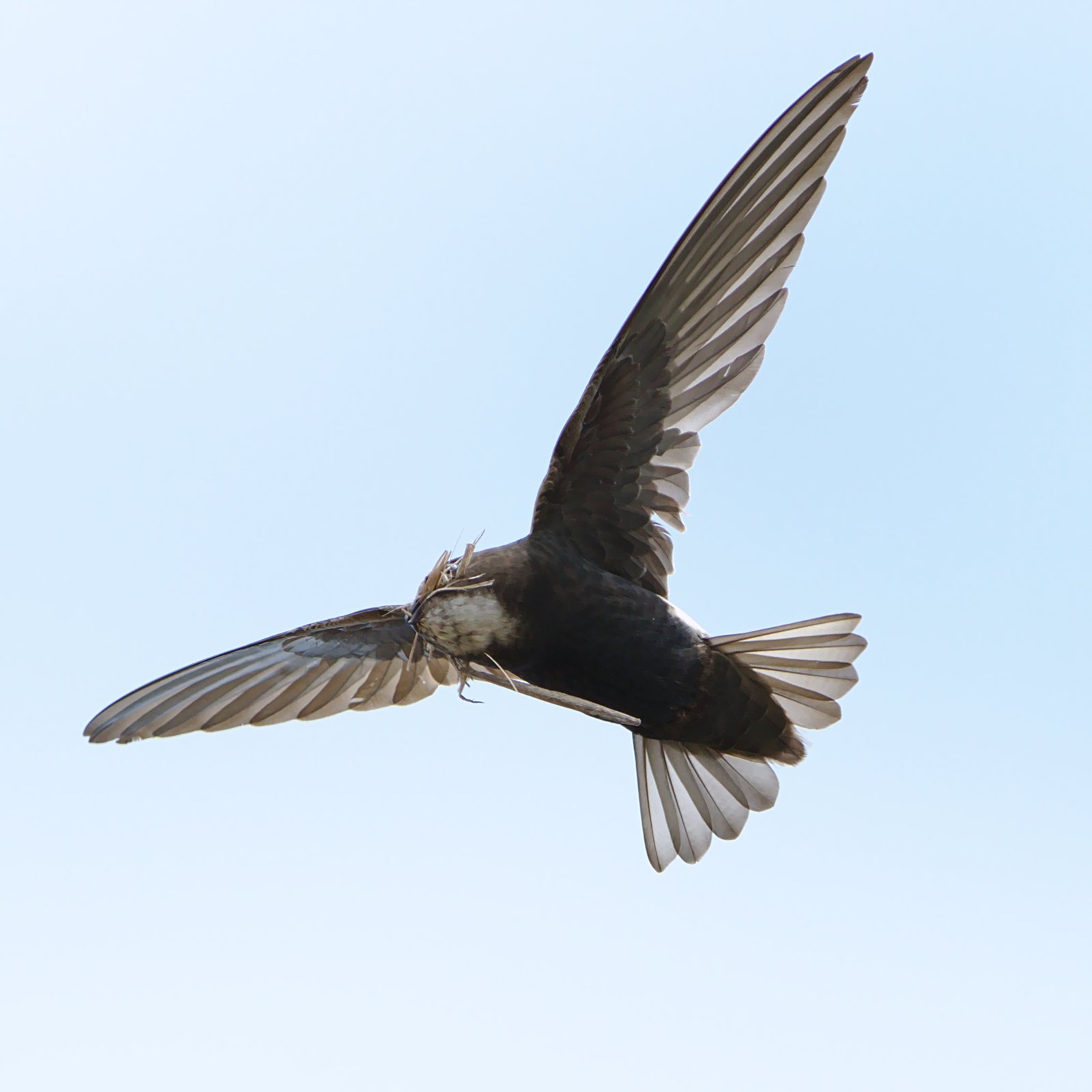
The Little Swift is a small, compact swift with a square-cut tail and a broad white rump that wraps round onto the flanks. It breeds in colonies under bridges, eaves and rock overhangs and in many towns and villages is the swift seen most often.
Voice
A high, trilling twitter, tsirrrr-rit-rit, and high screaming runs, especially when parties hunt low round buildings near the colony. A soft continuous chatter is also heard from the nests.
Recording: African Bioacoustics Community — CC BY-NC-SA 4.0 · converted to mono · xeno-canto
Identification
12–14 cm, wingspan 32–35 cm. Blackish-brown with a white throat and a broad, square white rump patch that curves round onto the flanks on each side. The tail is short and square-ended, slightly rounded when spread, without a fork. The wings are shorter and broader than in the larger swifts. The forehead is slightly greyer. The sexes are alike; juveniles show pale fringes to the wing feathers. It flies with rapid fluttering beats interspersed with short glides, often low in twittering parties.
Confusion species
The White-Rumped Swift Apus caffer has a deeply forked tail, held closed as a spike, and only a narrow white crescent on the rump. The Horus Swift Apus horus has a broad white rump but a distinct shallow tail fork and is bulkier. The Brown-Throated Martin Riparia paludicola has a brown rump and a less stiff flight. A square tail with a large white rump is diagnostic.
Habitat
Mainly around human structures: towns, villages, bridges, dam walls and flyovers, and also cliffs and rock faces. It hunts small flying insects over almost any landscape, often over water. The nest is a half-cup of feathers and grass glued with saliva beneath an overhang; the bird often takes over a swallow's nest. Colonies hold tens to hundreds of pairs.
Where the bird is most at home, classified by the vegetation units of southern Africa.


Range and movements
Distributed across almost the whole region, from the Cape to Angola, Zambia and Malawi, common in South Africa, Eswatini, Lesotho, Zimbabwe, Mozambique and central and northern Namibia; scarcer in the driest parts of the Kalahari and the Namib. Birds from the cool interior partly move away in winter. Beyond the region it occurs over most of Africa and from the Middle East to India.
- Resident
- Summer visitor (c. Oct–Mar)
- Winter visitor (c. Apr–Sep)
- Passage (Mar–Apr, Oct–Nov)
- dark = core range, pale = thinly spread
How and when to look
Look under a bridge or a concrete flyover for the clusters of nests against the ceiling; in the early evening twittering parties circle there. In towns they often hunt round tall buildings and over parks. In flight watch for the square tail and the white rump curving round the flanks.
Conservation status
Not threatened and widespread; the species has expanded strongly with bridges and buildings and benefits from human structures. The removal or sealing of colonies during maintenance of bridges and buildings causes local losses.
Scientific name
Apus affinis | (Gray, 1830)
Gray described the species in 1830 as Cypselus affinis; because it was later moved to another genus, the author and year stand in brackets. The genus Apus was introduced in 1777 by Scopoli. Apus is Latin for a swift, from Greek a- 'without' and pous 'foot', the ancients taking it for a kind of swallow without feet. affinis is Latin for 'related to, similar'; which species the bird supposedly resembles is not clear from the description. The specimen the first description was based on came from the Ganges, India.