All species › Birds of prey › Hawks, eagles and kites › Black Kite
Black Kite | Milvus migrans
Zwarte wouw | Milano Negro
The Black Kite is one of the most numerous raptors in the world and in southern Africa one of the first signs that the rains are returning. Two forms occur in the region: the African Yellow-Billed Kite, which breeds here, and the European Black Kite, which winters. Both are opportunists that turn up along roads and at rubbish dumps, grass fires and termite emergences.

Voice
A high, quavering, plaintive whistle, klee-ee-ee-ee, often given while soaring over the nest or in display flights; also a short, sharp kik. European wintering birds are mostly silent.
Recording: Esperanza Poveda — CC BY-NC-SA 4.0 · converted to mono · xeno-canto
Identification
50–60 cm, wingspan 130–155 cm. A medium-sized, dark brown raptor with long, rather narrow wings and a long, shallowly forked tail that is constantly twisted in flight; when the tail is fanned the fork almost disappears. The Yellow-Billed Kite (parasitus) is warm rufous-brown with an all-yellow bill and yellow legs. The European form (migrans) is a colder brown with a greyish, streaked head, a black bill with yellow cere and a paler bar across the upperwing coverts. Juvenile Yellow-billed Kites have a black bill and so resemble migrans, but are more broadly pale-streaked below. In flight a pale patch at the base of the primaries is visible.
Confusion species
Common Buzzard Buteo buteo, especially the Steppe Buzzard (vulpinus), has a shorter, rounded tail without a fork, broader wings and a dark carpal patch. Western Marsh Harrier Circus aeruginosus and African Marsh Harrier Circus ranivorus have a long, square tail, glide with the wings in a V and hunt low over reeds. Tawny Eagle Aquila rapax is larger and heavier, with a short, square tail and fingered wingtips.
Habitat
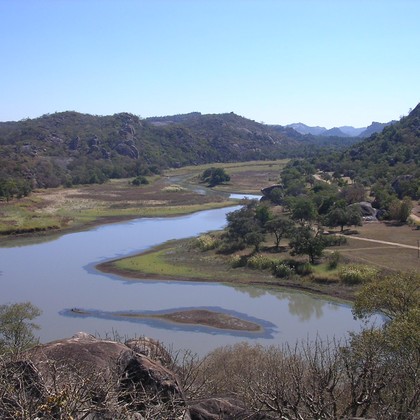
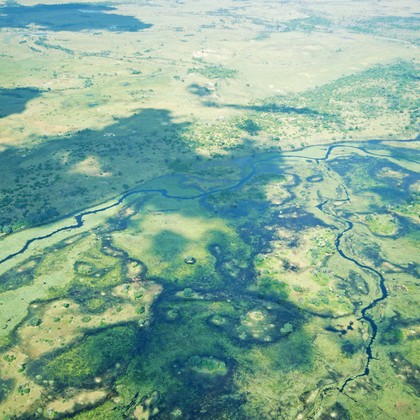
Almost any open to semi-open landscape: woodland, savanna, riverine forest, the margins of lakes and marshes, farmland, villages and suburbs. It nests in tall trees, often in riverine woodland or plantations. It eats carrion, refuse, insects, small mammals, birds, lizards and fish, and likes to hunt at grass fires and swarming termites, sometimes in flocks of hundreds.
Where the bird is most at home, classified by the vegetation units of southern Africa.

Range and movements
The Yellow-Billed Kite breeds across virtually the whole region, except the driest parts of the Namib and the western Karoo; common in eastern South Africa, Eswatini, Zimbabwe, Mozambique, Malawi, Zambia, northern Botswana and Namibia and in Angola. The European Black Kite is numerous mainly in the north and east (Zambia, Zimbabwe, Botswana, Malawi, Mozambique), with wandering flocks reaching South Africa. Worldwide the species breeds in Europe, Asia, Africa and Australia.
- Resident
- Summer visitor (c. Oct–Mar)
- Winter visitor (c. Apr–Sep)
- Passage (Mar–Apr, Oct–Nov)
- dark = core range, pale = thinly spread
How and when to look
The first Yellow-billed Kites arrive in August, often before the first rain, and stand out by their yellow bill and rufous-brown colour. In November–January look for swarming termites after thunderstorms: hundreds of kites sometimes hunt there alongside falcons and Lesser Spotted Eagles. Check the bill colour of every kite; a dark bill with a grey head points to a European bird.
Conservation status
Not threatened on the Red List and very numerous worldwide. In southern Africa the Yellow-Billed Kite has declined locally through poisoning, including baits laid for jackals and quelea control, and through collisions with power lines.
Scientific name
Milvus migrans | (Boddaert, 1783)
Boddaert described the species in 1783 as Falco migrans; because it was later moved to another genus, the author and year stand in brackets. The genus Milvus was introduced in 1799 by De Lacépède. Milvus is the Latin word for the red kite. migrans is Latin for 'migrating', from migrare 'to migrate', after the movements of the northern populations. The specimen the first description was based on came from France.