All species › Falcons › Falcons › Greater Kestrel
Greater Kestrel | Falco rupicoloides
Grote torenvalk | Cernícalo Overo
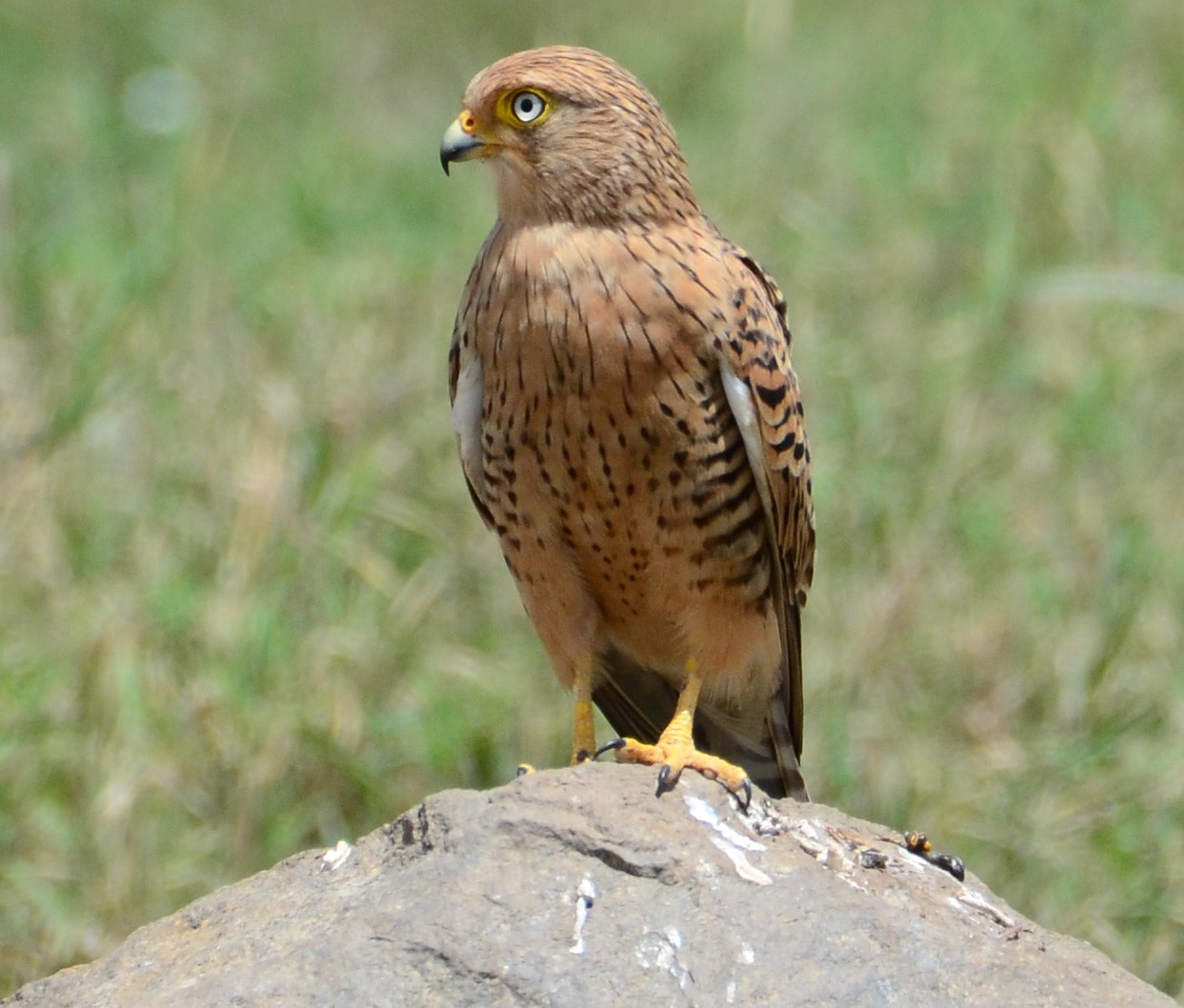
The Greater Kestrel is the largest kestrel in southern Africa and a bird of open, dry plains. The adult has a pale yellow to whitish iris, a feature no other falcon in the region shows.
Voice
A high repeated kik-kik-kik and a drawn-out kweeek, higher and more sustained than the call of Rock Kestrel. Loudest at the nest and during display flights.
Recording: Alan Collett — CC BY-NC-SA 4.0 · converted to mono · xeno-canto
Identification
About 33 cm, pale rufous in ground colour. The upperparts are closely barred black rather than spotted, the underparts cream with fine streaking on the breast and barring on the flanks. The head is pale rufous without a moustachial stripe. The tail is greyish with narrow dark bars and a broader terminal band, the underwing strikingly pale. The adult has a pale yellow to whitish iris; in the juvenile it is dark, breast and flanks are more heavily streaked and the tail is rufous.
Confusion species
Rock Kestrel (Falco rupicolus) is smaller and darker rufous, spotted rather than barred above, with a dark iris and, in the male, a grey head and tail; it hovers far more often. Lesser Kestrel (Falco naumanni), a Palearctic migrant from October to March, is smaller and gregarious, the male with an unspotted brick-red back and blue-grey head. Dickinson's Kestrel is grey and tied to palms. The pale iris and the barred upperparts settle the identification.
Habitat
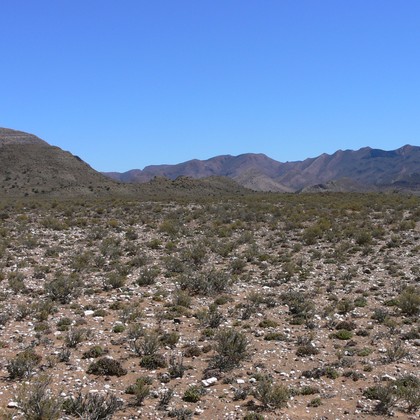
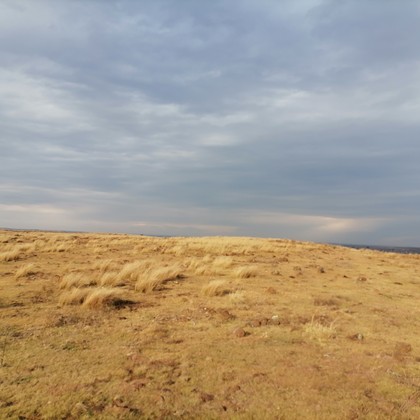
Dry and semi-arid open grassland, Karoo, Kalahari sandveld, the gravel plains of the Namib and open savanna with scattered trees. It hunts mainly from a pole, wire or treetop, dropping onto grasshoppers, beetles, lizards, small rodents and birds; it hovers less than Rock Kestrel. It builds no nest of its own but uses old nests of crows, buffalo-weavers and Sociable Weavers, including those on pylons.
Where the bird is most at home, classified by the vegetation units of southern Africa.
Range and movements
The dry west and interior of the region: Namibia, Botswana, western and central South Africa including the Karoo, the Free State and the Northern Cape, south-western Zimbabwe and south-western Angola. Absent from the humid east and from wooded country. A separate population occurs in East Africa, from Ethiopia to Tanzania.
- Resident
- Summer visitor (c. Oct–Mar)
- Winter visitor (c. Apr–Sep)
- dark = core range, pale = thinly spread
How and when to look
Drive the roads of the Karoo and the Kalahari and check every telephone pole, fence post and low treetop. For a pale kestrel perched in open country the iris colour gives certainty, so use a telescope. Present all year; breeding mainly from August to November.
Conservation status
Not threatened and stable across most of its range. The species depends on old stick nests, so the loss of nest trees and the management of pylons both matter. In treeless country poles and power lines instead provide extra perches and nest sites, and the species has increased locally as a result.
Scientific name
Falco rupicoloides | Smith, 1829
Smith described the species in 1829 and placed it straight away in the genus where it still stands. The genus Falco was introduced in 1758 by Linnaeus. Falco is the Latin word for 'falcon', possibly related to falx, 'sickle', for the curved shape of the claws or wings. rupicoloides combines the Latin rupicola, 'rock-dweller' (from rupes, 'rock', and -cola, 'dweller'), with the Greek suffix -oides, 'resembling' — for its resemblance to the smaller, also southern African rock kestrel (Falco rupicolus). The specimen the first description was based on came from South Africa.