All species › Falcons › Falcons › Lesser Kestrel
Lesser Kestrel | Falco naumanni
Kleine torenvalk | Cernícalo Primilla
The Lesser Kestrel is a Palearctic migrant that spends the austral summer in large flocks over the grasslands of the interior. Its communal roosts in trees in villages and towns can hold thousands of birds.

Click a thumbnail to switch the photo above.
Voice
At roosts and in flocks a continuous, rasping chatter, chay-chay-chay or kee-kee-kee, trisyllabic and harsher than the call of Common Kestrel.
Recording: Pere Josa — CC BY-NC-SA 4.0 · converted to mono · xeno-canto
Identification
About 30 cm, slimmer and narrower-winged than the other kestrels. The male has a blue-grey head without a moustachial stripe, an unspotted brick-red mantle, a blue-grey panel across the greater coverts and a grey tail with a black terminal band and often projecting central feathers. The underparts are warm cream with small round spots; the underwing is white with dark tips. The female is rufous with dark barring above, a finely streaked head and a weak moustachial stripe. The claws are white.
Confusion species
Common Kestrel (Falco tinnunculus) is slightly larger; the male has a black-spotted mantle, a clear moustachial stripe and no grey wing panel. Females of the two are barely separable, apart from the white claws and slightly paler underwing of Lesser Kestrel. Rock Kestrel (Falco rupicolus) is darker and rufous, heavily spotted below. Female Amur Falcons (Falco amurensis) often hunt in the same flocks but have a black cap, orange legs and a streaked white breast.
Habitat
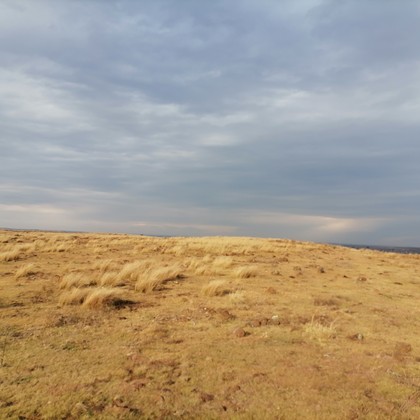
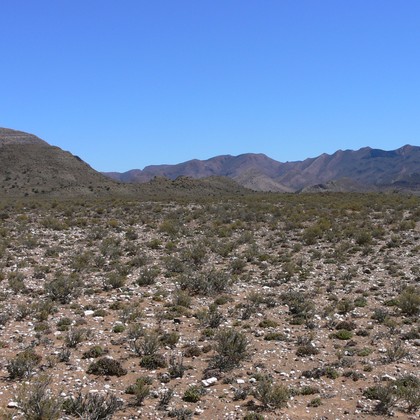
Open grassland of the Highveld, the eastern Karoo and dry savanna, also farmland and fallow grassland after fire or rain. It hunts in flocks, hovering or from wires and poles, taking grasshoppers, termites and beetles; it swarms at termite emergences. It roosts communally in tall trees, often eucalypts in villages and towns.
Where the bird is most at home, classified by the vegetation units of southern Africa.

Range and movements
Mainly in the interior of South Africa: the Free State, Gauteng, Mpumalanga, inland KwaZulu-Natal, the Northern Cape and the eastern Karoo; also southern and eastern Botswana and locally Namibia. On passage in Zambia, Malawi, Zimbabwe and Mozambique. It breeds in southern Europe, North Africa and Central Asia to China.
- Resident
- Summer visitor (c. Oct–Mar)
- Winter visitor (c. Apr–Sep)
- Passage (Mar–Apr, Oct–Nov)
- dark = core range, pale = thinly spread
How and when to look
Visit a known roost in a Highveld town at sunset: towards dusk flocks stream in from every direction. By day drive the roads and check every wire lined with small falcons; look for a male with a blue-grey wing panel to be sure.
Conservation status
Not globally threatened; the population has recovered after a steep decline in the twentieth century. In the wintering range roost trees are vulnerable to felling, and pesticide use against locusts reduces the food supply.
Scientific name
Falco naumanni | Fleischer, 1818
Fleischer described the species in 1818 and placed it straight away in the genus where it still stands. The genus Falco was introduced in 1758 by Linnaeus. Falco is the Latin word for 'falcon', possibly related to falx, 'sickle', for the curved shape of the claws or wings. naumanni honours the German naturalist Johann Friedrich Naumann. The specimen the first description was based on came from southern Germany.