All species › Falcons › Falcons › Common Kestrel
Common Kestrel | Falco tinnunculus
Torenvalk | Cernícalo Vulgar
In southern Africa the Common Kestrel is a scarce Palearctic migrant that mainly reaches the north of the region. The region's native kestrels are Rock Kestrels; to identify a Common Kestrel here, pay particular attention to head colour, underparts and tail.
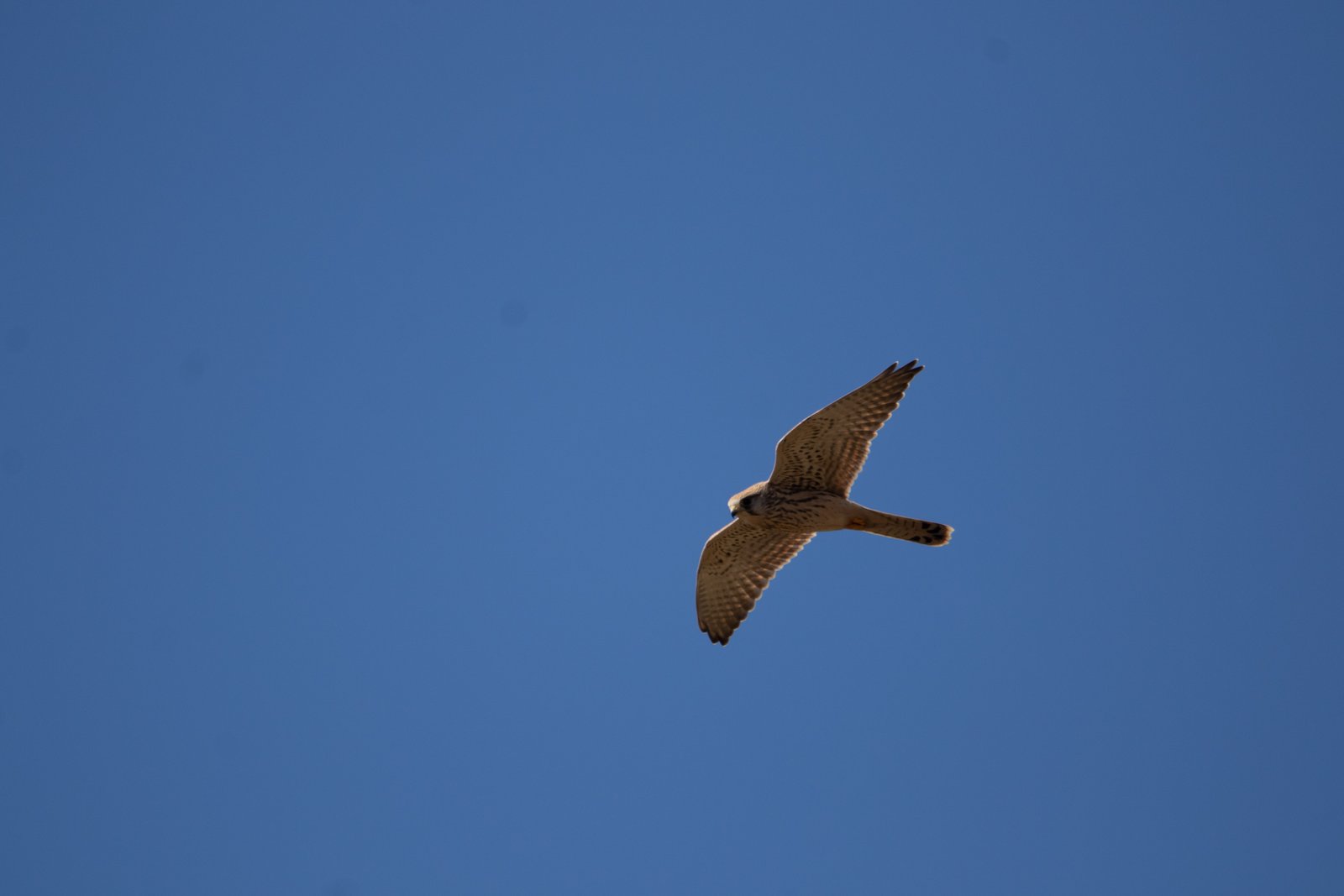
Click a thumbnail to switch the photo above.
Voice
Usually silent in the wintering range. A high kee-kee-kee when disturbed or between birds at a communal roost.
Recording: Paul Kelly — CC BY-NC-SA 4.0 · converted to mono · xeno-canto
Identification
About 34 cm, with long pointed wings and a long tail. The male has a blue-grey head with a clear black moustachial stripe, a rufous mantle with black drop-shaped spots, a blue-grey tail with a black terminal band, and pale creamy-buff underparts with dark streaks and spots. The female has a brown streaked head, rufous-brown upperparts barred black and a brown barred tail. Iris dark, legs yellow, claws black.
Confusion species
Rock Kestrel (Falco rupicolus) is darker and deeper rufous below, with a grey head and grey tail in both sexes. Lesser Kestrel (Falco naumanni) is smaller and slimmer, with white claws; the male has an unspotted mantle, no moustachial stripe and a grey wing panel. Greater Kestrel (Falco rupicoloides) has a pale iris, barred upperparts and a grey tail in both sexes.
Habitat
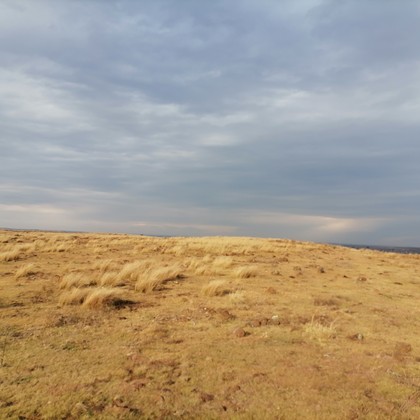
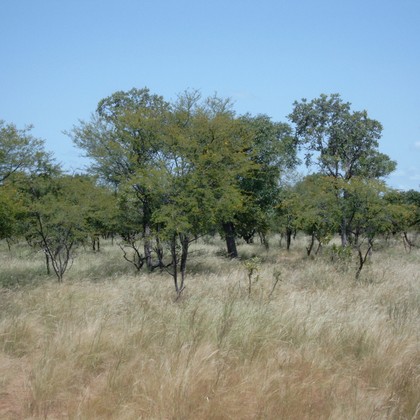
Open grassland, dambos, farmland and open savanna, often on high plateaus. It hunts by hovering or from a wire or pole, taking grasshoppers, termites and small rodents; it sometimes joins flocks of Lesser Kestrels and Red-Footed Falcons.
Where the bird is most at home, classified by the vegetation units of southern Africa.
Range and movements
Mainly in the north of the region: Zambia, Malawi, northern Botswana and Namibia and Zimbabwe; rarely further south into South Africa. A native dark subspecies also lives in northern Angola. The Palearctic birds breed in Europe, North Africa and Asia and mostly winter north of the equator.
- Summer visitor (c. Oct–Mar)
- Passage (Mar–Apr, Oct–Nov)
- dark = core range, pale = thinly spread
How and when to look
In the austral summer check kestrels on the high plateaus of Zambia and Malawi and among flocks of migrant falcons. A female type with a brown streaked head and brown tail, or a male with a black moustachial stripe and pale breast, points to this species; use photographs to support the identification.
Conservation status
Not globally threatened, although numbers have fallen in parts of Europe through agricultural intensification. In the region only a small number of wintering birds is involved, with no conservation issues of its own.
Scientific name
Falco tinnunculus | Linnaeus, 1758
Linnaeus described the species in 1758 and placed it straight away in the genus where it still stands. He introduced the genus Falco in that same work. Falco is the Latin word for 'falcon', possibly related to falx, 'sickle', for the curved shape of the claws or wings. tinnunculus is the Latin name of the kestrel, from tinnulus 'shrill', after the call. The specimen the first description was based on came from Sweden.