All species › Falcons › Falcons › Red-Footed Falcon
Red-Footed Falcon | Falco vespertinus
Roodpootvalk | Cernícalo Patirrojo
The Red-Footed Falcon is a small, gregarious falcon from eastern Europe and central Asia that winters in the west of southern Africa during the austral summer. It is far scarcer than the closely related Amur Falcon and is usually found among flocks of that species.

Click a thumbnail to switch the photo above.
Voice
Mostly silent in its winter quarters; at roosts a high, rapid kew-kew-kew, higher and higher than that of Common Kestrel.
Recording: Arjun Dutta — CC BY-NC-SA 4.0 · converted to mono · xeno-canto
Identification
About 30 cm, slender with long pointed wings. The male is uniform dark slate-grey with silvery primaries, rufous undertail coverts and ‘trousers’ and orange-red cere, eye-ring and legs; the underwing is entirely grey. The female has an orange-buff crown and lightly streaked underparts, a small black mask around the eye, a white throat and grey upperparts barred black. The juvenile resembles a young Eurasian Hobby but is paler, with a light crown and a dark eye patch.
Confusion species
Amur Falcon (Falco amurensis) is very similar, but the male has white underwing coverts that flash in flight, and the female has a grey crown and white, black-spotted underparts with buff trousers. Eurasian Hobby (Falco subbuteo) has a clear moustachial stripe, heavily streaked white underparts and rufous only on the trousers. Lesser Kestrel (Falco naumanni) has a rufous back.
Habitat
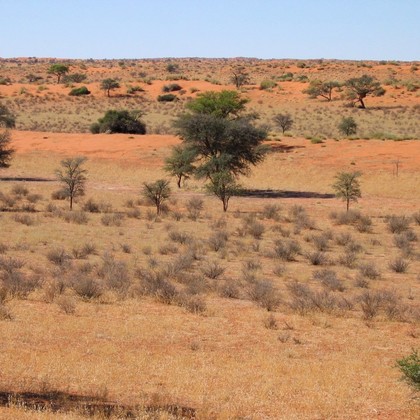
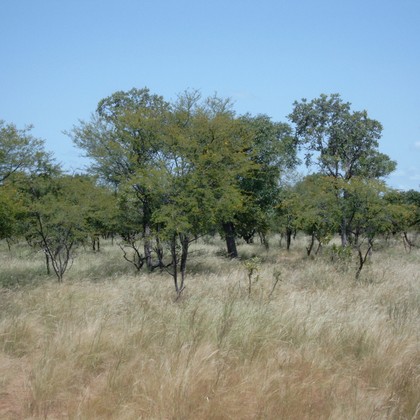
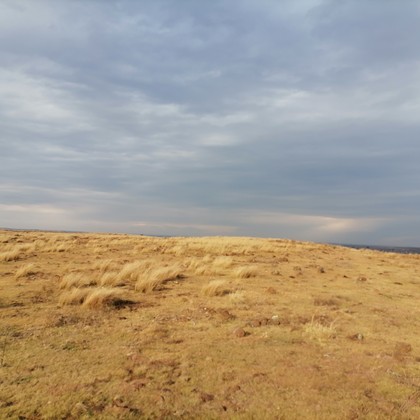
Open grassland, dry savanna and Kalahari thornveld, often after rain when termites emerge. It hunts from wires and dead branches or by hovering for large insects, chiefly grasshoppers, beetles and flying termites, which it eats on the wing. It roosts communally in tall trees, often with Amur Falcons and Lesser Kestrels.
Where the bird is most at home, classified by the vegetation units of southern Africa.
Range and movements
In the region mainly in the west: Angola, northern and central Namibia, western and northern Botswana and western Zambia; rare in Zimbabwe and northern South Africa, and a vagrant further east. Breeds from eastern Europe to central Asia and winters in south-western Africa.
- Summer visitor (c. Oct–Mar)
- Passage (Mar–Apr, Oct–Nov)
- dark = core range, pale = thinly spread
How and when to look
In Namibia and Botswana scan flocks of falcons on telephone wires after summer thunderstorms. Check the underwing of every male in flight: all grey means Red-Footed Falcon, contrasting white coverts an Amur Falcon. Females are identified by their orange crown.
Conservation status
Globally Vulnerable because of a steep decline on the breeding grounds, where the loss of rookeries (its nest sites), intensive agriculture and pesticides play a part. Numbers in the wintering range are poorly known; loss of grassland and insecticides used against locusts are potential threats there.
Scientific name
Falco vespertinus | Linnaeus, 1766
Linnaeus described the species in 1766 and placed it straight away in the genus where it still stands. The genus Falco was introduced in 1758 by Linnaeus. Falco is the Latin word for 'falcon', possibly related to falx, 'sickle', for the curved shape of the claws or wings. vespertinus is Latin for 'of the evening', from vesper 'evening'. The specimen the first description was based on came from the St Petersburg region.