All species › Waterfowl › Ducks and geese › Yellow-Billed Duck
Yellow-Billed Duck | Anas undulata
Geelsnaveleend | Ánade Picolimón
The Yellow-Billed Duck is the common large dabbling duck of southern Africa, found on every dam and vlei. It is scaled grey-brown, with a bright yellow bill bearing a black saddle, and fills the role here that the Mallard has in Europe.

Click a thumbnail to switch the photo above.
Voice
The female gives a loud, descending series of quacks, quaak-quaak-quak-quak, as in Mallard; the male a soft rasping rhaeb and a whistle in display.
Recording: African Bioacoustics Community — CC BY-NC-SA 4.0 · converted to mono · xeno-canto
Identification
51–58 cm. The plumage is dark grey-brown with pale edges to all feathers, giving a scaled pattern; the head is more finely streaked and slightly darker. The bill is bright yellow with a black patch on the culmen and a black nail; the legs are brownish-black. In flight it shows a glossy green to blue-green speculum bordered black and white in front and behind, and white underwings. The sexes are alike; the male is larger with a slightly brighter bill.
Confusion species
Hybrids with Mallard Anas platyrhynchos are the main problem: they have a duller, greenish-yellow or orange bill with an irregular patch, often a greenish sheen on the head, a paler tail or curled tail feathers. African Black Duck Anas sparsa is blackish with white back spots and a grey bill. Cape Shoveler Spatula smithii has a heavy black spatulate bill.
Habitat
Almost any fresh water: dams, reservoirs, rivers, vleis, pans, sewage ponds and park ponds, preferably with open water and marginal vegetation. It dabbles for seeds, water plants, roots and invertebrates and grazes on banks and in fields, especially on spilt grain. Outside the breeding season large flocks moult on reservoirs, where they are temporarily flightless.
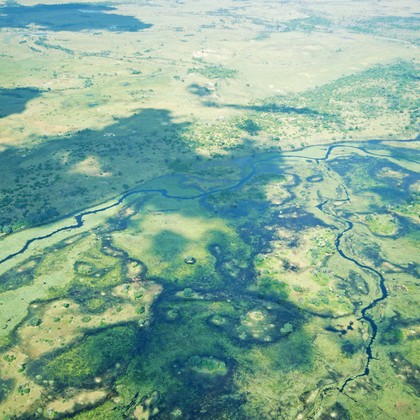
Where the bird is most at home, classified by the vegetation units of southern Africa.

Range and movements
Over most of the region: very common in South Africa (especially the highveld and Western Cape), Lesotho and Eswatini, also in Zimbabwe, Botswana, Namibia, Zambia, Malawi, western Mozambique and the Angolan plateau; scarce in the driest parts of the Karoo, Kalahari and Namib. Beyond the region a northern subspecies occurs in East Africa to Ethiopia and South Sudan.
- Resident
- Summer visitor (c. Oct–Mar)
- Winter visitor (c. Apr–Sep)
- Passage (Mar–Apr, Oct–Nov)
- dark = core range, pale = thinly spread
How and when to look
All year on almost any dam or sewage works, often in pairs or small groups along the shore. Check the purity of the yellow and the sharpness of the black patch on the bill, especially in towns and parks where hybrids with Mallards occur. In winter hundreds may gather on large reservoirs.
Conservation status
Not threatened and numerous in much of the region. The greatest threat is genetic mixing with feral Mallards, especially around South African towns; the species is also hunted and locally regarded as a pest on grain fields.
Scientific name
Anas undulata | Dubois, 1839
Dubois described the species in 1839 and placed it straight away in the genus where it still stands. The genus Anas was introduced in 1758 by Linnaeus. Anas is the Latin word for 'duck'. undulata is Latin for 'wavy', for the fine wavy markings on the plumage. The specimen the first description was based on came from Cape of Good Hope.