All species › Cuckoos › Cuckoos › Black Coucal
Black Coucal | Centropus grillii
Zwarte spoorkoekoek | Cucal Negro
The Black Coucal is the smallest coucal of the region and the only one that in breeding plumage has a wholly black body with chestnut wings. It lives hidden in tall, wet grass and is known mainly by its hollow, bubbling call. Roles are reversed in this species: the larger female defends the territory and mates with several males, which incubate and raise the young.

Voice
A hollow, dull two-note series, pop-pop ... pop-pop, often repeated at length from the grass, and a bubbling, watery series that rises and falls, woo-woo-woo-woo-woo, like that of other coucals but softer and faster. The female calls mainly at the start of the rains, sometimes from a grass stem or low bush.
Recording: Magnus Wadstein — CC BY-NC-SA 4.0 · converted to mono · xeno-canto
Identification
30–35 cm; the female is clearly larger than the male. In breeding plumage the head, body and long broad tail are dull black, with fine pale barring on the rump; the wings are bright chestnut with dark bars on the primaries. The eye is dark and the bill black and rather short. Non-breeding plumage is quite different: upperparts dark brown with rufous and buff streaks and bars, head and breast buffy brown with pale shaft streaks, underparts pale buff and the tail finely barred; the bill is then horn-coloured. Juveniles resemble non-breeding adults. It flies low and heavily over the grass with the tail spread and soon drops back into cover.
Confusion species
White-Browed Coucal Centropus superciliosus and Senegal Coucal Centropus senegalensis are larger and have white or creamy underparts in all plumages; the former also shows a white supercilium. Coppery-Tailed Coucal Centropus cupreicaudus is much larger, with a dark head and a coppery-glossed tail. The streaked non-breeding plumage resembles juveniles of those species, but the bird is smaller, with finer buff streaking on head and back and a shorter bill.
Habitat
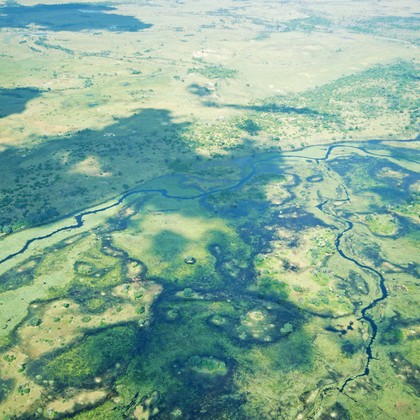
Tall, dense grass on seasonally flooded plains, marsh edges, vleis and wet grassland with scattered bushes; also reed fringes along rivers and floodplains. It forages on the ground and in grass for grasshoppers, beetles and other large insects, occasionally frogs. The nest is a loose grass dome low in a tussock, often hidden by pulled-over blades.
Where the bird is most at home, classified by the vegetation units of southern Africa.
Range and movements
Mainly in the north of the region: Angola, Zambia, Malawi, Mozambique and northern Botswana (Okavango Delta, Linyanti and Chobe), with the Zambezi Region of Namibia; scarce in northern and eastern Zimbabwe and only exceptional in the far north-east of South Africa. It moves with the rains to newly flooded grassland and leaves again afterwards. Beyond the region it is widespread in much of sub-Saharan Africa, from Senegal to Ethiopia and Tanzania.
- Resident
- Summer visitor (c. Oct–Mar)
- Passage (Mar–Apr, Oct–Nov)
- dark = core range, pale = thinly spread
How and when to look
Search wet grassland along the Okavango, Chobe or Zambezi from December to March and listen in the early morning for the hollow pop-pop. A calling female sometimes climbs a grass stem or small bush and is then visible; otherwise the species is mostly seen in flight, low over the grass on rufous wings.
Conservation status
Not threatened and widespread over a large range. The species depends on seasonally flooded grassland and disappears where this is drained, ploughed, or heavily grazed or burnt. Its secretive habits and seasonal occurrence mean it is probably under-recorded in the region.
Scientific name
Centropus grillii | Hartlaub, 1861
Hartlaub described the species in 1861 and placed it straight away in the genus where it still stands. The genus Centropus was introduced in 1811 by Illiger. Centropus comes from the Greek kentron, 'spur, goad', and pous, 'foot' — for the long, straight hind claw, a feature of all coucals. grillii honours the Swedish patron of the sciences, antiquarian and bibliophile Johan Wilhelm Grill (1815–1864). The specimen the first description was based on came from Gabon.