All species › Cuckoos › Cuckoos › White-Browed Coucal
White-Browed Coucal | Centropus superciliosus
Wenkbrauwspoorkoekoek | Cucal Cejiblanco
The White-Browed Coucal is the most widespread and best-known coucal of the region, from the shores of Malawi to the gardens of Durban and the Garden Route. Its bubbling call, which sounds like water poured from a bottle, is traditionally taken in the south as a harbinger of rain. In the southern part of the region lives a form without an obvious supercilium, sometimes treated as a separate species, Burchell's Coucal.
Voice
A long, bubbling series of hollow notes, doo-doo-doo-doo-doo-doo, first falling and accelerating and then rising and slowing, like water poured from a bottle; often in duet, mainly at dawn, at dusk and before or after rain. When alarmed a harsh hissing chek.
Recording: Jonathan Onongo — CC BY-NC-SA 4.0 · converted to mono · xeno-canto
Identification
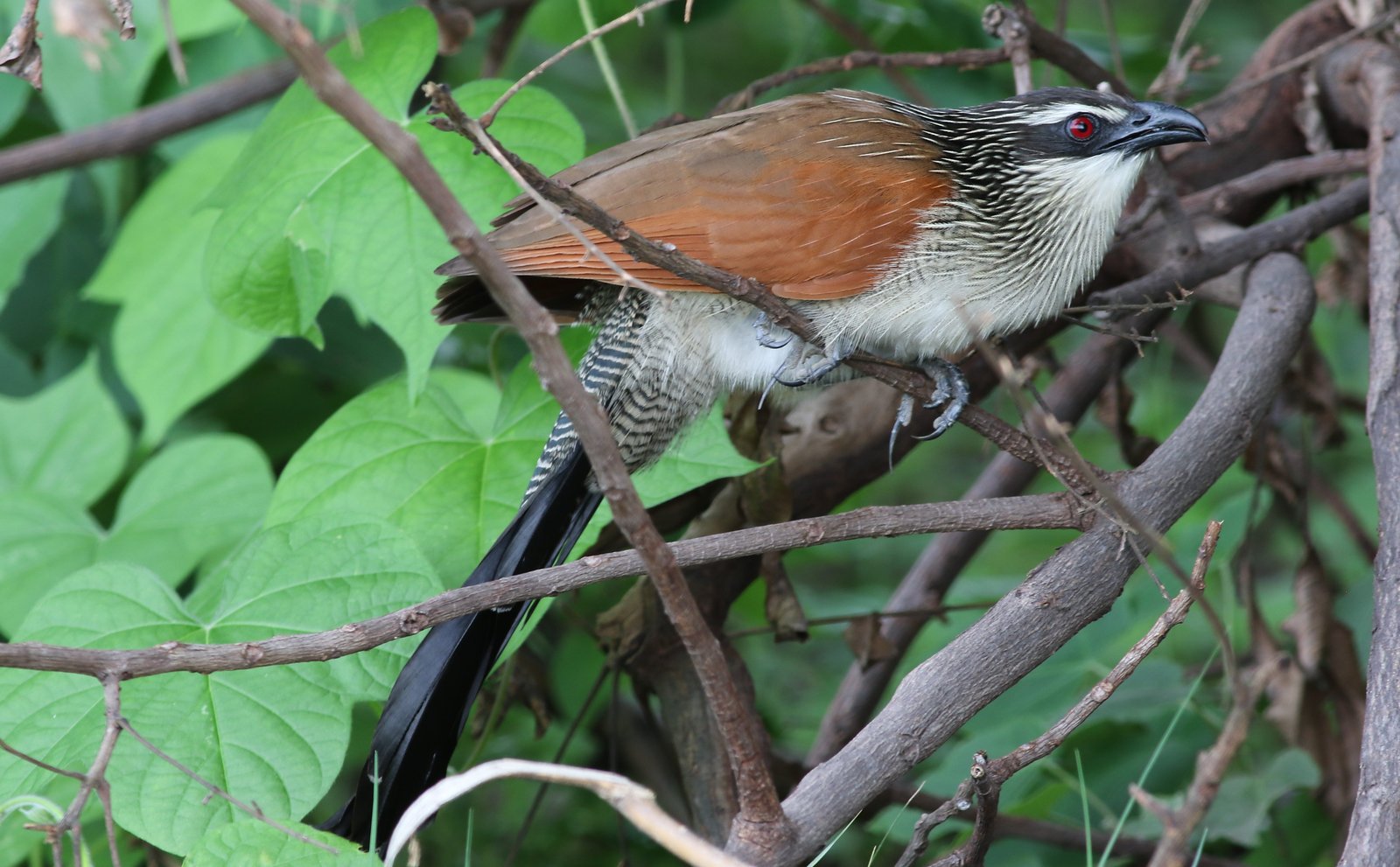
40–44 cm. Northern forms have a dark brown to blackish crown, a broad white supercilium and a hindneck and mantle finely streaked with white. In the southern form (burchellii), found in South Africa, Eswatini and southern Mozambique and Zimbabwe, the crown and hindneck are glossy black and the supercilium is largely absent. In both the back is rufous-brown, the wings chestnut, the underparts cream and the rump and uppertail coverts finely barred black and cream; the long tail is black with a greenish gloss. Red eye, black bill. Juveniles have a barred back and a dark eye.
Confusion species
The Senegal Coucal (Centropus senegalensis) lacks the supercilium and has a plain blackish, unbarred rump; the latter feature also separates it from the southern form without a brow. The Coppery-Tailed Coucal (Centropus cupreicaudus) is larger and darker, with a heavy bill, no supercilium or barred rump and a coppery gloss on the tail. The Black Coucal (Centropus grillii) is smaller and black below in breeding plumage.
Habitat
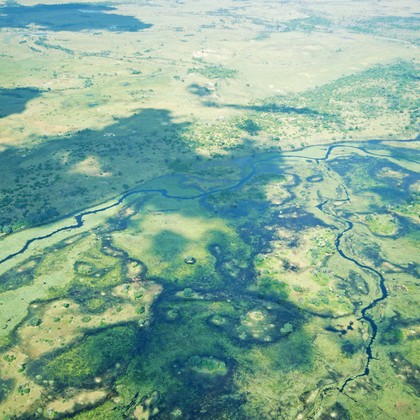
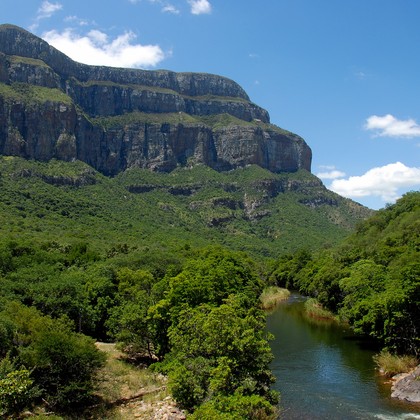
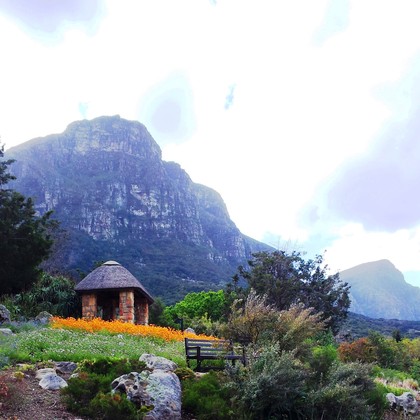
Rank, dense vegetation near water: reed fringes, tall grass and bushes along rivers, marshes and dams, riverine forest, overgrown field edges, sugarcane and untidy gardens. It forages low in dense cover and on the ground. It eats large insects, snails, frogs, lizards, rodents and the eggs and young of other birds.
Where the bird is most at home, classified by the vegetation units of southern Africa.
Range and movements
Most of the north and east of the region: Angola, Zambia, Malawi, Mozambique, Zimbabwe, northern and eastern Botswana, north-eastern Namibia, Eswatini and in South Africa the east and north (Limpopo, Mpumalanga, Gauteng, KwaZulu-Natal, the Eastern Cape) west along the coast to the Garden Route. Absent from the dry western half. Beyond the region through East Africa north to Ethiopia, Eritrea and Sudan, and in south-western Arabia.
- Resident
- Summer visitor (c. Oct–Mar)
- Winter visitor (c. Apr–Sep)
- Passage (Mar–Apr, Oct–Nov)
- dark = core range, pale = thinly spread
How and when to look
The most frequently observed coucal in the region: in the early morning search reed fringes and rank banks, for example at iSimangaliso, in Kruger or along Lake Malawi, for birds sunning themselves with spread wings. On birds without a supercilium check for the finely barred rump to separate them from the Senegal Coucal.
Conservation status
Not threatened, widespread and common across much of its range. It adapts well to farmland as long as rank cover remains; locally it disappears where riverside vegetation and marshes are cleared.
Scientific name
Centropus superciliosus | Hemprich & Ehrenberg, 1829
Hemprich & Ehrenberg described the species in 1829 and placed it straight away in the genus where it still stands. The genus Centropus was introduced in 1811 by Illiger. Centropus comes from the Greek kentron, 'spur, goad', and pous, 'foot' — for the long, straight hind claw, a feature of all coucals. superciliosus is Latin for 'eyebrowed' — for the broad white supercilium. The specimen the first description was based on came from Arabia and Ethiopia.