All species › Passerines › Vangas and helmetshrikes › African Shrike-Flycatcher
African Shrike-Flycatcher | Megabyas flammulatus
Afrikaanse klauwiervliegenvanger | Bias Llameante
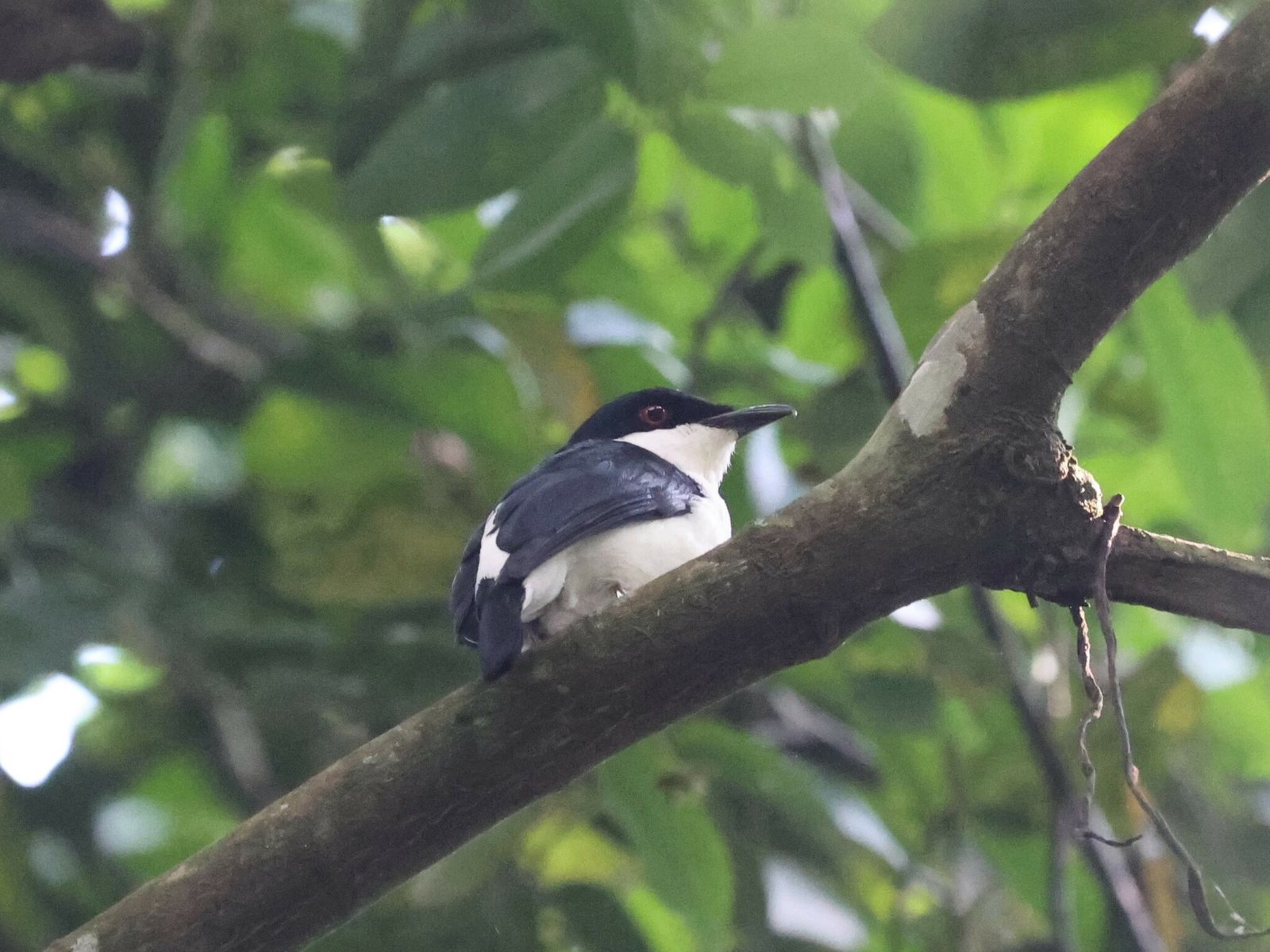
African Shrike-Flycatcher is an upright-perching forest bird with a broad, hooked bill, which in the region only reaches the southern edge of the Congo rainforest. The male is glossy blue-black with white underparts and a red eye; the female is rufous-brown with streaked flanks. A characteristic habit is swinging the tail from side to side.
Voice
A repeated, dry chik-chik or chek, and a short, clear whistle of two or three notes. Also bill-snapping. The calls do not carry far and the bird is often silent.
Recording: Patrik Åberg — CC BY-NC-SA 4.0 · shortened to the first 60 s, mono · xeno-canto
Identification
15–16 cm. The male is glossy blue-black above, with a white rump that shows in flight, and pure white below, from throat to undertail coverts. The eye is red and the broad, hooked bill black. The female has a greyish-brown head, a warm rufous-brown back, rump and tail, and is white below with brown streaks on breast and flanks. Juveniles resemble the female. The bird perches upright like a flycatcher and swings its tail from side to side while perched.
Confusion species
Male Black-and-White Shrike-Flycatcher Bias musicus has a crest, a black breast, a yellow eye and a shorter tail; the female has a black head and a chestnut back without streaks below. Black-Throated Wattle-Eye Platysteira peltata is smaller, with a red eye-wattle and a black breast band. African Paradise Flycatcher Terpsiphone viridis has a long tail, a blue eye-wattle and grey or rufous underparts.
Habitat
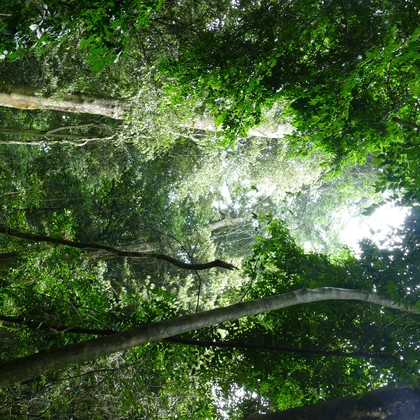
Moist evergreen forest, including secondary forest, forest edge, gallery forest along rivers and old plantations with shade trees. It forages in the middle storey and canopy, often in mixed foraging flocks, catching insects in short sallies from a perch and gleaning them from leaves.
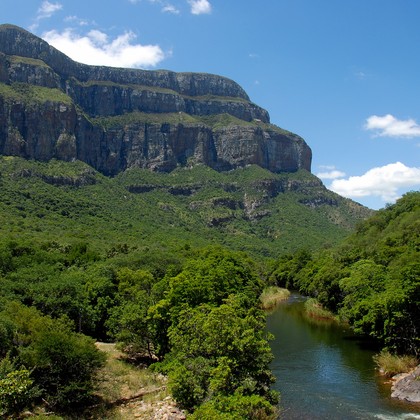
Where the bird is most at home, classified by the vegetation units of southern Africa.
Range and movements
Within the region only at the northern edge: northern Angola (Cabinda, Uíge, Cuanza Norte and the Lunda provinces) and, very locally, gallery forest in the far north-west of Zambia in Mwinilunga District. Beyond, from Sierra Leone through the Congo Basin to Uganda and western Kenya.
- Passage (Mar–Apr, Oct–Nov)
- dark = core range, pale = thinly spread
How and when to look
Year-round, but confined to northern Angola and the far north-west of Zambia. Search gallery forest and forest edge for an upright black-and-white bird swinging its tail; follow mixed foraging flocks in the middle storey.
Conservation status
Not threatened; widespread in the African rainforest. At the southern edge, within the region, the species is scarce and depends on forest and gallery forest, which is locally cleared for farming.
Scientific name
Megabyas flammulatus | Verreaux & Verreaux, 1855
Verreaux & Verreaux described the species in 1855 and placed it straight away in the genus where it still stands. He introduced the genus Megabyas in that same work. Megabyas combines the Greek mega, 'large', with Bias, the genus to which this species is evidently related. flammulatus is Modern Latin for 'with flame-like markings', from the Latin flammula, 'little flame' (diminutive of flamma, 'flame'). The specimen the first description was based on came from Muni River (Gabon–Equatorial Guinea border).