All species › Passerines › Vangas and helmetshrikes › White-Crested Helmetshrike
White-Crested Helmetshrike | Prionops plumatus
Helmklauwier | Prionopo Crestiblanco
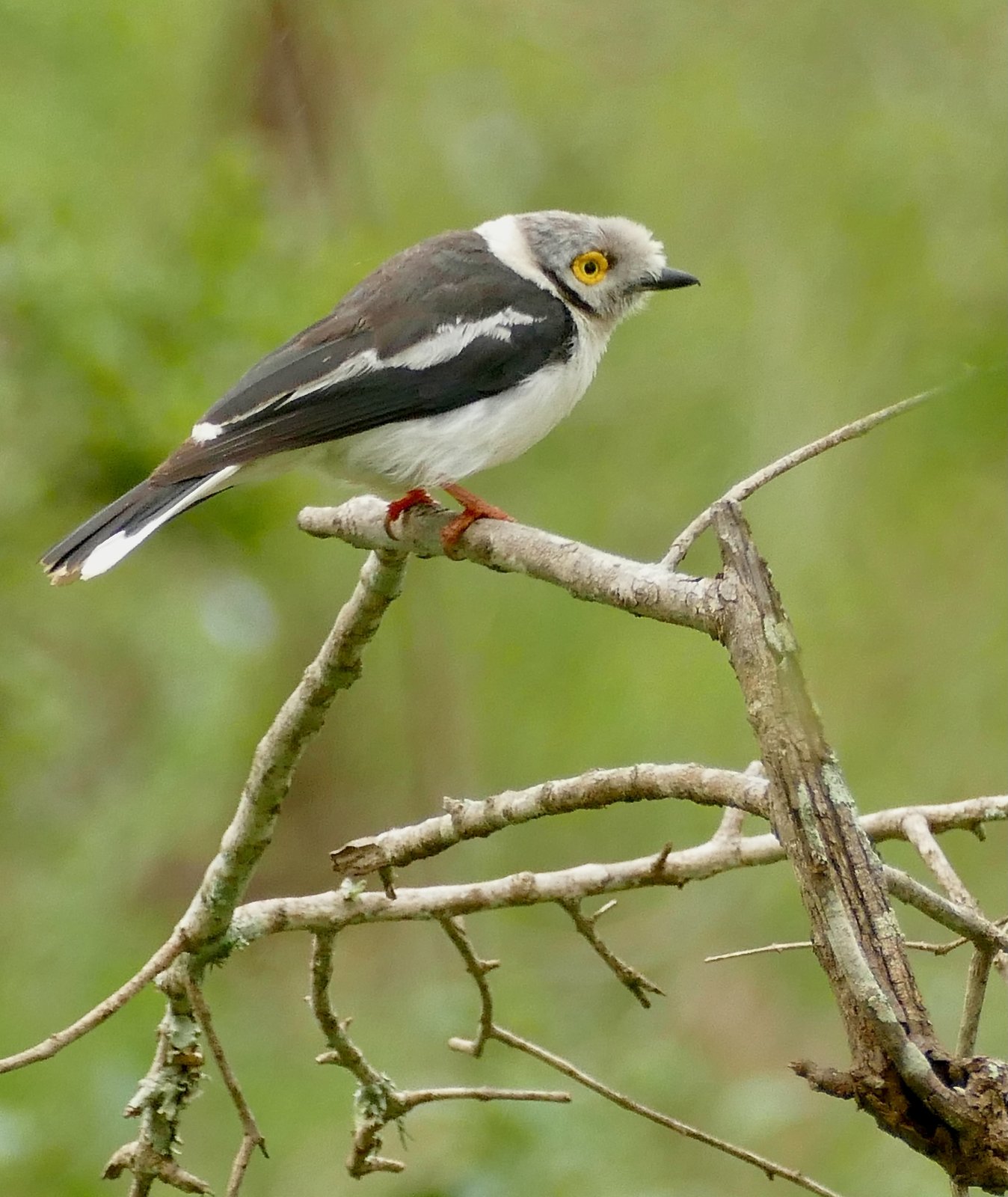
White-Crested Helmetshrike moves through woodland in close-knit groups of five to twelve birds, tree to tree, amid constant chatter and bill-snapping. The white, curling forehead crest, yellow eye-wattle and black-and-white wing pattern make it unmistakable. All group members help to build the nest and raise the young.
Voice
A group is rarely silent: an incessant, harsh chattering and churring such as chrrr-chrrr and kwirr-kwirr, mixed with loud bill-snapping. Group members call in chorus, especially when flying to the next tree, and give a hard, rattling series when alarmed.
Recording: Alain Malengreau — CC BY-NC-SA 4.0 · converted to mono · xeno-canto
Identification
19–20 cm. The forehead carries a bristly, forward-curling crest of white to pale grey feathers merging into the pale grey crown. A black ear patch is bordered by a white collar on the nape. Back and wings are black with a broad white wing stripe and much white in the primaries, giving a striking pattern in flight; the tail is black with white outer edges. The underparts are wholly white. The eye is yellow, surrounded by a yellow, scalloped wattle; the bill is black and the legs orange. The sexes are alike. Juveniles lack the wattle and have a brownish crown and a dark eye.
Confusion species
Retz's Helmetshrike Prionops retzii is almost entirely black with a dark brown back, a red, yellow-tipped bill and a red eye-wattle; the two species sometimes travel together. Chestnut-Fronted Helmetshrike Prionops scopifrons of the Mozambican coastal forests is grey with a chestnut bristly forehead and lacks the white collar. Brubru Nilaus afer and Chinspot Batis Batis molitor are black and white but much smaller, live singly or in pairs and have no crest.
Habitat
Open and semi-open broadleaf woodland: miombo, mopane, mixed woodland and tall savanna with scattered trees, also riverine woodland and old parks. It forages in the middle storey and on thick branches, where group members in turn take insects, caterpillars and spiders from bark and leaves.
Where the bird is most at home, classified by the vegetation units of southern Africa.


Range and movements
Widespread in the woodlands of the region: Angola, Zambia, Malawi, Mozambique and Zimbabwe, northern and eastern Botswana, northern Namibia including the Caprivi, and in South Africa in Limpopo, Mpumalanga and northern KwaZulu-Natal, with Eswatini. Absent from the arid west and the south of the region. Beyond, from Senegal east to Ethiopia and south to Tanzania.
- Resident
- Summer visitor (c. Oct–Mar)
- Winter visitor (c. Apr–Sep)
- Passage (Mar–Apr, Oct–Nov)
- dark = core range, pale = thinly spread
How and when to look
Year-round, most often seen in the dry season, when groups range more widely and the trees are barer. Listen for the chatter and bill-snapping and follow the group: they move in a set order from tree to tree and allow close views. In mixed foraging flocks in miombo it often leads the way.
Conservation status
Not threatened; fairly common in most areas. The species depends on larger trees and disappears where woodland is cleared completely, but it occurs in many protected areas, such as Kruger and Hwange.
Scientific name
Prionops plumatus | (Shaw, 1809)
Shaw described the species in 1809 as Lanius plumatus; because it was later moved to another genus, the author and year stand in brackets. The genus Prionops was introduced in 1816 by Vieillot. Prionops comes from the Greek priōn, 'saw', and ōps, 'eye' — probably for the serrated eye-wattle or the stiff forehead feathers. plumatus is Latin for 'feathered, plumed', for the erect crown feathers. The specimen the first description was based on came from Senegal.