All species › Passerines › Leaf warblers › Yellow-Browed Warbler
Yellow-Browed Warbler | Phylloscopus inornatus
Bladkoning | Mosquitero bilistado
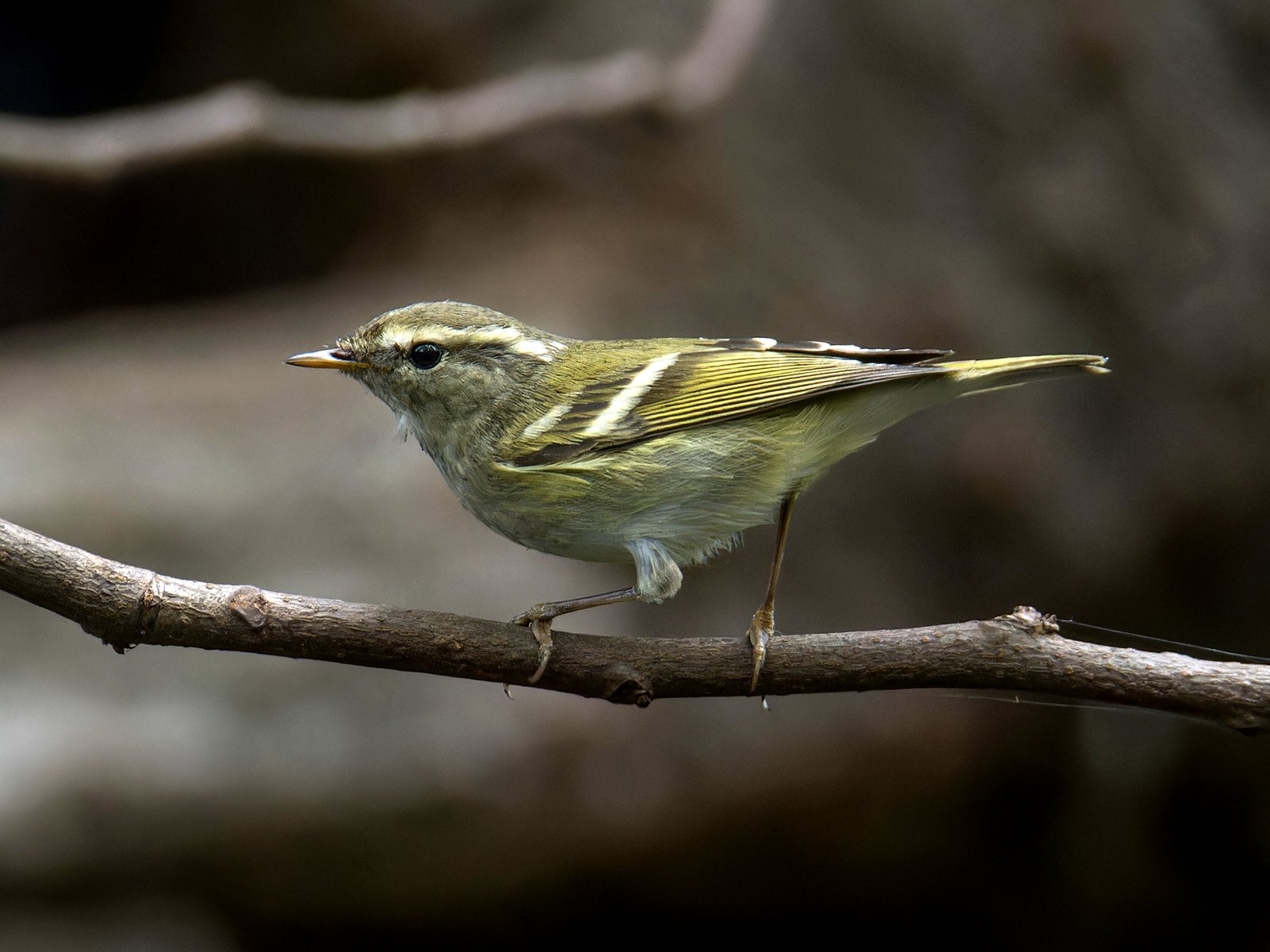
The Yellow-browed Warbler is a tiny, fresh green leaf warbler from the Siberian taiga that normally winters in South-East Asia. Since the 1990s it has appeared ever more often west of its traditional route, and in this region it is a scarce but regular visitor in autumn and winter, from Morocco to the Gulf states.
Voice
The call is a loud, penetrating, rising tsoo-eest, strong for such a small bird and often the first thing noticed. The song, rarely heard in winter quarters, is a series of high, descending squeaks.
Recording: Bjarne Verhaeghe — CC BY-NC-SA 4.0 · converted to mono · xeno-canto
Identification
9.5–10.5 cm. Olive green above and white below, with much pattern on head and wing: a long, broad, creamy-yellow supercilium reaching far behind the eye, a dark eye-stripe, often a faint pale crown stripe, and two pale wing bars, the upper one across the greater coverts broad and yellowish-white. Tertials with white edges. Bill dark with an orange-pink base to the lower mandible; legs pale brown. Always active, with much wing-flicking.
Confusion species
Hume's Warbler (Phylloscopus humei) is greyer and duller, with an off-white supercilium, a faint or missing second wing bar, an almost entirely dark bill and dark legs; the call is the best feature. Pallas's Leaf Warbler (Phylloscopus proregulus) is smaller, with a yellow crown stripe and a yellow rump. Green Warbler (Phylloscopus nitidus) is larger and yellower, with only one narrow wing bar. Goldcrest (Regulus regulus) has a black-bordered yellow crown stripe and a plain face.
Habitat
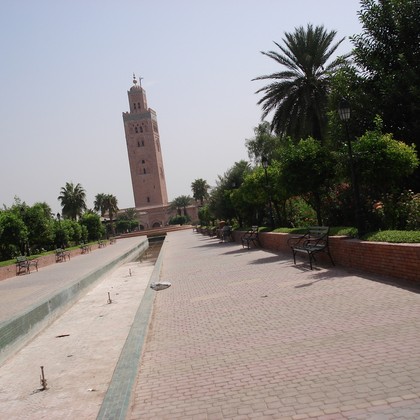
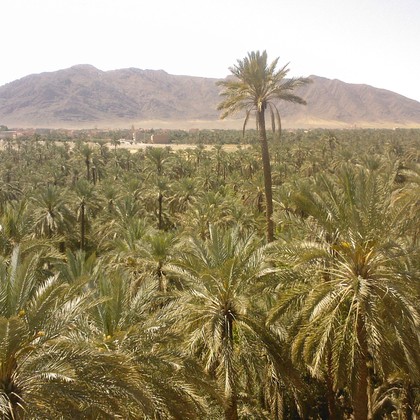
In the region mainly in parks, gardens with flowering trees, date-palm gardens and coastal groves, also in clumps of tamarisk and acacia; forages high and low in foliage, often together with chiffchaffs.
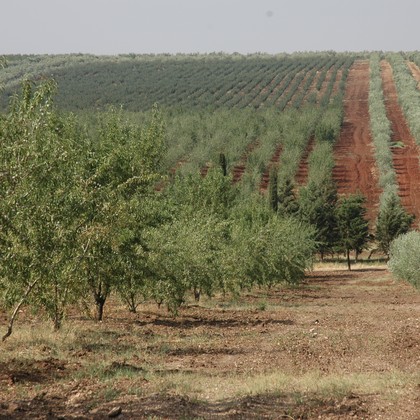
Where the bird is most at home, classified by the habitats of North Africa and the Middle East.
Range and movements
Scarce but annual passage migrant and winter visitor. In Morocco now several dozen records, mainly in October and November along the Atlantic coast and in the oases, occasionally wintering; rare in Algeria, Tunisia, Libya and Egypt. In Israel a scarce winter visitor to parks and gardens, mainly along the coast and at Eilat. In Kuwait, Bahrain, Qatar, eastern Saudi Arabia, the UAE and Oman a rare to scarce passage migrant and winter visitor. Breeds in the taiga from the Urals to eastern Siberia and winters mainly from north-eastern India to southern China and South-East Asia.
- Winter visitor (c. Oct–Mar)
- Passage (Mar–Apr, Oct–Nov)
- dark = core range, pale = thinly spread
How and when to look
From October to March listen in city parks with tall trees and flowering shrubs for the penetrating tsoo-eest call, for example at Eilat, in the parks of Dubai and Abu Dhabi or in the gardens of Rabat. Where a group of chiffchaffs is feeding, one may be among them.
Conservation status
Not globally threatened, with a large population. The marked increase in records in western Europe and North Africa is attributed to a westward shift in migration and possibly a new wintering area in West Africa or southern Europe.
Scientific name
Phylloscopus inornatus | (Blyth, 1842)
Blyth described the species in 1842 as Regulus inornatus; because it was later moved to another genus, the author and year stand in brackets. The genus Phylloscopus was introduced in 1826 by Boie. Phylloscopus is Greek, from phullon 'leaf' and skopos 'seeker', from skopeō 'to watch': the bird that searches the foliage. inornatus is Latin for 'plain, unadorned', from in- 'not' and ornatus 'adorned'. The specimen the first description was based on came from near Calcutta.