All species › Storks › Storks › White Stork
White Stork | Ciconia ciconia
Ooievaar | Cigüeña blanca
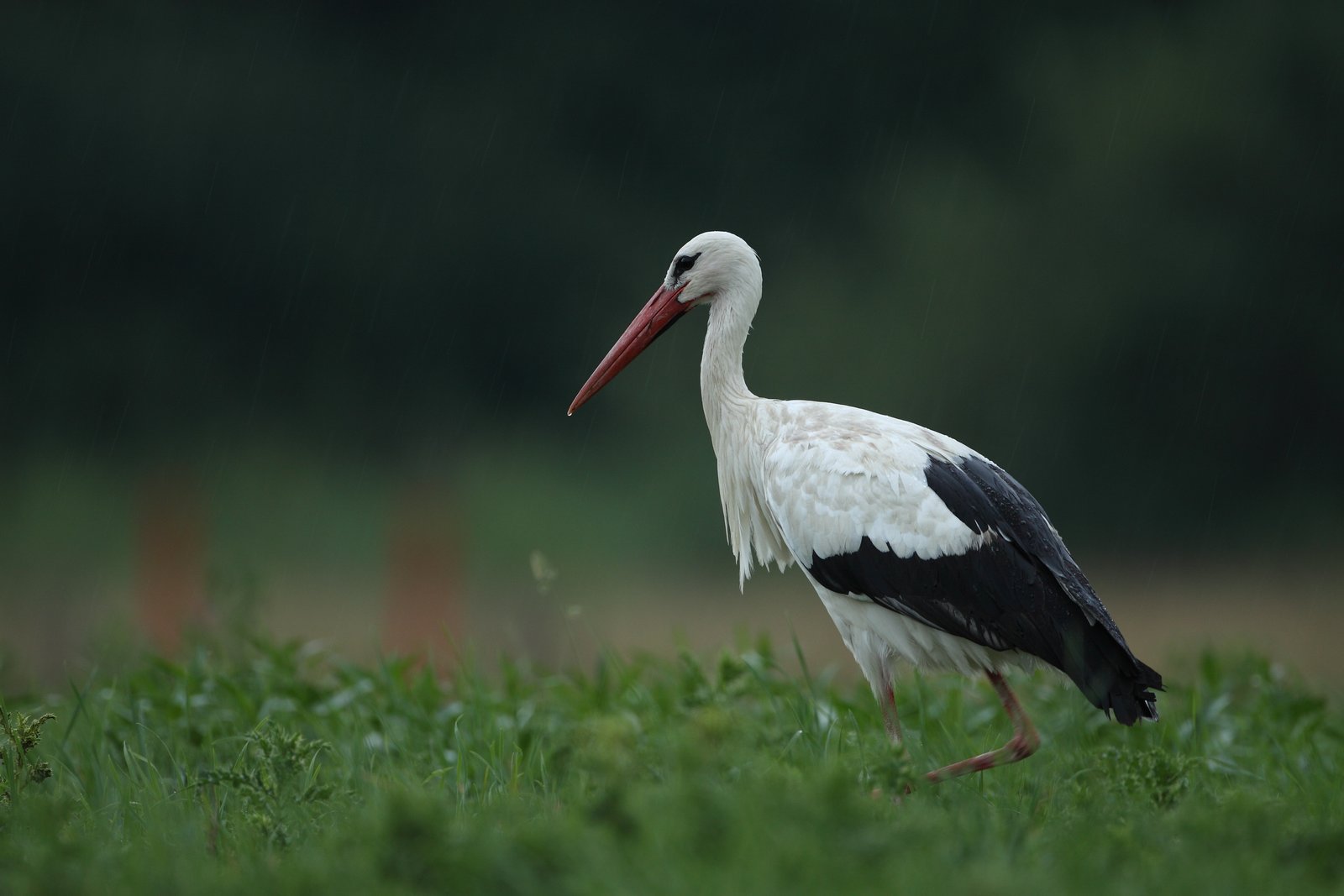
The familiar white stork with red bill and legs, a well-known breeding bird on roofs, minarets and pylons in the Maghreb. In the east of the region it is above all an abundant passage migrant: hundreds of thousands of birds from eastern Europe move through the Levant, Sinai and the Suez Canal to and from Africa in spring and autumn.
Voice
Virtually mute; its sound is the loud, rattling bill-clattering at the nest, with the head thrown back onto the mantle. Otherwise at most hissing; the young squeak and mew.
Recording: Petter Westberg — CC BY-NC-SA 4.0 · converted to mono · xeno-canto
Identification
Large and white with black flight feathers and greater coverts, so the rear half of the wing is black; the long straight bill and the legs are red. A narrow patch of black bare skin surrounds the dark eye. Juveniles have a duller, brownish-red bill with a dark tip and some brownish black in the wing. The legs are often whitewashed with droppings, which the bird uses to cool itself. Flies with outstretched neck and legs projecting well beyond the tail; soars a lot and spirals up in thermals in large flocks.
Confusion species
At a distance or against the light a soaring flock can recall Great White Pelicans (Pelecanus onocrotalus), but these fly with the neck retracted and have a huge bill and short legs. Yellow-billed Stork (Mycteria ibis) has a red face, a yellow, slightly decurved bill and a black tail. Abdim's Stork (Ciconia abdimii) is largely black. Egrets fly with the neck retracted.
Habitat
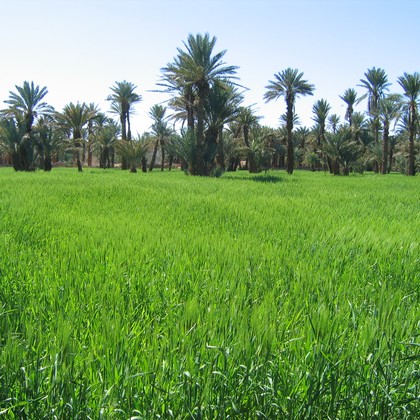
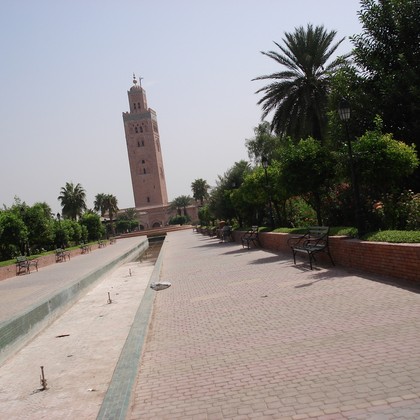
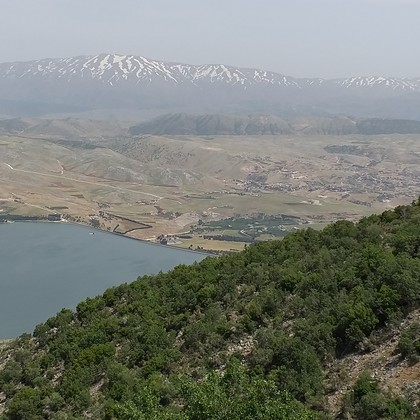
Open, moist farmland, irrigated fields, meadows, river valleys and marsh edges, also rubbish dumps and fish ponds. In the Maghreb it nests on roofs, chimneys, minarets, ruins, power pylons and trees, often in loose colonies in villages and towns. On passage it rests in flocks on fields, fish ponds and landfills.
Where the bird is most at home, classified by the habitats of North Africa and the Middle East.
Range and movements
Breeds in northern Morocco and the Moroccan interior south to the Haouz near Marrakech and the Souss valley, in northern Algeria (numerous in the Tell and on the High Plateaux) and northern Tunisia, with several thousand pairs in each (Tunisia just over 1,000); in Libya only locally and in small numbers. In the east it breeds in northern Iraq and northeastern Syria, and sporadically in Israel. On migration virtually the entire eastern European population passes through Syria, Lebanon, Israel, Jordan and Sinai to Egypt and down the Nile to Sudan; a few hundred to thousands winter in Israel, and smaller numbers in Saudi Arabia (especially the Tihama and the southwest), Yemen and scattered across the Arabian Peninsula. Western birds cross the Strait of Gibraltar to the Sahel; part of the Moroccan population now winters within the country. Beyond the region it breeds over much of Europe and western Asia and winters in sub-Saharan Africa; there is also a small population in South Africa.
- Resident
- Summer visitor (c. Apr–Sep)
- Winter visitor (c. Oct–Mar)
- Passage (Mar–Apr, Oct–Nov)
- dark = core range, pale = thinly spread
How and when to look
Spring passage through Eilat and the Arava (March) and autumn passage through the Jordan Valley, the Beit She'an Valley and the Hula Valley (August–September) bring flocks of thousands. In Morocco the nests on the walls of the El Badi Palace in Marrakech and in the Kasbah of the Udayas in Rabat are famous.
Conservation status
Not globally threatened, and recovering after a steep decline in the twentieth century, partly because birds exploit landfills and migrate shorter distances. In the region electrocution on power pylons, hunting along the flyways, loss of wetlands and poisoning threaten the species; the North African breeding population has grown in recent decades.
Scientific name
Ciconia ciconia | (Linnaeus, 1758)
Linnaeus described the species in 1758 as Ardea Ciconia; because it was later moved to another genus, the author and year stand in brackets. The genus Ciconia was introduced in 1760 by Brisson. Ciconia is the Latin word for 'stork'. The specific name repeats the genus name. The specimen the first description was based on came from Sweden.