All species › Passerines › Starlings › Tristram's Starling
Tristram's Starling | Onychognathus tristramii
Tristrams spreeuw | Estornino de Tristram
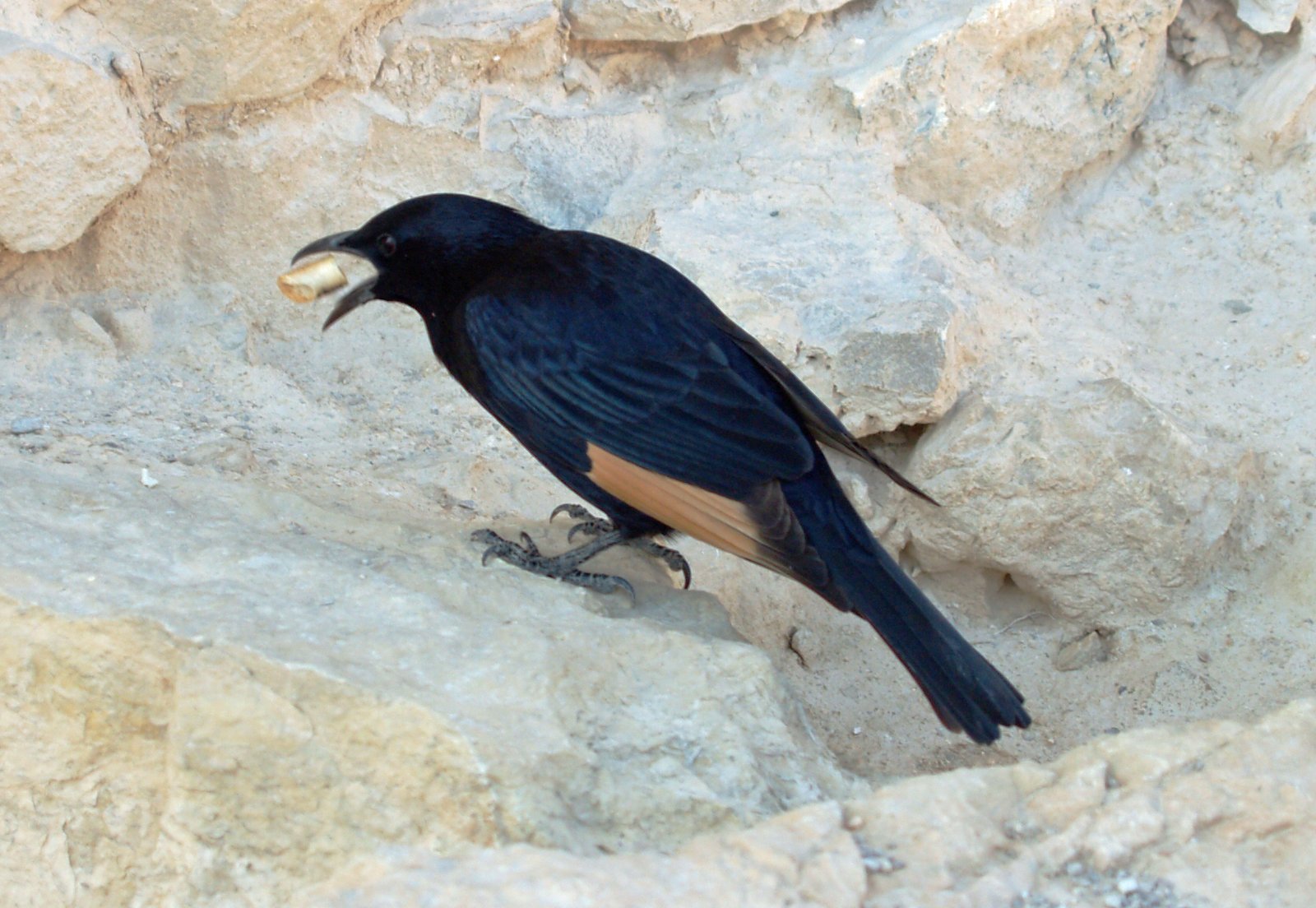
Tristram's Starling is the orange-winged black starling of the desert gorges around the Red Sea and the Dead Sea, one of the characteristic birds of the Levant and western Arabia. Noisy groups glide along cliff faces with whistling calls and are often tame at settlements, campsites and viewpoints.
Voice
Very distinctive: loud, melodious, gliding whistles, wee-oo-wee and dee-oo, echoing between the gorge walls, like a whistled foo-weet. Groups also make a soft chattering and twittering.
Recording: Zsombor Károlyi — CC BY-NC-SA 4.0 · converted to mono · xeno-canto
Identification
24–26 cm. A slim, long-tailed starling with a fairly long, slightly curved black bill and black legs. The male is glossy blue-black. The female has a dark grey head and neck with fine dark streaks, sharply set off from the black body. Both sexes have striking rufous primaries with dark tips: at rest a narrow orange edge, in flight a large orange patch on the wing. The flight is fast and light, with short glides along the rocks. Juveniles resemble the male but are duller.
Confusion species
Somali Starling (Onychognathus blythii) and Socotra Starling (Onychognathus frater) occur only on Socotra and do not overlap. At a distance it may recall Fan-tailed Raven (Corvus rhipidurus) or Brown-necked Raven (Corvus ruficollis), but these are much larger and lack the orange wings. Blue Rock-Thrush (Monticola solitarius) has no orange wing patch and a shorter tail.
Habitat
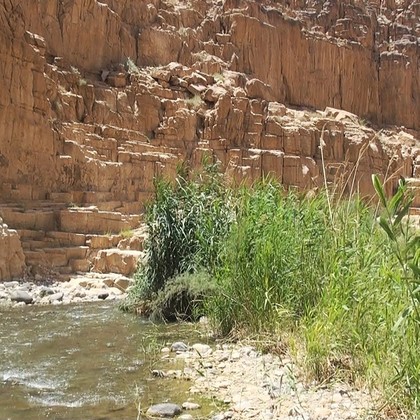
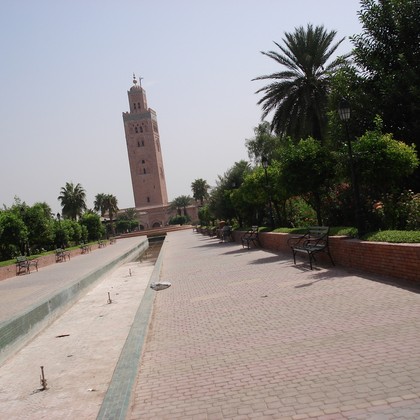
Rocky gorges, canyons, wadis and steep mountain slopes in desert and semi-desert, from below sea level along the Dead Sea to high in the mountains of south-west Arabia. Increasingly in and around settlements, kibbutzim, campsites, hotels and oases, where it eats scraps and fruit. Nests in rock crevices and cavities in buildings. Eats fruit, seeds and invertebrates, and picks parasites from Nubian ibex and livestock.
Where the bird is most at home, classified by the habitats of North Africa and the Middle East.

Range and movements
Resident in the Rift Valley and the mountains around the Red Sea. In Israel along the Dead Sea, in the Negev and the Eilat Mountains; in Samaria and Judea in the Judean Desert; in Jordan along the Dead Sea, in Wadi Araba, at Petra and in Wadi Rum; in Egypt in southern Sinai and the mountains by the Gulf of Aqaba (the Eastern Desert west of the Red Sea is not part of the regular range). In Saudi Arabia along the whole western mountain chain from Midian and the Hejaz to Asir; in Yemen in the western highlands and Tihama foothills, east to Hadramaut; in Oman in Dhofar and the mountains of central Oman. Absent from the Gulf states. The species is almost entirely confined to the region covered by this guide.
- Resident
- Summer visitor (c. Apr–Sep)
- Passage (Mar–Apr, Oct–Nov)
- dark = core range, pale = thinly spread
How and when to look
At Ein Gedi, Masada and Ein Bokek by the Dead Sea, or at Petra in Jordan: groups come to car parks and picnic sites. Listen for the whistles echoing between the rocks.
Conservation status
Not globally threatened. Locally increasing thanks to food available at settlements and from tourism.
Scientific name
Onychognathus tristramii | (Sclater, 1858)
Sclater described the species in 1858 as Amydrus Tristramii; because it was later moved to another genus, the author and year stand in brackets. The genus Onychognathus was introduced in 1849 by Hartlaub. Onychognathus combines the Greek onyx 'nail, claw' and gnathos 'jaw'. tristramii honours the English clergyman, biblical scholar and ornithologist Henry Baker Tristram (1822–1906). The specimen the first description was based on came from Mar Saba, near Hebron.