All species › Waders, gulls and terns › Plovers and lapwings › Spur-Winged Lapwing
Spur-Winged Lapwing | Vanellus spinosus
Sporenkievit | Avefría espolonada
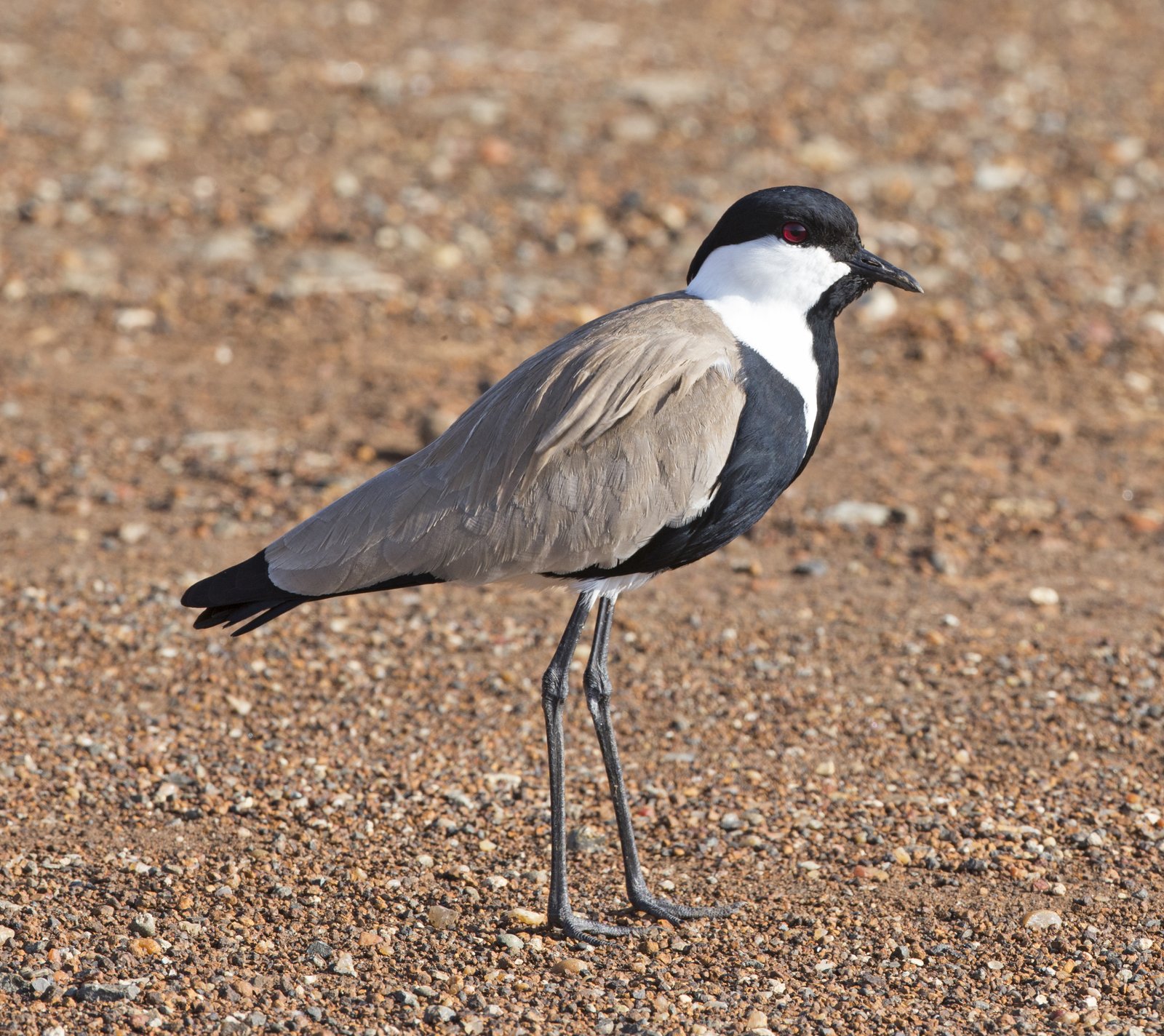
A contrasting black, white and brown lapwing that in Egypt is the wader of every ditch, field and canal bank. From the Nile Delta to Aswan, and in Israel and the Jordan Valley, it is one of the first birds a visitor notices, often noisy and not at all shy.
Voice
Very noisy. A sharp, metallic tik or kik and, when alarmed, a loud repeated chik-chik-chee-wee; around the nest a persistent screaming as the bird fiercely attacks intruders, including dogs and raptors.
Recording: He Wenjin/文进 — CC BY-NC-SA 4.0 · converted to mono · xeno-canto
Identification
A medium-sized, upright lapwing with a striking pattern: black crown with a short black nape plume, white cheeks and neck sides, a black stripe from chin to breast, and an entirely black breast and flanks. Belly and undertail coverts are white, upperparts plain sandy brown. Bill and legs black. In flight note the black flight feathers, a broad white band across the greater coverts, the white rump and the white tail with a broad black terminal band. The sharp spur at the bend of the wing is rarely visible in the field. Juveniles are duller, with brownish-black areas and pale fringes above; the sexes are alike.
Confusion species
Northern Lapwing (Vanellus vanellus), which winters on the same Egyptian and Levantine fields, has a long crest, a green-glossed back and only a black breast band. Red-wattled Lapwing (Vanellus indicus) of Iraq and the Gulf has a red wattle in front of the eye, a red bill base, yellow legs and a white belly. White-tailed Lapwing (Vanellus leucurus) lacks any black and has an all-white tail.
Habitat
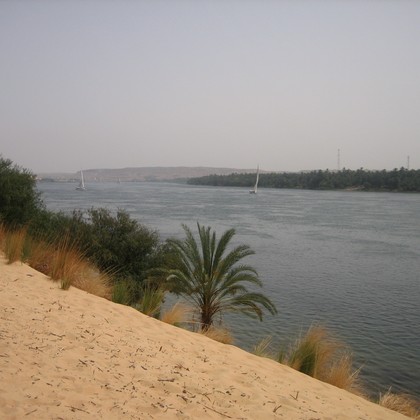
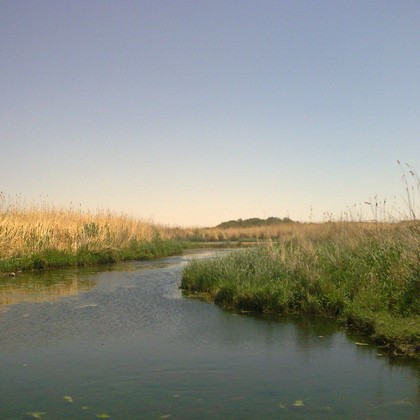
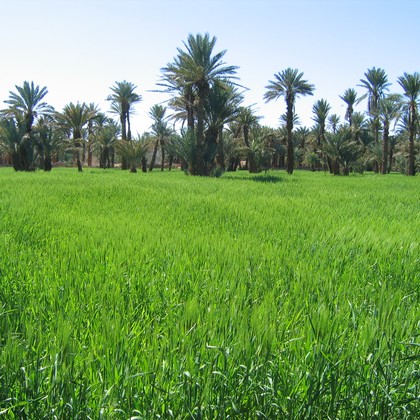
Banks of rivers, canals, lakes and fish ponds, irrigated fields, rice fields and pasture, salt marshes and coastal lagoons; in Egypt also sports grounds and town edges. Absent from true desert but present in oases with water. The nest is a scrape on bare ground, often close to water.
Where the bird is most at home, classified by the habitats of North Africa and the Middle East.
Range and movements
A common resident in Egypt: in the Nile Delta and the Nile valley to Aswan and Lake Nasser, in the Faiyum, along the Suez Canal and in the irrigated oases of the Western Desert; scarcer in northern Sinai. In Israel a common breeder of the coastal plain, the Jezreel Valley, the Hula Valley and Beit She'an, south through the Arava to Eilat; also in the Jordan Valley in Samaria and Judea and in Jordan (Jordan Valley, Azraq). In Syria it breeds along the coast and the Euphrates, in Lebanon only since 2006 (Tyre, Aammiq), where it is present from February to October. Scarce in Iraq along the Euphrates and Tigris. On the Arabian Peninsula, in Kuwait, the Gulf states and Oman a scarce winter visitor or vagrant; in Libya and the Maghreb a rare vagrant. Beyond the region it breeds in Turkey, Cyprus and Greece and in a broad belt from the Sahel to Kenya.
- Resident
- Summer visitor (c. Apr–Sep)
- Winter visitor (c. Oct–Mar)
- Passage (Mar–Apr, Oct–Nov)
- dark = core range, pale = thinly spread
How and when to look
From Cairo any canal bank in the Delta or the Faiyum will do; around Lake Qarun they stand on the fields in large numbers. In Israel the fish ponds of Ma'agan Michael and the Hula Valley are reliable, and near Eilat they frequent the KM 20 salt pans. Do not approach a pair with chicks too closely: the birds will also dive at people.
Conservation status
Not globally threatened and spreading in the Levant: in recent decades it has expanded in Israel, Lebanon and Cyprus, helped by irrigation and fish ponds. Locally hunting (Lebanon, Syria) and the loss of wet field margins threaten it.
Scientific name
Vanellus spinosus | (Linnaeus, 1758)
Linnaeus described the species in 1758 as Charadrius spinosus; because it was later moved to another genus, the author and year stand in brackets. The genus Vanellus was introduced in 1760 by Brisson. Vanellus is Latin for 'little fan', the diminutive of vannus 'winnowing fan'. spinosus is Latin for 'thorny', from spina 'thorn', after the sharp spur on the bend of the wing. The specimen the first description was based on came from Egypt.