All species › Owls › Typical owls › Spotted Eagle-Owl
Spotted Eagle-Owl | Bubo africanus
Afrikaanse oehoe | Búho africano
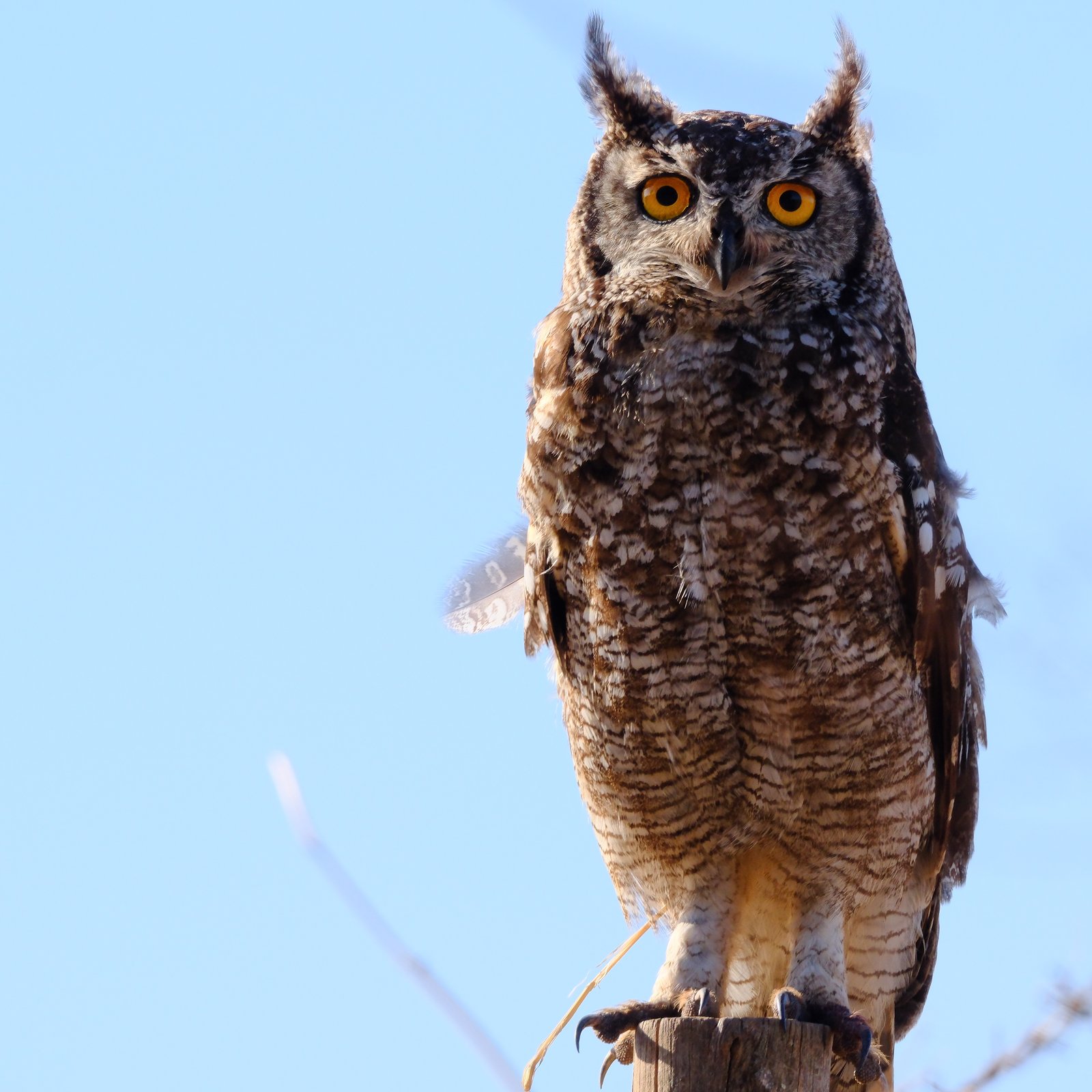
A medium-sized, grey-brown eagle-owl that in the region occurs only as the Arabian form milesi, a small, dark subspecies of the mountains and wadis of south-west Arabia and Oman. Some authors treat it as a separate species, Arabian Eagle-Owl (Bubo milesi). It is scarce, secretive and one of the least known owls of the region.
Voice
A soft, hollow two-note hoo-hooo, the second part lower, answered by the female with a three-note hoo-hoo-hoo; often in duet and mainly in the first hour after dusk. Alarm a hard, short wak; young beg with a hissing rasp.
Recording: Charles Hopkins — CC BY-NC-SA 4.0 · converted to mono · xeno-canto
Identification
Smaller than the other eagle-owls, with obvious ear tufts and yellow eyes. The upperparts are grey-brown with white and dark spotting; the underparts pale grey to off-white with dense, fine dark barring and a few coarser dark blotches on the upper breast. The face is grey with a dark rim. Arabian birds are smaller and darker than those of southern Africa, often with a warm ochre wash on the breast. In flight rather short-winged and big-headed, with barred flight feathers.
Confusion species
Pharaoh Eagle-Owl (Bubo ascalaphus) is larger and sandy, with orange eyes and streaks rather than bars on the breast; in the Arabian mountains both can occur in the same wadi. Long-eared Owl (Asio otus) has orange eyes, a slimmer build and streaked underparts. Desert Owl (Strix hadorami) and Omani Owl (Strix butleri) lack ear tufts.
Habitat
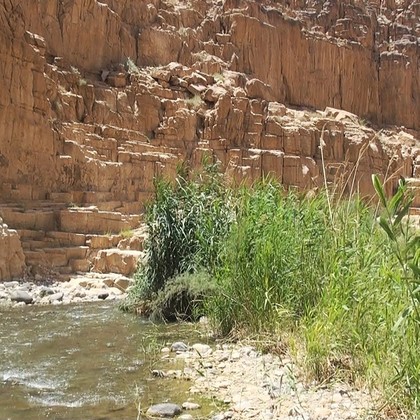
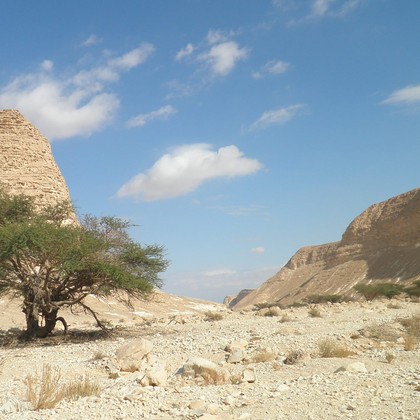
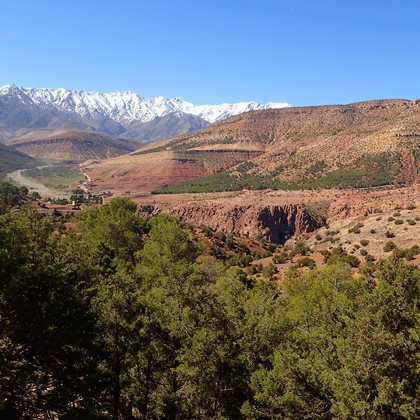
Rocky mountain slopes, deep gorges and wadis with acacias, figs and bushes, often near terraces, springs and villages, from sea level to over 2000 m; in Dhofar also in the monsoon woodland and ravines of the escarpment. The nest is on a ledge, in a hole or in an old raptor nest.
Where the bird is most at home, classified by the habitats of North Africa and the Middle East.
Range and movements
Within the region in the mountains of south-west Saudi Arabia (Asir and southern Hejaz), in the highlands and wadis of Yemen, in Oman in Dhofar and the Hajar Mountains, and in the Emirates, where it was first found in 2017 in the Hajar Mountains near Fujairah. Beyond the region the species occurs over much of sub-Saharan Africa, from Kenya and Gabon to South Africa.
- Summer visitor (c. Apr–Sep)
- Winter visitor (c. Oct–Mar)
- Passage (Mar–Apr, Oct–Nov)
- dark = core range, pale = thinly spread
How and when to look
In Dhofar calling birds can be heard in the escarpment wadis around Salalah, such as Wadi Darbat and Ayn Hamran, in the evening after the monsoon. In the Asir Mountains around Abha and in Yemen in deep wadis with acacias. It helps to choose a spot at dusk with a good view of a cliff and to listen.
Conservation status
Not globally threatened, but the Arabian population is small, scattered and poorly known. Possible threats are disturbance and loss of trees in wadis, rodent poisoning, traffic and power lines.
Scientific name
Bubo africanus | (Temminck, 1821)
Temminck described the species in 1821 as Strix africana; because it was later moved to another genus, the author and year stand in brackets. The genus Bubo was introduced in 1805 by Duméril. Bubo is the Latin word for the eagle-owl. africanus is Latin for 'African'. The specimen the first description was based on came from Cape of Good Hope.