All species › Owls › Typical owls › Pharaoh Eagle-Owl
Pharaoh Eagle-Owl | Bubo ascalaphus
Woestijnoehoe | Búho desértico
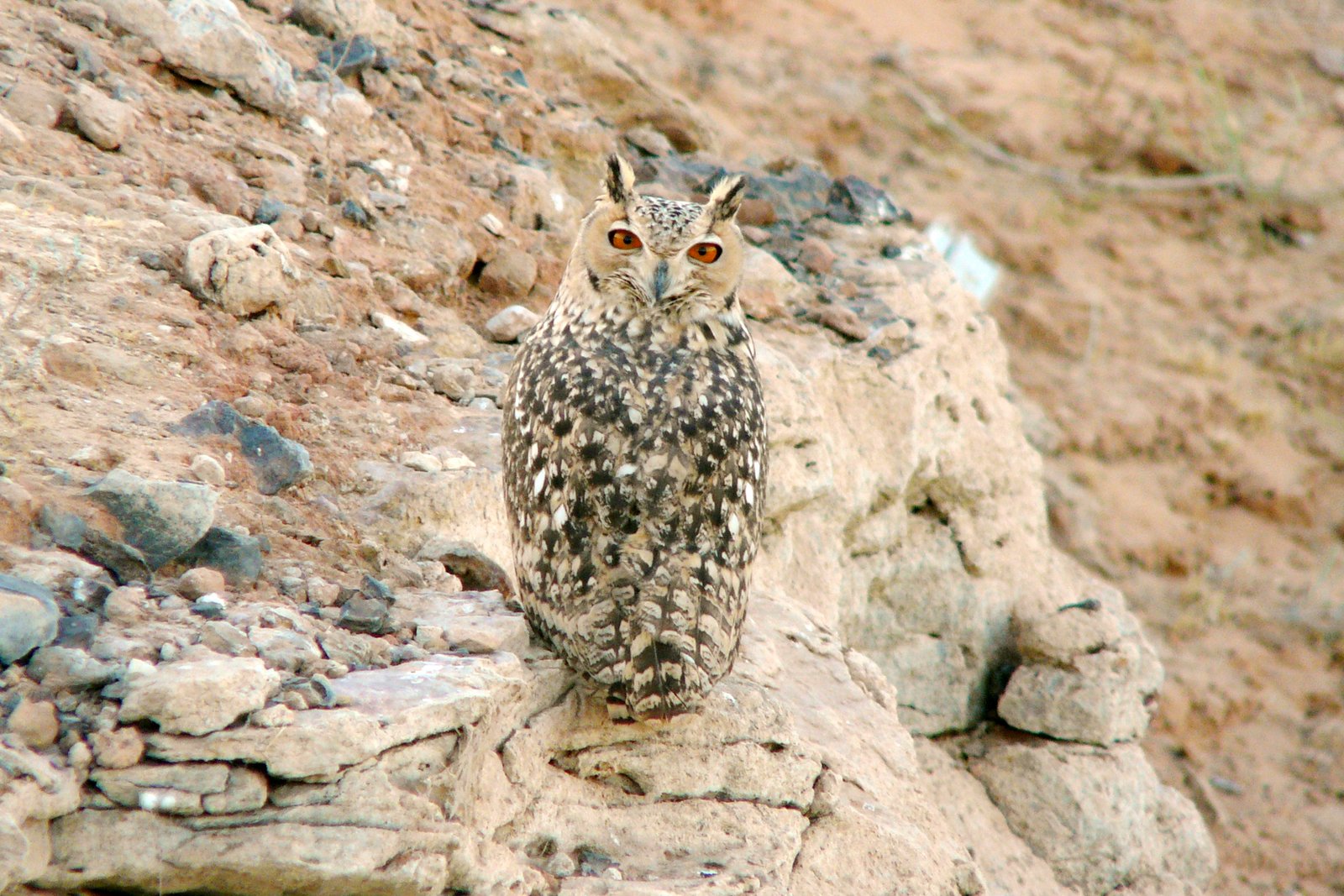
The eagle-owl of the desert: a large, pale, eared owl inhabiting rocky deserts and wadis from Morocco to Iraq and over most of Arabia. It is smaller and much paler than Eurasian Eagle-Owl, of which it was long treated as a subspecies, and hunts jerboas, gerbils, hedgehogs and birds at night.
Voice
A short, deep but fairly high-pitched whoo-oo or oo-hoo, shorter and less powerful than Eurasian Eagle-Owl, stressed at the end and carrying far; pairs duet. Alarm is a dog-like bark; young beg with a hoarse, hissing rasp.
Recording: Stanislas Wroza — CC BY-NC-SA 4.0 · shortened to the first 60 s, mono · xeno-canto
Identification
A large owl with short, often inconspicuous ear tufts and orange eyes. The upperparts are sandy to ochre-yellow with fine dark spotting, the underparts pale yellowish with thin, sharp streaks on the breast and very fine wavy barring on the belly; the facial disc is pale with a narrow dark rim. Birds of the Sahara and Arabia are the palest, almost sandy-white; those of northern Morocco and the Levant are darker and warmer. In flight broad and big-headed, with pale underwings and finely barred wingtips.
Confusion species
Eurasian Eagle-Owl (Bubo bubo) is much larger and darker, with heavier breast streaking, long ear tufts and a darker facial rim; both occur in the Levant, where intermediates are known. Spotted Eagle-Owl (Bubo africanus) of the Arabian mountains is smaller and greyer, with dense barring on the belly and yellow eyes. Long-eared Owl (Asio otus) also has ear tufts and orange eyes, but is half the size and slender.
Habitat
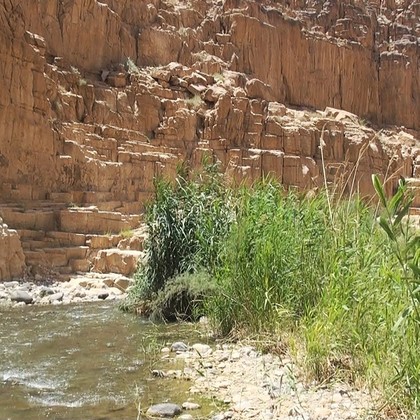
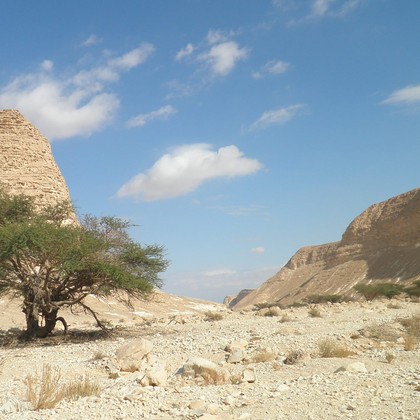
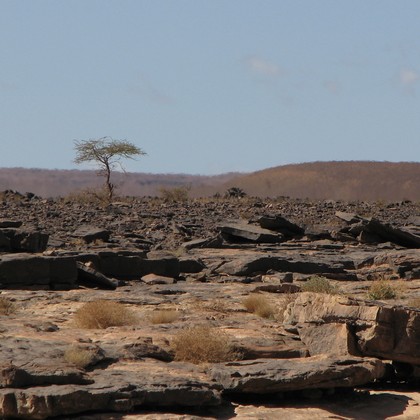
Rocky desert and semi-desert with gorges, wadis, cliffs and boulders, also ruins, quarries and old forts; in the Sahara and Arabia also near oases, date gardens and irrigated fields at the desert edge. The nest is on a ledge or in a hole in a cliff, sometimes on the ground among rocks.
Where the bird is most at home, classified by the habitats of North Africa and the Middle East.
Range and movements
In North Africa widespread in Morocco (including Western Sahara, mainly south and east of the Atlas and in the Anti-Atlas), the Saharan regions and Atlas foothills of Algeria, southern Tunisia, the Libyan desert and Egypt, where it occurs in the Western and Eastern Deserts, along the edge of the Nile valley and in Sinai. In the east it breeds in the Negev, the Arava and the Judean Desert in Israel, in Jordan (including Wadi Rum and Azraq), the desert steppe of Syria and the western and southern deserts of Iraq. In Arabia widespread through Saudi Arabia, Kuwait, Bahrain, Qatar, the Emirates and Oman, local and scarce in Yemen. Beyond the region from Mauritania and Mali to Chad and Sudan and in south-western Iran.
- Resident
- Summer visitor (c. Apr–Sep)
- Winter visitor (c. Oct–Mar)
- Passage (Mar–Apr, Oct–Nov)
- dark = core range, pale = thinly spread
How and when to look
Easiest at day roosts known to local guides, as in the Moroccan Sahara around Merzouga and Erfoud or in the gorges of the Anti-Atlas. In Israel and Jordan it calls after dusk in winter and early spring in the wadis of the Negev, the Arava and Wadi Rum. In daytime check rocky overhangs for white droppings and pellets.
Conservation status
Not globally threatened, but poorly studied in much of the region. Threats include rodent poisoning, shooting, traffic and power lines, which kill many owls; capture for trade and falconry plays a role in Arabia.
Scientific name
Bubo ascalaphus | de Savigny, 1809
De Savigny described the species in 1809 and placed it straight away in the genus where it still stands. The genus Bubo was introduced in 1805 by Duméril. Bubo is the Latin word for the eagle-owl. ascalaphus alludes to Ascalaphus of Greek myth, the son of Acheron who revealed that Persephone had eaten pomegranate seeds in the underworld and was turned into an eagle-owl for it. The specimen the first description was based on came from Upper Egypt.