All species › Passerines › Finches › Socotra Golden-Winged Grosbeak
Socotra Golden-Winged Grosbeak | Rhynchostruthus socotranus
Socotragoudvleugelvink | Picogordo de Socotora
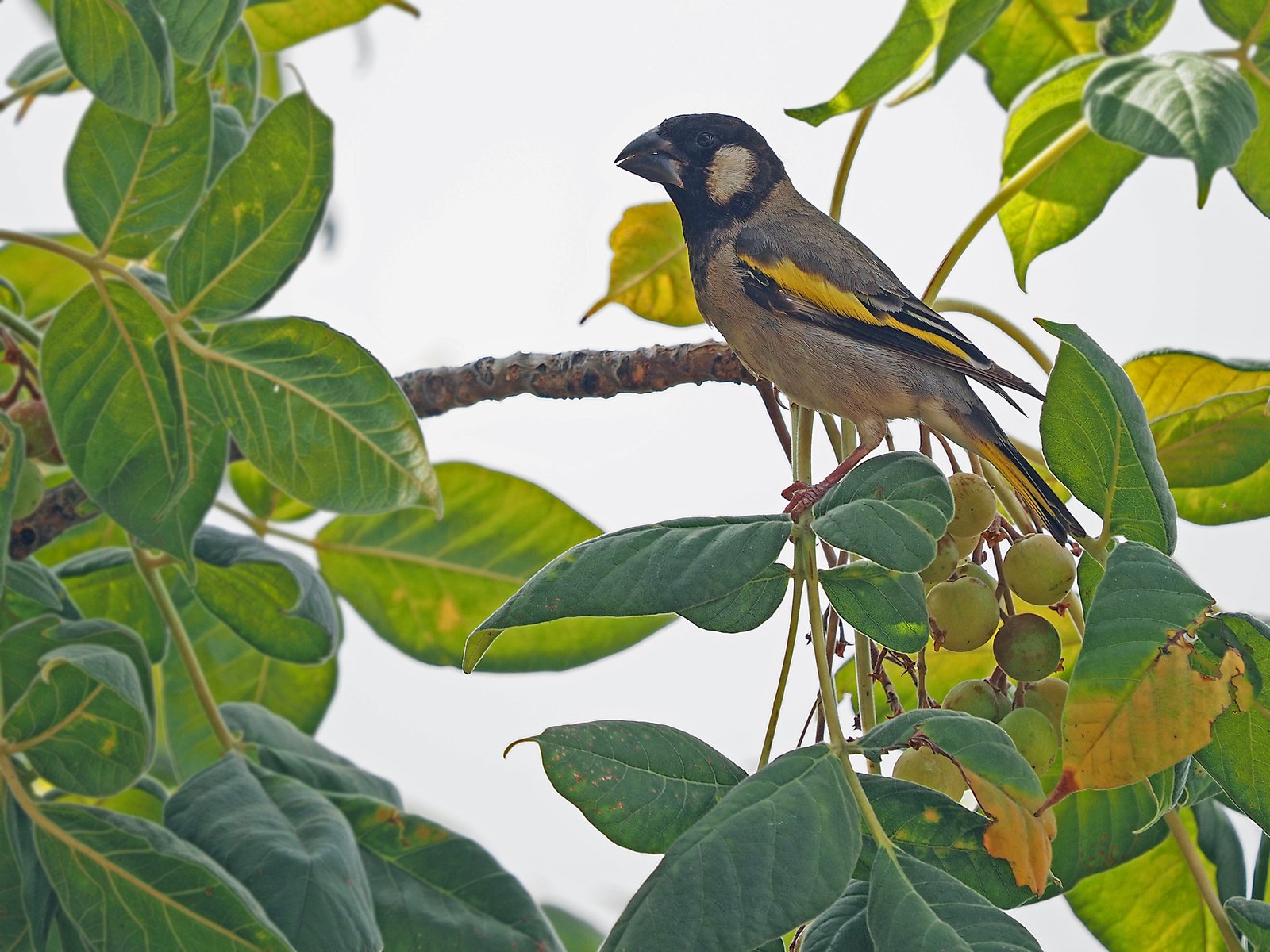
Socotra Golden-winged Grosbeak is a bulky finch with a massive black bill, a blackish head with a white cheek and large golden patches in wing and tail, found only on the island of Socotra. It is widespread there, from the coastal plain up into the Hajhir mountains.
Voice
A soft, whistled dwee-oo and nasal chwee calls, often in flight or between members of a pair. The song is a varied, canary-like twitter with whistled notes.
No recording with a suitable Creative Commons licence is available for this species yet.
Identification
14–15 cm, stocky, with a very heavy, conical black bill. The male is grey-brown, with a dark, blackish head, a black mask around eye and bill base and a large, sharply defined white cheek patch. A large bright yellow patch at the base of the primaries shows as a golden band in flight, and the sides of the tail are also yellow at the base. The female is duller and browner on the head, with less contrast and less yellow. Juveniles are streaked and lack the head pattern.
Confusion species
On Socotra no other finch has this bill and wing pattern. Socotra Sparrow (Passer insularis) and Socotra Bunting (Emberiza socotrana) are smaller, with a slim bill and no yellow in the wing. The male Arabian Golden-winged Grosbeak (Rhynchostruthus percivali) of the mainland has a brown head with a grey mask; the two species do not occur together.
Habitat
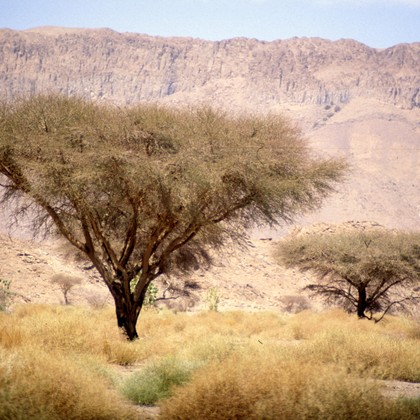
Dry scrub and open woodland from the coastal plain into the mountains, especially with tree spurges, acacias, Commiphora, frankincense trees and dragon's blood trees, on limestone plateaus, slopes and in wadis. It eats mainly fruits and seeds of these plants and comes to water to drink.
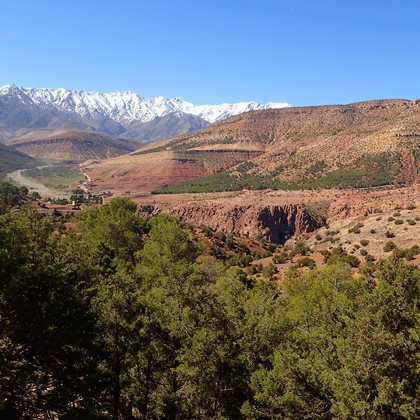
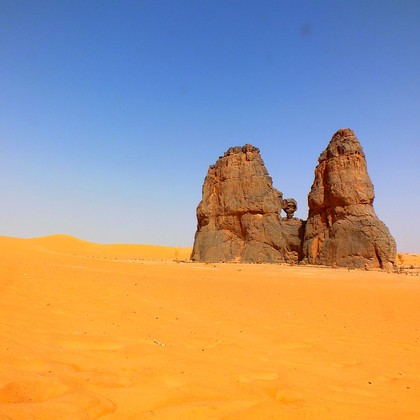
Where the bird is most at home, classified by the habitats of North Africa and the Middle East.
Range and movements
Endemic to Socotra (Yemen), where it occurs over almost the whole main island, from sea level up into the Hajhir mountains; absent from the smaller islands of the archipelago. Occurs nowhere else.
- Winter visitor (c. Oct–Mar)
- Passage (Mar–Apr, Oct–Nov)
- dark = core range, pale = thinly spread
How and when to look
Readily seen on the Diksam plateau and in the wadis at the foot of the Hajhir, especially at drinking places in the early morning. Also check the crowns of dragon's blood and frankincense trees; birds in flight give themselves away by the gold in the wing.
Conservation status
Not threatened. The population is estimated at about 6,500 adult birds. Overgrazing by goats, which prevents tree regeneration, and the decline of the old woodland remnants are the main long-term concerns.
Scientific name
Rhynchostruthus socotranus | Sclater & Hartlaub, 1881
Sclater & Hartlaub described the species in 1881 and placed it straight away in the genus where it still stands. He introduced the genus Rhynchostruthus in that same work. Rhynchostruthus is Greek, from rhunkhos 'bill' and strouthos 'sparrow', after the heavy bill. socotranus means 'of Socotra'. The specimen the first description was based on came from Goehel Valley, Socotra, Yemen.