All species › Passerines › Finches › Arabian Golden-Winged Grosbeak
Arabian Golden-Winged Grosbeak | Rhynchostruthus percivali
Arabische goudvleugelvink | Picogordo árabe
Arabian Golden-winged Grosbeak is a bulky, grey-brown finch with a massive black bill, a white cheek and large bright yellow patches in wing and tail. It occurs only in the mountains of south-western Arabia and Dhofar, everywhere at low density, and is one of the most sought-after species of the Arabian highlands.

Voice
The call is a soft, nasal chwee or a whistled dwee-oo, often in flight. The song is a varied, canary-like twitter of whistled and trilling notes, from a treetop or prominent branch.
Recording: Stanislas Wroza — CC BY-NC-SA 4.0 · converted to mono · xeno-canto
Identification
14–15 cm, stocky, with a strikingly heavy, conical black bill. The male is grey-brown, with a brown head, a dark grey mask around eye and bill base and a large white patch on the cheek. The flight feathers are dark with a large bright yellow patch at the base of the primaries, which shows as a golden band in flight; the tail also has yellow at the sides of the base. The female is duller, with a less sharply marked head and less yellow. Juveniles are streaked and lack the head pattern, but already show yellow in the wing.
Confusion species
Socotra Golden-winged Grosbeak (Rhynchostruthus socotranus) occurs only on Socotra; the male has a darker, blackish head with a black mask. Yemen Serin (Crithagra menachensis) and Arabian Serin (Crithagra rothschildi) are much smaller, with a slim bill and no yellow in the wing. European Greenfinch (Chloris chloris) does not occur in the same area. The combination of heavy black bill, white cheek and golden wing patch is unmistakable.
Habitat
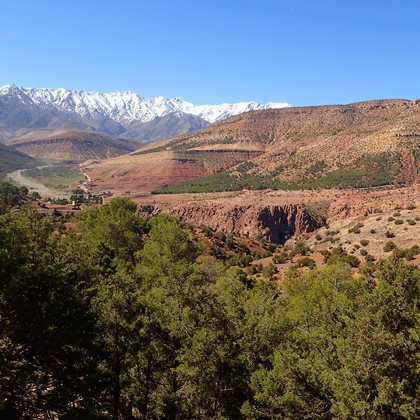
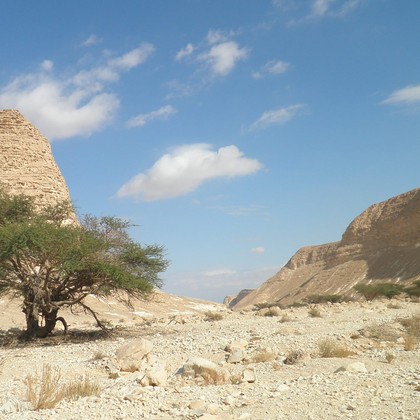
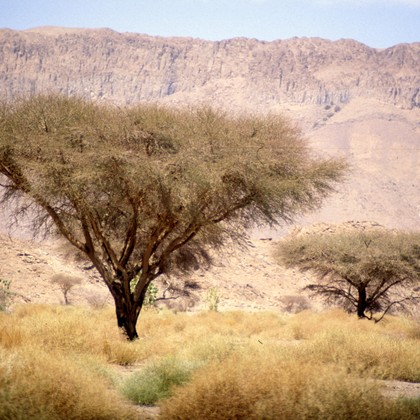
Vegetated wadis and slopes in the highlands, roughly between 1,000 and 2,800 m: in Saudi Arabia mainly the remnants of juniper forest, in Yemen tree-spurge scrub and acacia-juniper woodland, in Mahra and Dhofar dry woodland with Anogeissus and Commiphora. It eats mainly fruits and seeds of juniper, acacia and spurge, and visits water.
Where the bird is most at home, classified by the habitats of North Africa and the Middle East.
Range and movements
Endemic to Arabia: in Saudi Arabia in the Asir highlands (including around Abha, Tanomah and Raydah), the northernmost record being one or two birds near Ta'if in April 1996; in Yemen in the western highlands and in Mahra in the east; in Oman in the mountains of Dhofar. Local and at low density throughout. Occurs nowhere else.
- Winter visitor (c. Oct–Mar)
- Passage (Mar–Apr, Oct–Nov)
- dark = core range, pale = thinly spread
How and when to look
Visit a wadi with junipers or flowering spurges in Asir early in the morning, or the wooded wadis on the slopes of Dhofar. Watch for birds coming to drink at a spring or water trough; in flight the gold in the wing is obvious at once. It is shy and often seen only as a briefly flashing yellow panel.
Conservation status
Near Threatened. The world population is estimated at about 9,000 birds, spread at low density. Loss and die-back of juniper forest in Asir, tree cutting, overgrazing and disturbance are the main threats. Little is known of the situation in Yemen since the war.
Scientific name
Rhynchostruthus percivali | Ogilvie-Grant, 1900
Ogilvie-Grant described the species in 1900 and placed it straight away in the genus where it still stands. The genus Rhynchostruthus was introduced in 1881 by Sclater & Hartlaub. Rhynchostruthus is Greek, from rhunkhos 'bill' and strouthos 'sparrow', after the heavy bill. percivali honours the British naturalist Arthur Blayney Percival (1874–1940), who collected birds in southern Arabia in 1899. The specimen the first description was based on came from Yeshbum, Hadhramaut, Yemen.