All species › Gamebirds › Pheasants and partridges › See-See Partridge
See-See Partridge | Ammoperdix griseogularis
Perzische woestijnpatrijs | Perdiz persa
The eastern counterpart of Sand Partridge: a small, sandy-grey gamebird of the dry hills of northern Iraq and eastern Syria, at the western edge of a range reaching into Central Asia. It is one of the least observed gamebirds of the region, because its habitat could hardly be visited by birders in recent decades.
Voice
A repeated, whistled and slightly nasal wuit-wuit or hoo-weet, mainly at dawn and towards evening from a boulder; a flushing covey gives a quick, thin see-see-see, which gave the species its English name.
Recording: Patrik Åberg — CC BY-NC-SA 4.0 · shortened to the first 60 s, mono · xeno-canto
Identification
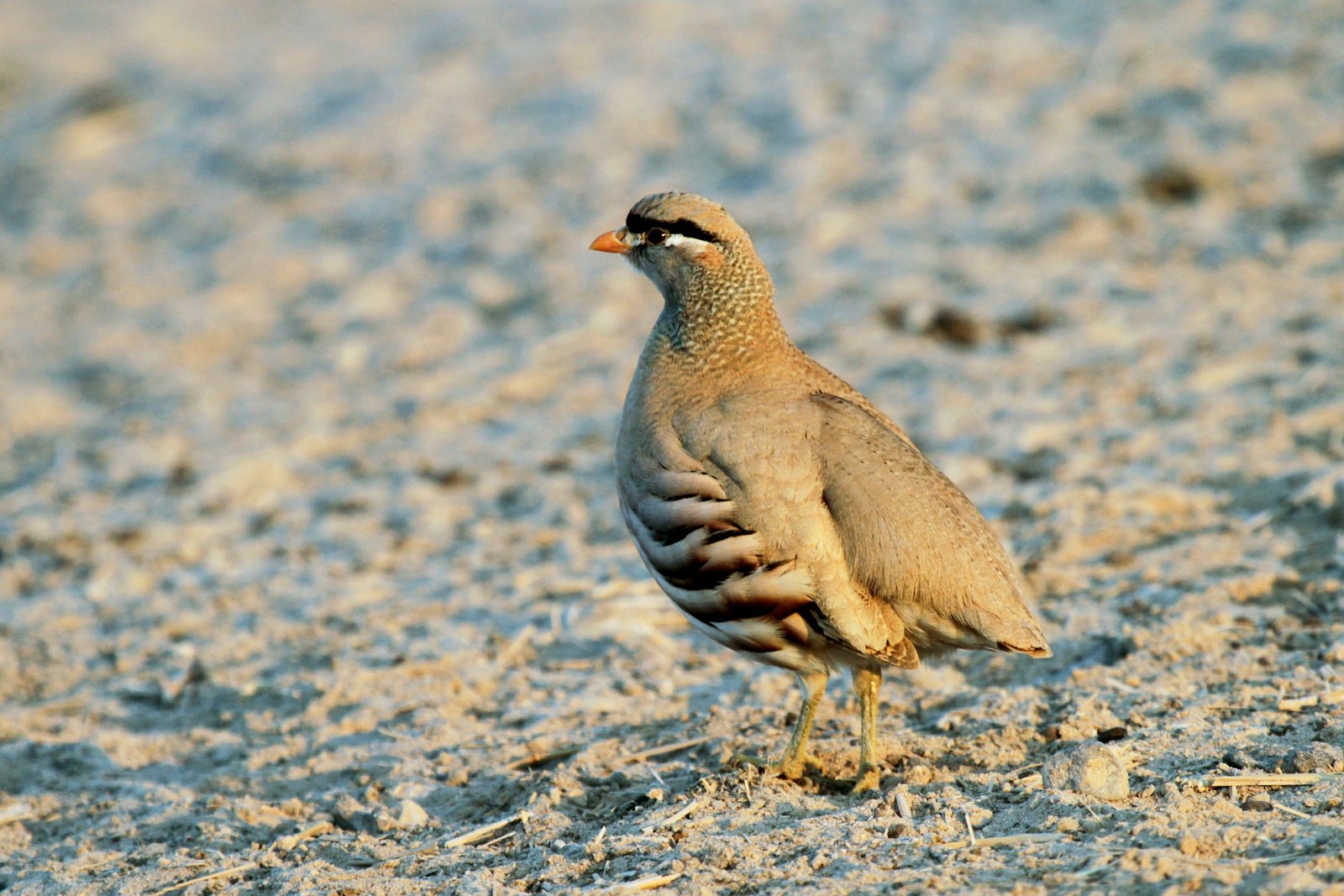
About 24 cm, round and short-tailed. The male has a grey head with a black band across the forehead that continues back as a narrow black stripe through the eye, with a white stripe along the cheek below it. The throat is grey, the neck sides vinaceous with white spots, the breast pinkish grey. The flanks carry broad bars of chestnut, black and creamy white; the upperparts are plain sandy grey with fine vermiculation. Bill orange, legs yellowish. The female is plain sandy and finely vermiculated, without head stripes, with dense fine barring on neck and breast. In flight the outer tail feathers are rufous.
Confusion species
Sand Partridge (Ammoperdix heyi) is its closest relative and replaces it to the south-west; their ranges barely overlap in the region. Its male lacks the black forehead band and eye-stripe and has instead a white spot in front of the eye and a white ear patch. Females of the two species are barely separable in the field: use location. Chukar Partridge (Alectoris chukar) shares the Kurdish hills but is almost twice the size, with red bill, red legs and a black-bordered creamy-white throat.
Habitat
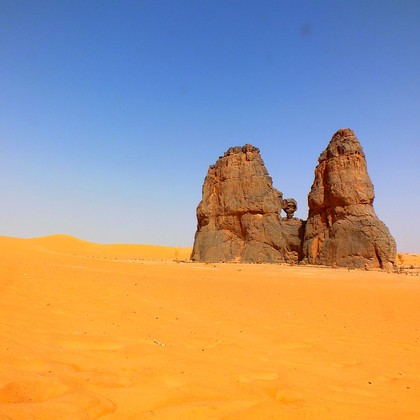
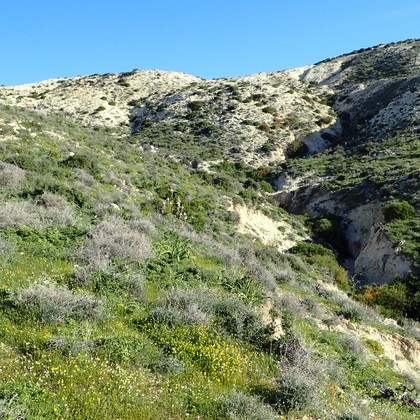
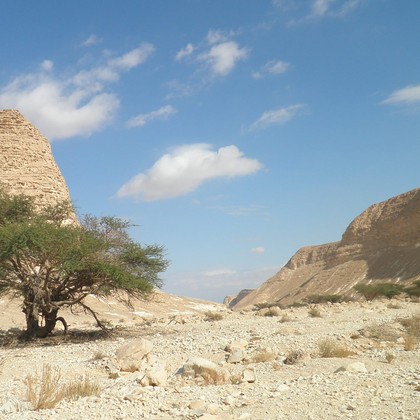
Dry, bare to sparsely vegetated hills and low mountains with boulders, scree slopes, ravines and the beds of dry streams, also steppe slopes with scattered dwarf shrubs and the edges of dry fields. Usually between 200 and 2,000 metres. Water within walking distance is essential; coveys walk to springs and pools in the morning and evening. Eats seeds, green plant matter and insects.
Where the bird is most at home, classified by the habitats of North Africa and the Middle East.
Range and movements
Within the region in northern and eastern Iraq, in the foothills of the Kurdish and Zagros ranges, on Jebel Sinjar and in the Jebel Hamrin hills, and in northern and eastern Syria, including Jebel Abd al-Aziz and the hills east of the Euphrates. The present status in both countries is poorly known. Beyond the region in south-eastern Turkey and through Iran and Afghanistan to Pakistan, Turkmenistan and Tajikistan.
- Resident
- Summer visitor (c. Apr–Sep)
- Winter visitor (c. Oct–Mar)
- Passage (Mar–Apr, Oct–Nov)
- dark = core range, pale = thinly spread
How and when to look
Where it is safe and permitted: Iraqi Kurdistan, at dawn on a lookout above a dry, rocky ravine in the low foothills. Listen for the whistled call, then scan the boulders. Anyone who finds a spring or water trough can watch coveys arrive there early in the morning.
Conservation status
Not globally threatened. In Iraq and Syria the species is under pressure from intensive hunting, including with decoy birds, and from overgrazing; because of insecurity in recent decades almost nothing is known about trends in the region.
Scientific name
Ammoperdix griseogularis | (Brandt, 1843)
Brandt described the species in 1843 as Perdix griseogularis; because it was later moved to another genus, the author and year stand in brackets. The genus Ammoperdix was introduced in 1851 by Gould. Ammoperdix is Greek, from ammos 'sand' and perdix 'partridge': the partridge of the sand. griseogularis is Latin for 'grey-throated', from griseus 'grey' and gularis 'of the throat'. The specimen the first description was based on came from Iran.