All species › Waders, gulls and terns › Gulls and terns › Saunders's Tern
Saunders's Tern | Sternula saundersi
Saunders' dwergstern | Charrancito de Saunders
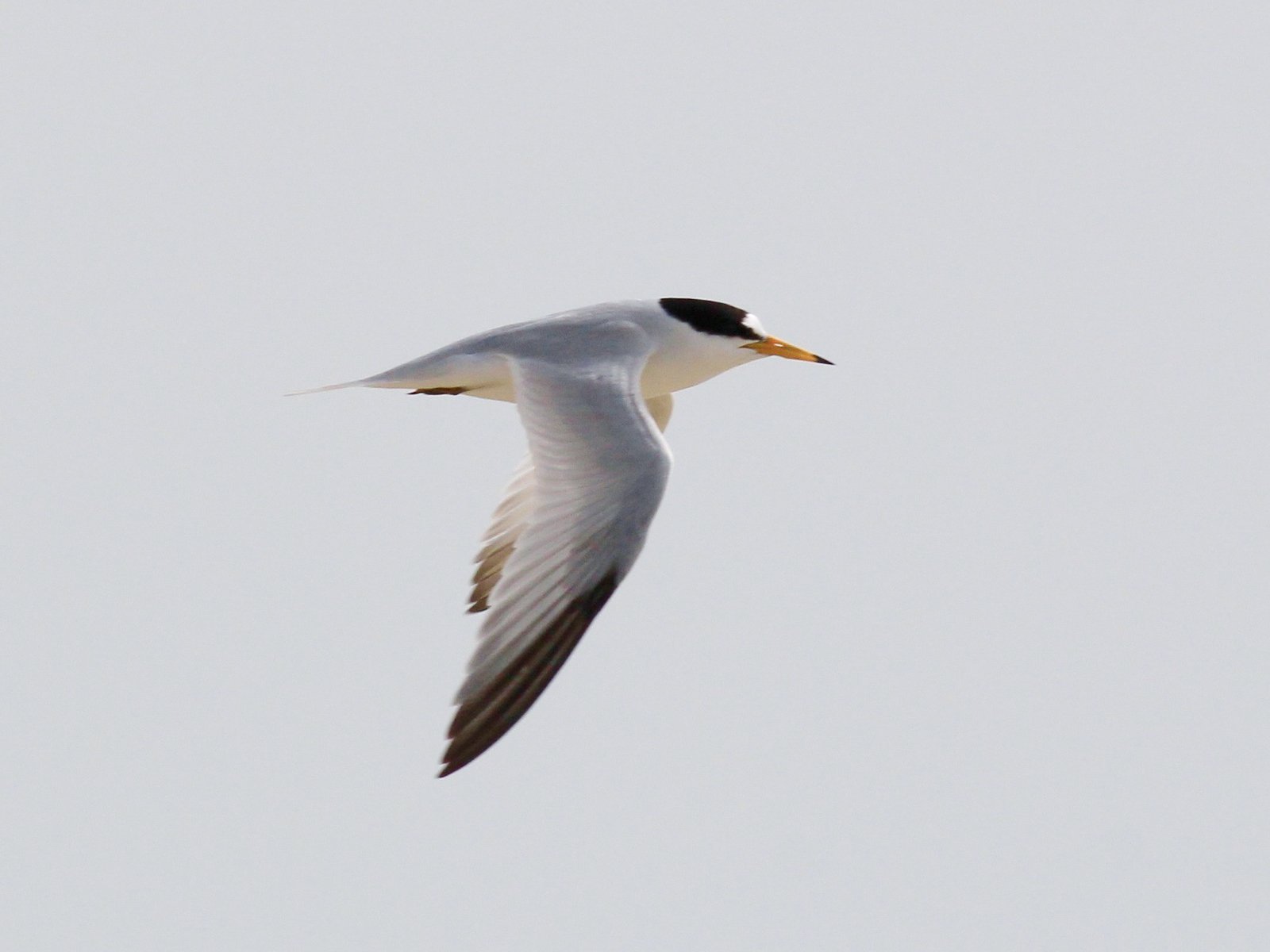
The little tern of the warm Arabian coasts, the Red Sea and the Gulf of Aden, where it largely replaces Little Tern as a breeding bird. It is very similar and is sometimes regarded as a subspecies of it; it can be identified with certainty only in breeding plumage and with a good view of rump and wings.
Voice
A sharp, short keet or cheet and a dry chatter; according to some observers slightly lower and harsher than in Little Tern.
Recording: David Darrell-Lambert — CC BY-NC-SA 4.0 · converted to mono · xeno-canto
Identification
Small and slender, pale grey above and white below. In the breeding season a black cap with a small, square white forehead patch that does not reach behind the eye. Rump and central tail feathers grey, as pale as the back. The three or four outer primaries are blackish with dark shafts and form a clear dark wedge at the wingtip. Bill yellow with a black tip, often slightly darker than in Little Tern; legs dull brownish, olive or orange-brown. Outside the breeding season the forehead is white and the bill dark, and it is almost impossible to tell from Little Tern.
Confusion species
Little Tern (Sternula albifrons) has a white rump and tail, a white forehead patch tapering to a point behind the eye, only two or three dark outer primaries with pale shafts and bright orange-yellow legs; its call is slightly higher. White-cheeked Tern (Sterna repressa) and other terns in the region are much larger.
Habitat
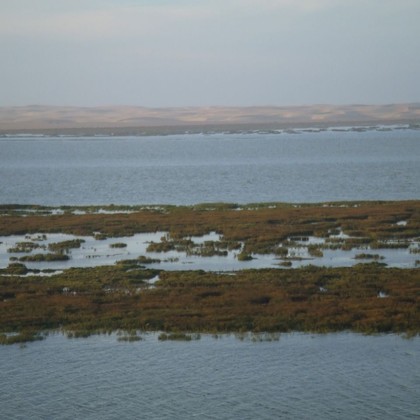
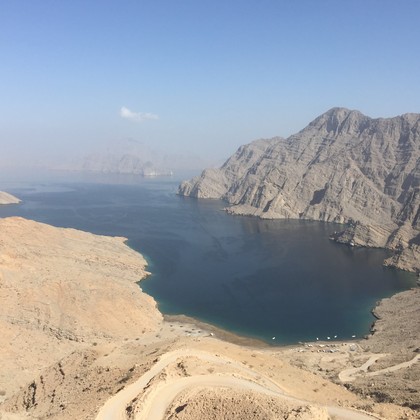
Sandy beaches, shell banks, bare sand flats and sandy islets on warm sea coasts, also sebkhas behind the coast and creeks with mangroves. Feeds over shallow, clear water near the shore and in lagoons. Breeds in small, loose colonies, often together with other terns or plovers.
Where the bird is most at home, classified by the habitats of North Africa and the Middle East.
Range and movements
Breeds along the coasts of the Arabian Peninsula: in the Persian Gulf (Kuwait, Bahrain, Qatar, the east coast of Saudi Arabia and the UAE), along the Gulf of Oman and the Arabian Sea coast of Oman, in Yemen, on Socotra and along the Saudi and Yemeni Red Sea coast. In Egypt known as a breeder only since 2014–2015, at Ras Sudr on the Gulf of Suez and on Ras Matarma island; this population appears to be increasing. Rare in the Gulf of Aqaba (Eilat). Most birds leave the region in winter, but a few stay on the Red Sea and Arabian Sea. Beyond the region it breeds along the Red Sea coast of Sudan and Eritrea, in Somalia, Pakistan and western India, and winters along the East African coast south to Mozambique.
- Resident
- Summer visitor (c. Apr–Sep)
- Winter visitor (c. Oct–Mar)
- Passage (Mar–Apr, Oct–Nov)
- dark = core range, pale = thinly spread
How and when to look
The coast of Barr al Hikman and Masirah Island in Oman, the sand flats of Khor Kalba and Abu Dhabi in the UAE and the beaches of Bahrain are good sites in May and June. In mixed flocks check the rump: grey in Saunders's, white in Little Tern.
Conservation status
Not globally threatened, but numbers are poorly known, partly because of the difficult identification. Breeding sites on beaches and sand flats are threatened by coastal development, off-road vehicles on beaches, recreation and disturbance by dogs and cats.
Scientific name
Sternula saundersi | (Hume, 1877)
Hume described the species in 1877 as Sterna Saundersi; because it was later moved to another genus, the author and year stand in brackets. The genus Sternula was introduced in 1822 by Boie. Sternula is a Latin diminutive of Sterna and so means 'little tern'. saundersi honours the British ornithologist Howard Saunders (1835–1907), a specialist in gulls and terns. The specimen the first description was based on came from Karachi, Sindh, Pakistan.