All species › Waders, gulls and terns › Gulls and terns › Caspian Tern
Caspian Tern | Hydroprogne caspia
Reuzenstern | Pagaza piquirroja
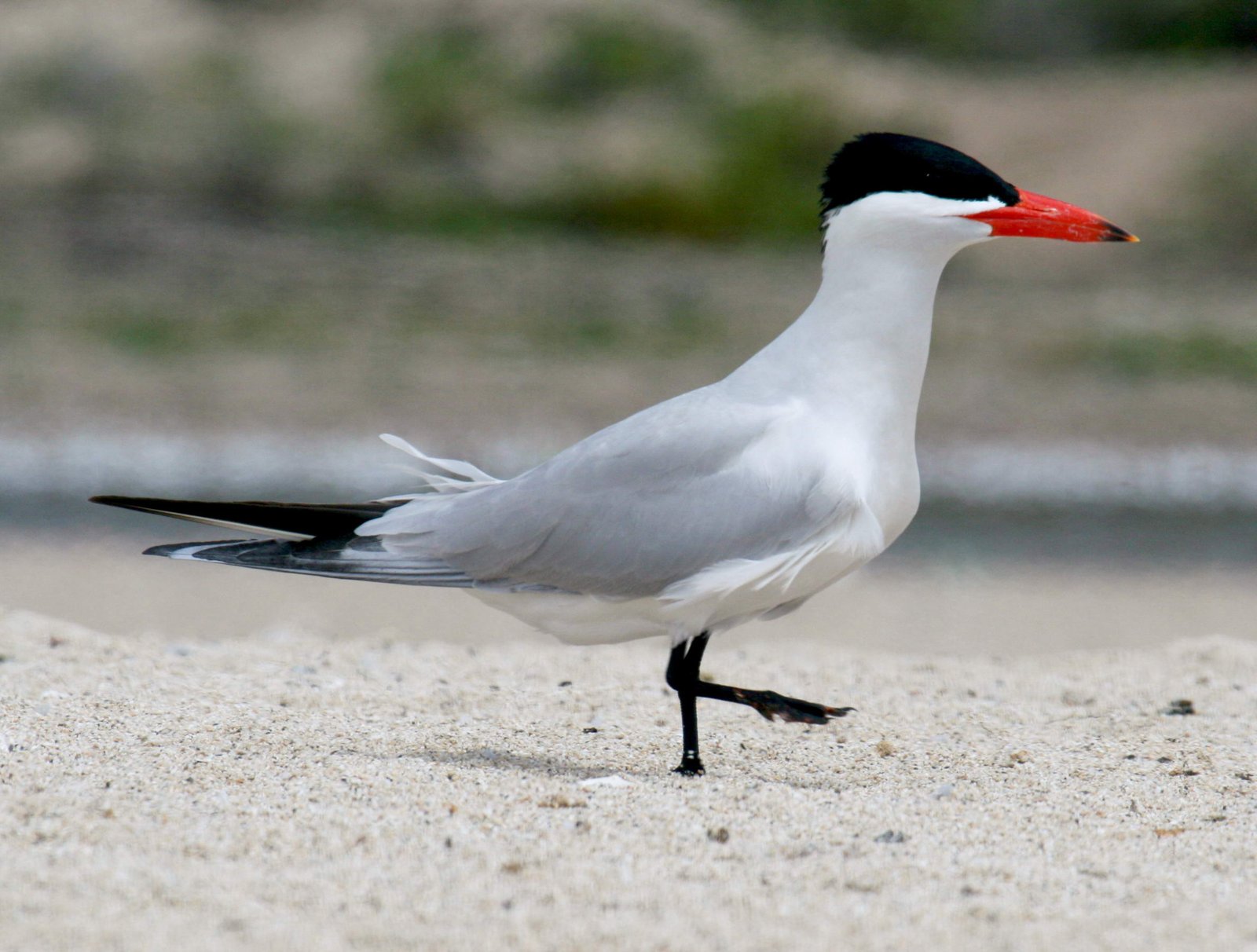
The largest tern in the world, as big as a medium-sized gull, with a huge coral-red bill. In the region it breeds in colonies on islands in the Red Sea, the Persian Gulf and the Arabian Sea and in small numbers in Tunisia, and in winter it is found along almost all coasts and on larger inland waters.
Voice
A very loud, raw and hoarse kraa-ah or krrrjaa, heron-like; juveniles beg with a high, whistled wee-oo, even in winter.
Recording: Clément Bruneau — CC BY-NC-SA 4.0 · converted to mono · xeno-canto
Identification
Large and heavily built, with broad wings. Pale grey above and white below; in the breeding season a full black cap with a short, shaggy crest. The heavy, dagger-shaped bill is coral to blood red with a dark smudge near the tip. Legs black. In winter the cap is white with fine black streaks. From below the primaries are strikingly dark, giving a dark wingtip in flight. Short, shallowly forked tail. Juveniles have a brownish-marked back and a more orange bill.
Confusion species
Greater Crested Tern (Thalasseus bergii) is smaller and slimmer, with a yellow bill, a darker grey mantle and a white forehead patch; Royal Tern (Thalasseus maximus), a vagrant, has a slimmer orange bill, a whiter forehead outside the early breeding season and pale underwing tips. Gull-billed Tern (Gelochelidon nilotica) has a short black bill. Young gulls such as Sooty Gull (Ichthyaetus hemprichii) are bulkier and fly differently.
Habitat
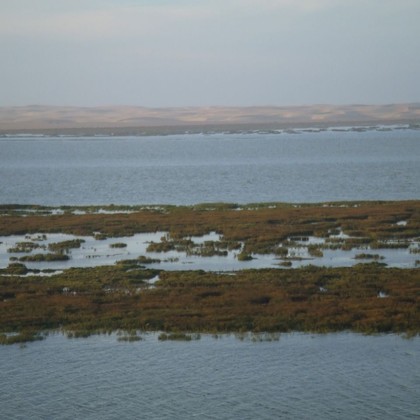
Coastal lagoons, tidal flats, salt pans and estuaries; in winter also large lakes, reservoirs and rivers inland, such as the Nile and Lake Nasser. Plunges for fish with a firm dive. Breeds in colonies on bare, sandy or rocky islands.
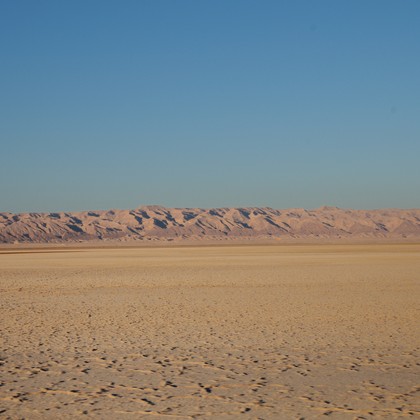
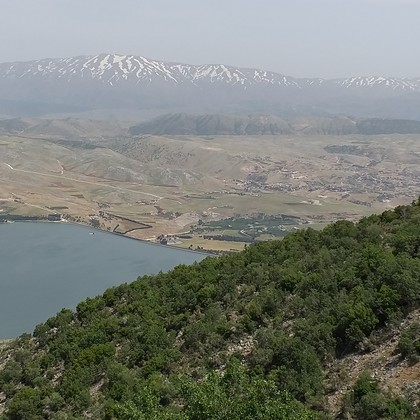
Where the bird is most at home, classified by the habitats of North Africa and the Middle East.
Range and movements
In North Africa a small colony breeds in Tunisia; otherwise it is mainly a winter visitor here along the coasts of Morocco (especially the Atlantic coast south to Western Sahara), Algeria, Tunisia, Libya and Egypt, where it also winters on the delta lakes and along the Nile. In the Red Sea it breeds on sandy islands along the Egyptian coast (including Ashrafi, Gifton, Wadi El Gemal and the Hamata islands, about 60 pairs, with a remarkably early breeding season from December) and along the Saudi and Yemeni coasts. It also breeds on islands in the Persian Gulf (Bahrain, Saudi Arabia, Qatar, the UAE) and along the coast of Oman, including at Barr al Hikman. In Israel, Lebanon, Syria, Iraq and Kuwait mainly a passage migrant and winter visitor. Beyond the region it breeds patchily in Europe (Baltic, Black Sea), Central Asia, Australia, North America and western, eastern and southern Africa.
- Resident
- Summer visitor (c. Apr–Sep)
- Winter visitor (c. Oct–Mar)
- Passage (Mar–Apr, Oct–Nov)
- dark = core range, pale = thinly spread
How and when to look
In winter they are easy to see in the Gulf of Gabès and at Sfax in Tunisia, at Lake Burullus in Egypt and along Khnifiss lagoon and Dakhla in southern Morocco. In the Gulf they rest at low tide on the sand flats of Al Jahra (Kuwait) and Ras al-Khor (Dubai).
Conservation status
Not globally threatened and increasing in parts of its range. In the region the colonies are small and vulnerable to disturbance of breeding islands by tourism and fishermen, egg collecting and coastal development; the Egyptian Red Sea islands lie largely within protected areas.
Scientific name
Hydroprogne caspia | (Pallas, 1770)
Pallas described the species in 1770 as Sterna caspia; because it was later moved to another genus, the author and year stand in brackets. The genus Hydroprogne was introduced in 1829 by Kaup. Hydroprogne joins Greek hudro- 'water' to Latin progne 'swallow'. caspia is Latin and refers, like the English name, to the Caspian Sea. The specimen the first description was based on came from Caspian Sea.