All species › Waders, gulls and terns › Gulls and terns › Little Tern
Little Tern | Sternula albifrons
Dwergstern | Charrancito común
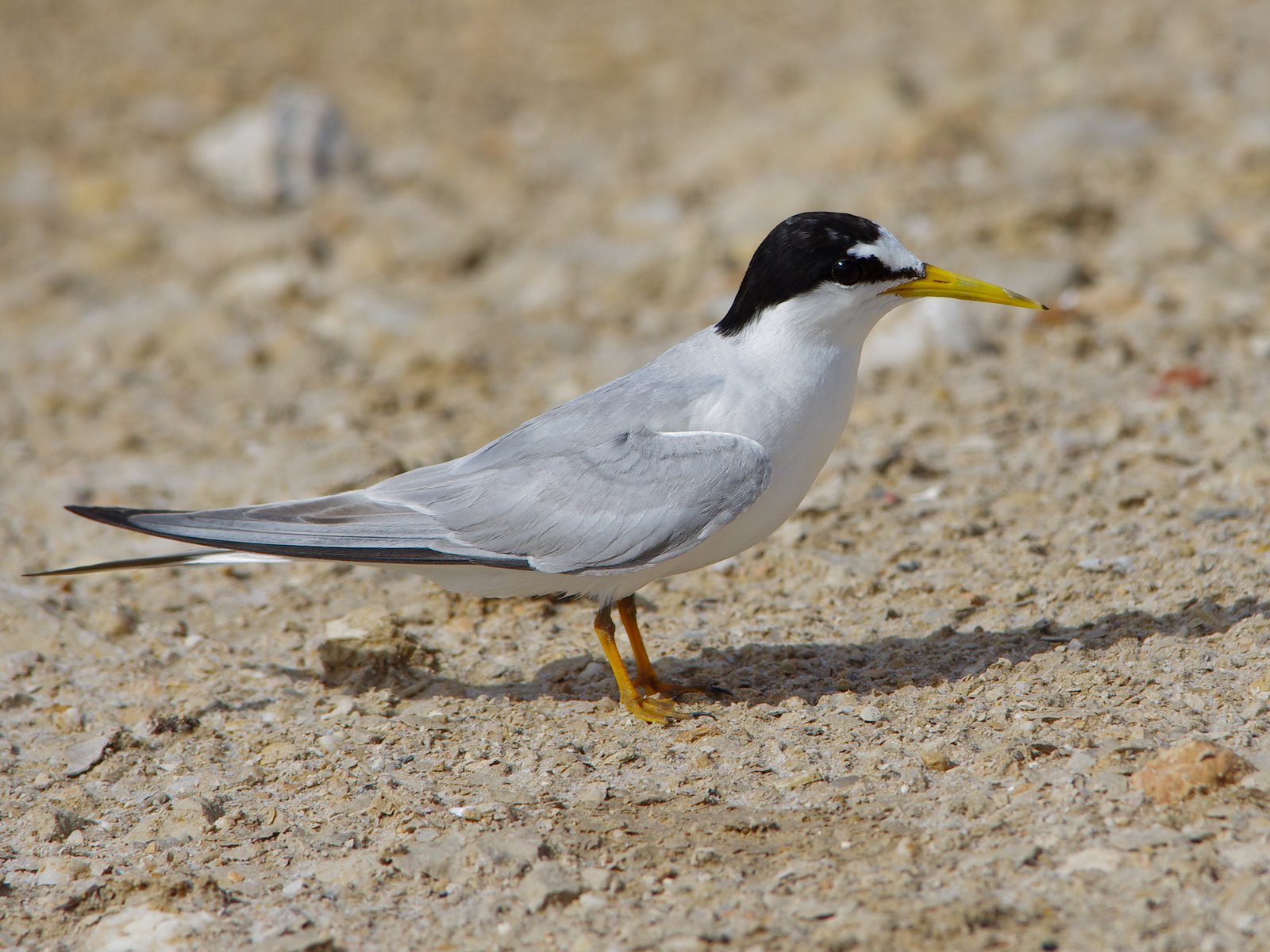
The smallest tern of the region, a lively bird with rapid wingbeats that hovers over shallow water and then drops like an arrow. It breeds patchily along the North African coasts, in the Nile delta and valley, in the Levant and in Mesopotamia, and passes in large numbers through the Red Sea and the Gulf.
Voice
A high, sharp kree-ik or kit, and a fast, busy chattering kirri-kirri-kirri at the colony.
Recording: Ricardo Hevia — CC BY-NC-SA 4.0 · converted to mono · xeno-canto
Identification
Small and slender, pale grey above and white below. In the breeding season a black cap with a sharply defined white forehead patch reaching above the eye and tapering to a point behind; the yellow bill has a black tip, the legs are orange-yellow. Rump and tail white, the tail shortly forked. In flight the two or three dark outer primaries show as a narrow black wedge on the leading edge. Outside the breeding season and in juveniles the forehead is extensively white, the bill dark and a dark bar across the lesser coverts is visible.
Confusion species
Saunders's Tern (Sternula saundersi) is very similar; in the breeding season it has a smaller, square white forehead patch that does not reach behind the eye, grey rather than white rump and central tail feathers, three or four blacker outer primaries with dark shafts, and duller, brownish or olive legs. Outside the breeding season the two often cannot be separated with certainty. All other terns in the region are clearly larger.
Habitat
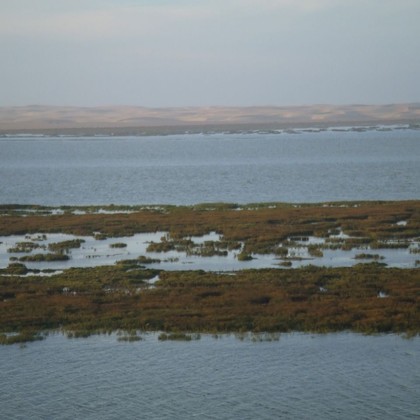
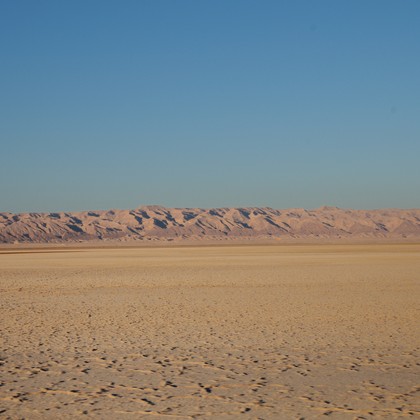
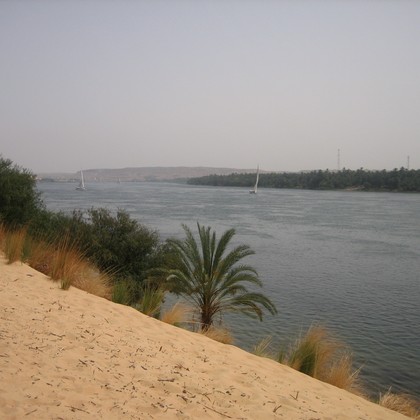
Sandy beaches, shell banks and bare shores of coastal lagoons, salt pans and sebkhas; in Egypt and Iraq also sandbars in rivers, irrigation canals and inland lakes. Feeds over shallow, clear water. Breeds in loose colonies on bare, open ground.
Where the bird is most at home, classified by the habitats of North Africa and the Middle East.
Range and movements
Breeds in North Africa along the coast of Morocco (including the Moulouya estuary and Merja Zerga), Algeria and Tunisia (Gulf of Gabès, Kneiss), locally in Libya, and in Egypt in the Nile delta, along the Mediterranean coast (Lake Bardawil) and in the Nile valley. In the east it breeds in small numbers in Israel, Syria and Lebanon, and in Iraq in the Mesopotamian marshes and along the Euphrates and Tigris; also in Kuwait. A passage migrant along all coasts, including the Red Sea and the Persian Gulf, where a few winter. In Arabia it is largely replaced as a breeder by Saunders's Tern. Beyond the region it breeds from Europe to Japan and Australia and winters along the coasts of Africa and South Asia.
- Resident
- Summer visitor (c. Apr–Sep)
- Winter visitor (c. Oct–Mar)
- Passage (Mar–Apr, Oct–Nov)
- dark = core range, pale = thinly spread
How and when to look
In Egypt they are easy to see in summer at Lake Manzala and Lake Burullus in the Nile delta. In Morocco they breed on the beaches at the mouth of the Moulouya. In Arabia and the Red Sea check the rump and primaries carefully: there it overlaps with Saunders's Tern.
Conservation status
Not globally threatened, but sensitive in the Mediterranean. Beach breeding sites are threatened by tourism, beach recreation, loose dogs, coastal building and fluctuating water levels; in the Nile delta also by the conversion of lakes into fish farms.
Scientific name
Sternula albifrons | (Pallas, 1764)
Pallas described the species in 1764 as Sterna albifrons; because it was later moved to another genus, the author and year stand in brackets. The genus Sternula was introduced in 1822 by Boie. Sternula is a Latin diminutive of Sterna and so means 'little tern'. albifrons is Latin, from albus 'white' and frons 'forehead', after the white forehead below the black cap. The specimen the first description was based on came from the Meuse region, Netherlands.