All species › Passerines › Chats and flycatchers › Red-Breasted Flycatcher
Red-Breasted Flycatcher | Ficedula parva
Kleine vliegenvanger | Papamoscas papirrojo
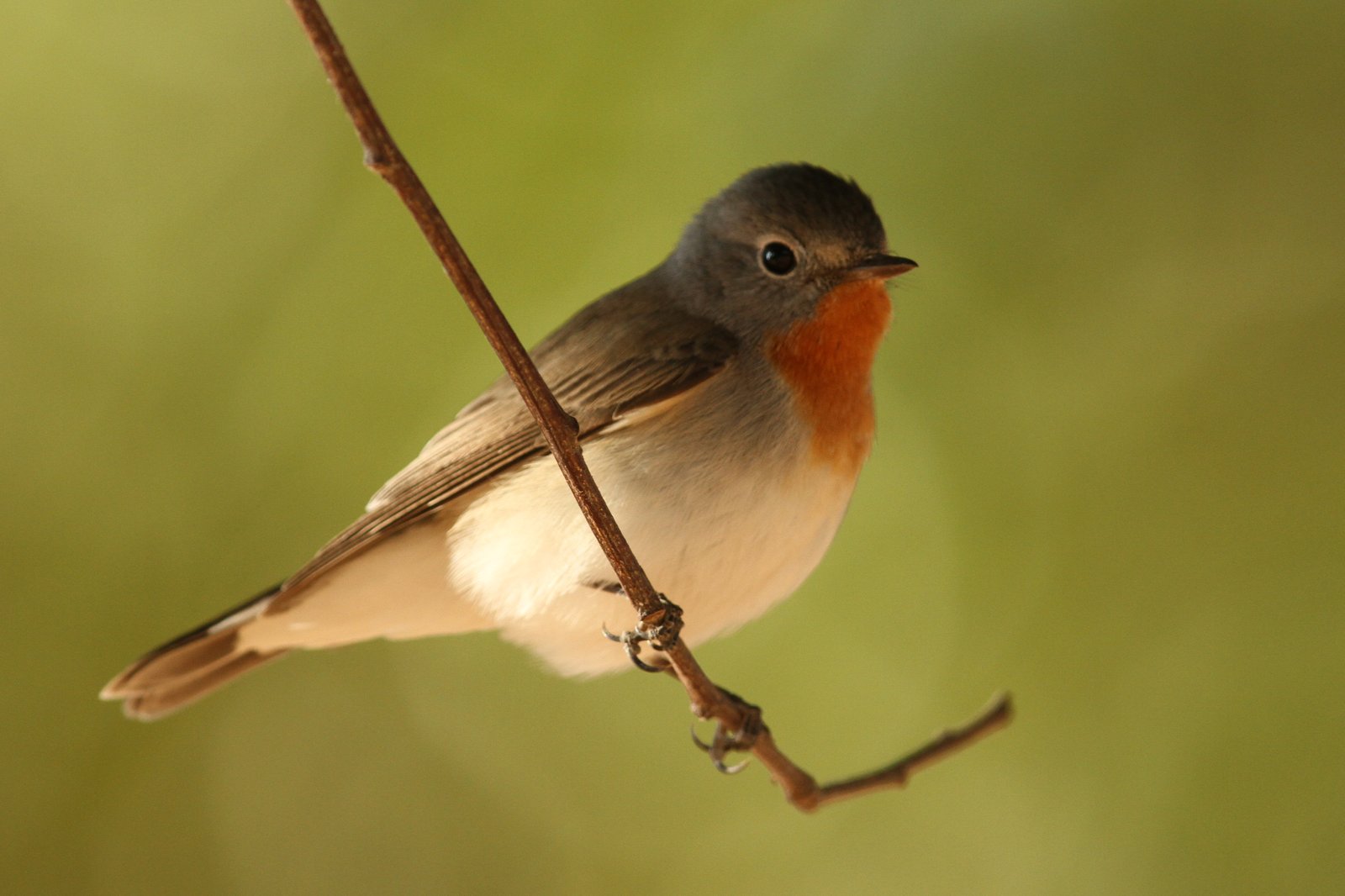
The Red-breasted Flycatcher is a tiny, active flycatcher that reaches the region mainly in the east: as a passage migrant in the Levant and as a winter visitor to the parks and gardens of Kuwait, the UAE and Oman. West of Egypt it is rare.
Voice
The call is a dry, rattling trrrt, like a soft wren, and a short tchik or tek; in parks and gardens in winter often the first clue. The song, rarely heard in the region, is a clear, descending series of whistles, tsi-tsi-tsi-tyoo-tyoo-tyoo.
Recording: David Darrell-Lambert — CC BY-NC-SA 4.0 · converted to mono · xeno-canto
Identification
11–12 cm. Small and round, with a large head, a large dark eye in a pale eye-ring and a short, fine bill; the shape of a miniature robin. Upperparts grey-brown, underparts off-white with a buff wash on the breast. The key feature is the black tail with large white patches at the base of the outer feathers, flashing whenever the bird cocks and spreads its tail, which it does constantly, often with drooped wings. The adult male has an orange-red throat and upper breast and a grey head; it acquires the red throat only in its second or third year. Females and young birds, by far the majority in the region, have a plain buffish-white throat; first-winters show pale tips to the greater coverts.
Confusion species
Taiga Flycatcher (Ficedula albicilla), a vagrant to the region, is very similar but has jet-black uppertail coverts as black as the tail (browner than the tail in Red-breasted Flycatcher), an all-dark bill and a greyer breast; the male has a smaller, brighter orange throat patch bordered by grey and no orange on the breast. The call also differs. European Robin (Erithacus rubecula) is larger, with an orange face and no white in the tail. Spotted Flycatcher (Muscicapa striata) is larger and streaked, without white in the tail.
Habitat
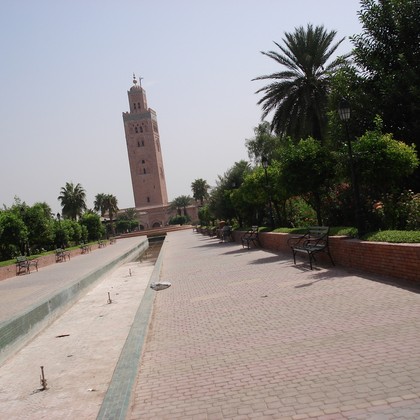
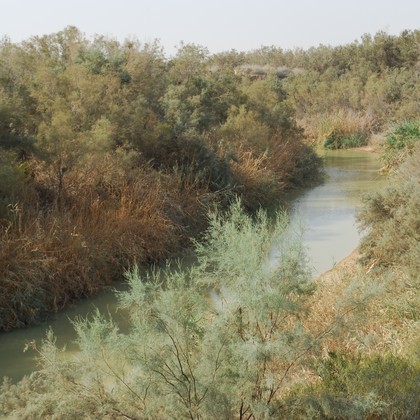
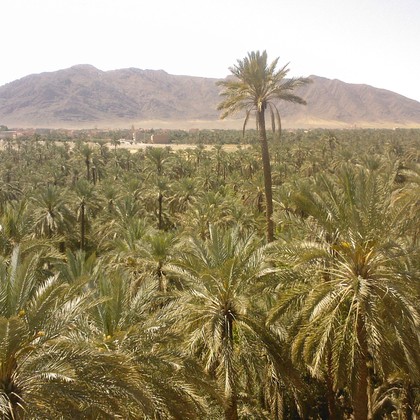
On passage and in winter in trees and bushes with cover: city parks, gardens with dense trees, riverine woodland with tamarisk and poplar, oases, date-palm gardens and mangroves along the Gulf. Feeds in the lower canopy, gleaning insects from leaves and making short sallies after flying prey.
Where the bird is most at home, classified by the habitats of North Africa and the Middle East.
Range and movements
A passage migrant mainly in the east: in Israel (mostly in autumn, October – November), Jordan, Syria, Lebanon, Iraq, Kuwait and the rest of the Arabian Peninsula. Winters in small numbers in Kuwait, Qatar, Bahrain, the UAE and Oman (including Dhofar), more scarcely in Saudi Arabia and Yemen; a few also winter in Israel. In Egypt a scarce passage migrant and winter visitor, mainly in Sinai and along the Nile. In Libya, Tunisia, Algeria and Morocco rare, with at most a few records per year. Beyond the region it breeds from central and eastern Europe to the Urals and northern Iran, and winters mainly in Pakistan and India.
- Summer visitor (c. Apr–Sep)
- Winter visitor (c. Oct–Mar)
- Passage (Mar–Apr, Oct–Nov)
- dark = core range, pale = thinly spread
How and when to look
In winter search the green parks of Kuwait, Dubai, Abu Dhabi or Muscat for a small bird flicking its tail in the low foliage; listen for the rattle. In Israel the kibbutz gardens of the Arava and Eilat are best in October and November.
Conservation status
Not globally threatened. In the region it depends on trees in parks, gardens and oases; the planting of greenery in the cities of the Gulf has probably increased the number of wintering birds.
Scientific name
Ficedula parva | (Bechstein, 1792)
Bechstein described the species in 1792 as Muscicapa parva; because it was later moved to another genus, the author and year stand in brackets. The genus Ficedula was introduced in 1760 by Brisson. Ficedula is Latin for a small fig-eating bird, from ficus 'fig'; it was believed to turn into the blackcap in winter. parva is the feminine form of Latin parvus 'small'. The specimen the first description was based on came from the Thuringian Forest, Germany.