All species › Waders, gulls and terns › Auks › Razorbill
Razorbill | Alca torda
Alk | Alca común
The auk that penetrates furthest into the Mediterranean: every winter British, Irish and Scandinavian Razorbills move south to the Strait of Gibraltar and the coasts of the Maghreb. There, whirring low over the water or diving between the waves, it adds an unexpected northern element to the North African winter.
Voice
Almost always silent in winter. In the breeding colonies a low, growling orrrr is heard; it is not heard in the region.
Recording: Roland Arnison — CC BY-NC-SA 4.0 · converted to mono · xeno-canto
Identification
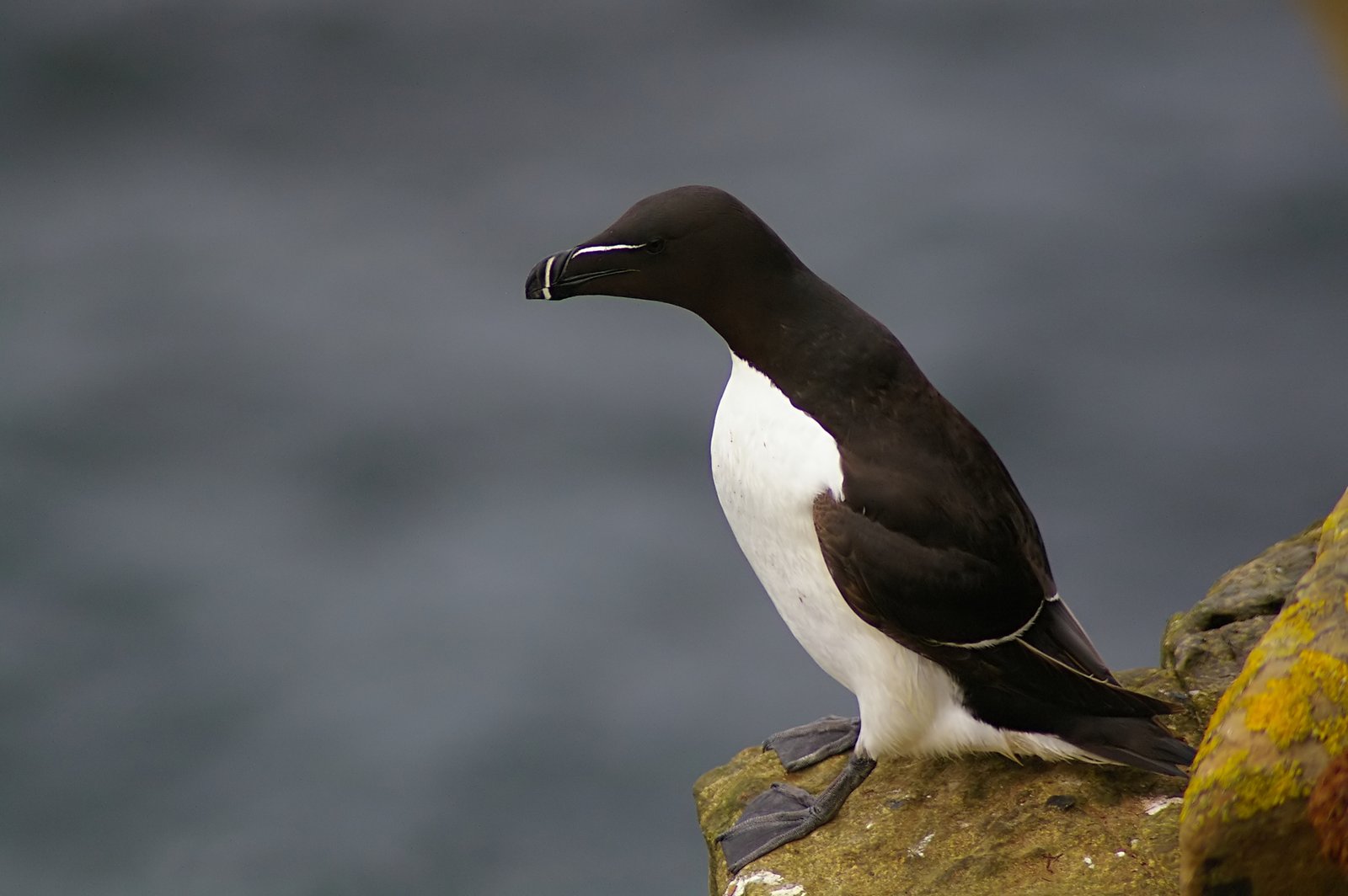
Upperparts jet black, clearly darker than the chocolate brown of Common Murre, with a deep, laterally compressed, blunt bill. In winter plumage, the plumage seen in the region, throat and cheeks are white to behind the eye, without a dark cheek stripe; the white vertical line across the bill remains visible. The tail is long and pointed and often cocked on the water; in flight it projects beyond the feet. In flight: fast whirring wingbeats low over the water, a white trailing edge to the arm and a white underwing. First-winter birds have a smaller bill without the white line.
Confusion species
Common Murre (Uria aalge) is browner and slimmer, with a straight, dagger-shaped bill, a short tail beyond which the feet project in flight, and in winter plumage a dark stripe behind the eye. Atlantic Puffin (Fratercula arctica) is smaller and rounder, with a dark underwing. At a distance Common Scoters (Melanitta nigra) or Great Cormorants (Phalacrocorax carbo) on the water can cause confusion, but neither has white underparts.
Habitat
Coastal waters and open sea over the continental shelf, also in bays and harbour mouths; dives for small shoaling fish such as sardines and anchovies. After storms sometimes inside harbours or washed up on beaches.
Where the bird is most at home, classified by the habitats of North Africa and the Middle East.
Range and movements
Morocco: regular winter visitor from November to March, most numerous in the Strait of Gibraltar, the Alboran Sea and off the Mediterranean coast east to the Moulouya, and along the Atlantic coast south to around Agadir, scarce further south. Algeria: regular winter visitor along the entire coast, especially in the west. Tunisia: smaller numbers along the north coast, including the Gulf of Tunis; rare in the Gulf of Gabès. Libya: rare. Egypt, Israel and Lebanon: very rare vagrant. Breeds around the North Atlantic, from Brittany and the British Isles to Iceland, Norway, the Baltic, Greenland and eastern Canada; European birds winter from the North Sea into the western Mediterranean.
- Resident
- Winter visitor (c. Oct–Mar)
- Passage (Mar–Apr, Oct–Nov)
- dark = core range, pale = thinly spread
How and when to look
The ferries between Tangier and Algeciras or Tarifa are an excellent platform in January and February; from the headlands around Tangier and Ceuta small groups can also be seen flying low over the water. In the Strait, watch for the difference from the scarcer Common Murre and Atlantic Puffin.
Conservation status
Globally not threatened, but most of the world population breeds in Iceland, where numbers fluctuate with food supply. In the wintering areas oil pollution and bycatch in gillnets are the main threats, including in the Strait of Gibraltar with its heavy shipping traffic.
Scientific name
Alca torda | Linnaeus, 1758
Linnaeus described the species in 1758 and placed it straight away in the genus where it still stands. He introduced the genus Alca in that same work. Alca comes from Norwegian alke, the name of this bird. torda goes back to törd, a Gotland Swedish dialect word for the same bird. The specimen the first description was based on came from southern Sweden.