All species › Waders, gulls and terns › Auks › Common Murre
Common Murre | Uria aalge
Zeekoet | Arao común
The most numerous auk of the North Atlantic, which occupies European cliffs in hundreds of thousands, is a rarity in the region. The odd bird reaches the Strait of Gibraltar or the Moroccan Atlantic coast in winter, often weakened after a storm or fouled with oil.
Voice
Silent away from the colony. On the breeding cliffs a continuous, growling aarrrr of hundreds of birds at once is heard; it is not heard in the region.
Recording: Sven Normant — CC BY-NC-SA 4.0 · converted to mono · xeno-canto
Identification
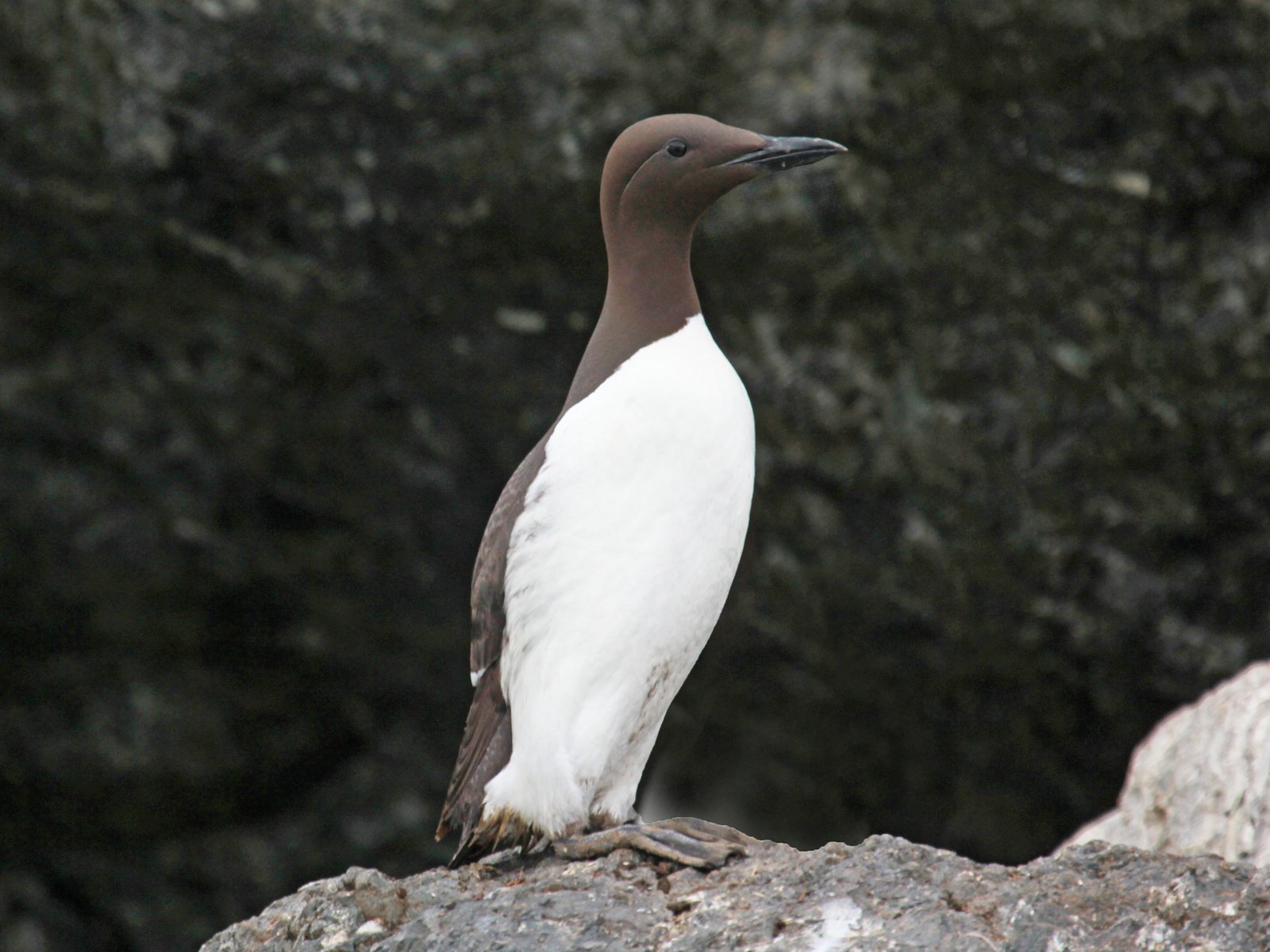
Slimmer and more elongated than Razorbill, with a straight, dagger-shaped bill. Upperparts dark chocolate brown, in bright light clearly warmer than the jet black of Razorbill; flanks with fine brown streaks. In winter plumage face and throat are white, with one decisive feature: a dark line running back from the eye across the white cheek. Northern birds sometimes show the bridled form, with a white eye-ring and a white line behind it. In flight the feet project beyond the short tail; the arm has a white trailing edge and the underwing is white.
Confusion species
Razorbill (Alca torda), far more likely in the region, is blacker, with a deep blunt bill, a long pointed tail and in winter plumage a white cheek without an eye stripe. Atlantic Puffin (Fratercula arctica) is much smaller and has a dark underwing. Loons such as Arctic Loon (Gavia arctica) are much larger, with a longer neck and a lower-lying body.
Habitat
Coastal waters and open sea over the continental shelf, where it dives deep for shoaling fish. Vagrants in the region are usually found close inshore, in harbours or on the beach, often weakened.
Where the bird is most at home, classified by the habitats of North Africa and the Middle East.
Range and movements
Morocco: rare winter visitor, with a handful of records in the Strait of Gibraltar and along the northern Atlantic coast, mostly between November and February and often as weakened or stranded birds; there are no certain records further south. Algeria and Tunisia: very rare, with only a few old reports. No records are known from the rest of the region. Breeds around the northern Atlantic and Pacific, in Europe from Portugal and Brittany, where the populations have almost disappeared, to the British Isles, Iceland, Norway and the Baltic; winters mostly near the breeding areas, south to the Bay of Biscay and Portugal.
How and when to look
In winter, scan the Razorbills in the Strait of Gibraltar for a browner, slimmer bird with a dark eye stripe. After winter storms, check the tideline of the beaches around Tangier and Asilah for stranded auks, and report certain records to the Moroccan rarities committee.
Conservation status
Globally not threatened and still very numerous with millions of birds, but the southernmost colonies in Portugal and Spain have almost vanished, and in the North Sea and north-east Atlantic the species suffers from food shortage, oil spills and bycatch in gillnets. Within the region it is too rare for specific threats to be named.
Scientific name
Uria aalge | (Pontoppidan, 1763)
Pontoppidan described the species in 1763 as Colymbus aalge; because it was later moved to another genus, the author and year stand in brackets. The genus Uria was introduced in 1760 by Brisson. Uria goes back to Ancient Greek ouria, a waterbird mentioned by Athenaeus. aalge is an old Danish word for an auk. The specimen the first description was based on came from Iceland.