All species › Birds of prey › Hawks, eagles and kites › Pallid Harrier
Pallid Harrier | Circus macrourus
Steppekiekendief | Aguilucho papialbo
The Pallid Harrier is the slimmest and palest of the grey harriers, a breeder of the steppes of Russia and Central Asia. It migrates on a broad front across the whole region, most commonly in the east, and in the last twenty years it has also been seen more and more often on the western route through Morocco.
Voice
Silent on migration and in winter. On the breeding grounds the male calls a high, fast kee-kee-kee-kee, and the female begs with a shrill pee-pee.
Recording: Jan Studecky — CC BY-NC-SA 4.0 · converted to mono · xeno-canto
Identification
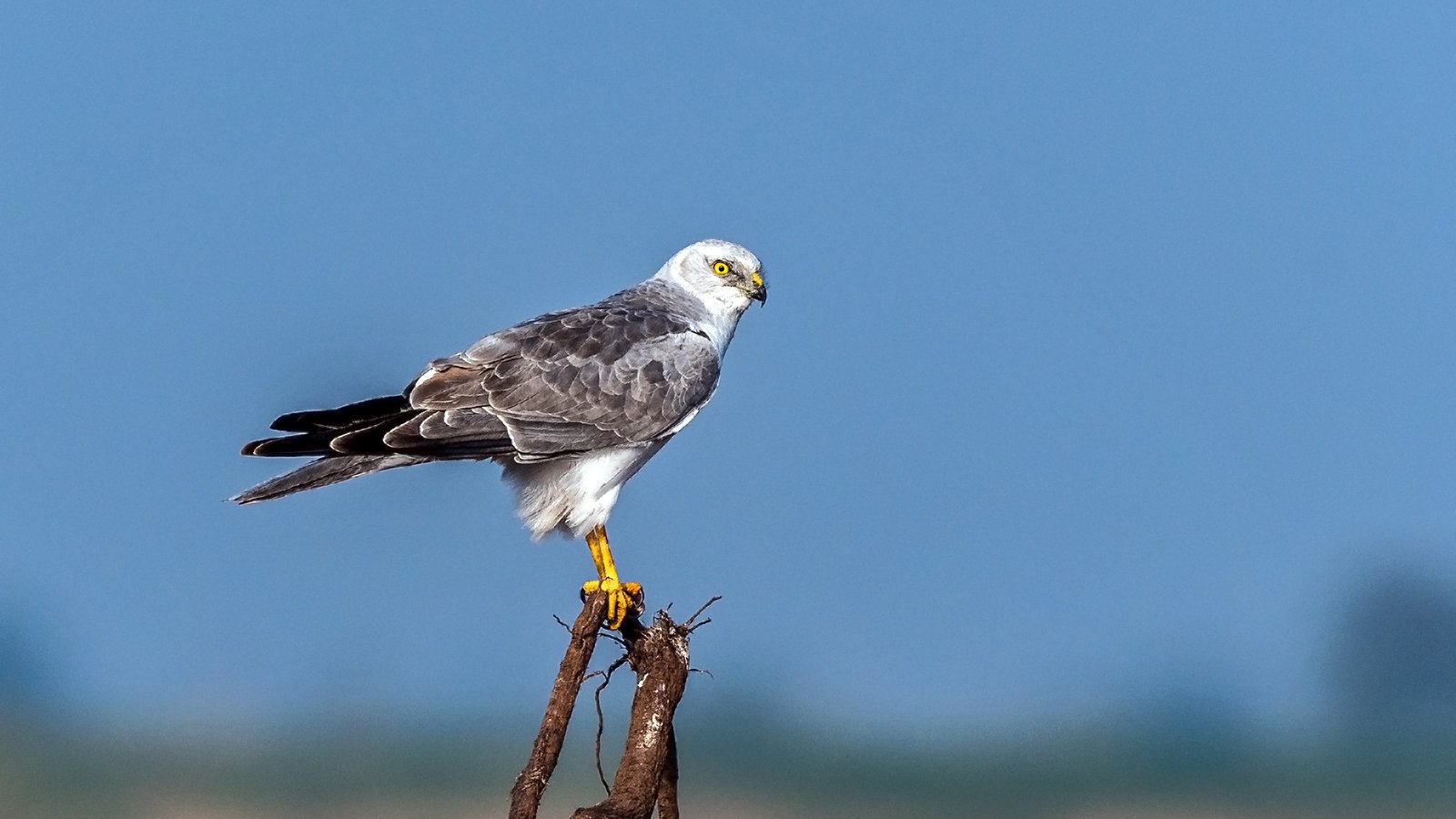
40–48 cm, wingspan 97–118 cm. Slim, with narrow, pointed wings, a small head and a long tail; glides with the wings in a shallow V. The male is very pale silvery grey above and almost white below, with only a narrow black wedge on the outer primaries and no black bars across the secondaries. The female is brown and streaked, with a white rump and a sharply marked head: a dark mask over the ear coverts, a pale collar that completely encircles the neck and pale stripes above and below the eye. The juvenile has plain orange-brown underparts without streaks, the same dark mask with a closed collar and a strikingly pale, unbarred base to the primaries on the underwing.
Confusion species
Montagu's Harrier (Circus pygargus) is the most similar. The male is darker grey, with a black bar across the secondaries on the upperwing, two black bars on the underwing, rufous streaks on the flanks and more black on the wingtip. Females and juveniles have an incomplete collar and a dark, double-barred underwing. Hen Harrier (Circus cyaneus) is bulkier and broader-winged, with five fingers on the wingtip; the male has a broad black wingtip, the female a larger white rump patch and heavily streaked underparts.
Habitat
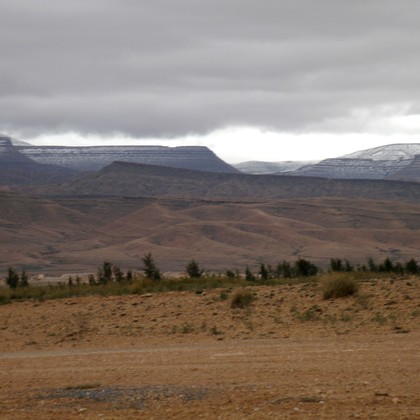
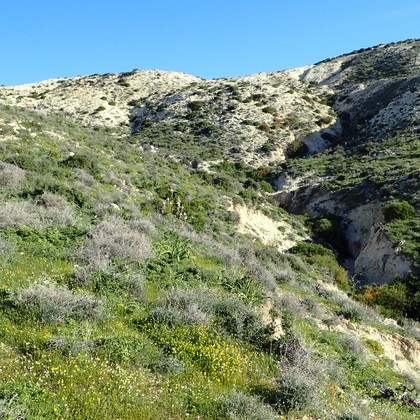
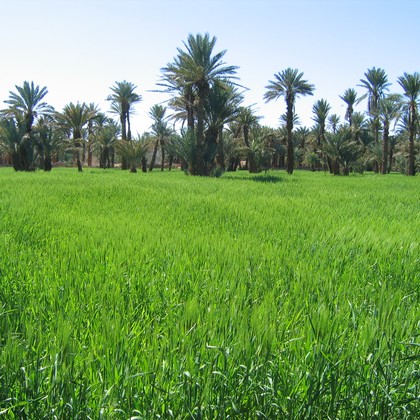
On migration and in winter in open dry country: alfa steppe, semi-desert with shrubs, herbaceous steppe, cereal fields, fallow land and irrigated farmland, also along the edges of marshes and salt flats. Hunts low for small birds such as larks and pipits, rodents, lizards and large insects.
Where the bird is most at home, classified by the habitats of North Africa and the Middle East.
Range and movements
In the east of the region a fairly common passage migrant in spring (mainly March and April) and autumn (mainly September and October): in Egypt, Israel, Jordan, Lebanon, Syria, Iraq and throughout Arabia, with large numbers over the Arava and Jordan valleys. A scarce winter visitor in Arabia, mainly in southwest Saudi Arabia and in Yemen, Oman and the Emirates, and in Egypt. In the Maghreb a scarce passage migrant, mainly in spring; in Morocco 64 records were known up to 2018, and in the winter of 2018–2019 a satellite-tagged Finnish bird wintered near Guelmim, the first proven wintering record. Also passes through Tunisia, Algeria and Libya. Beyond the region it breeds in the steppes from Ukraine and southern Russia to western China, with a small and growing population in Finland and Belarus; winters in the Sahel, East and southern Africa and India.
- Resident
- Summer visitor (c. Apr–Sep)
- Winter visitor (c. Oct–Mar)
- Passage (Mar–Apr, Oct–Nov)
- dark = core range, pale = thinly spread
How and when to look
In Israel and Jordan a good chance in March and April at the count sites in the Arava and Jordan valleys. On juveniles in autumn look for the plain orange underparts and the closed pale collar; on adult males for the almost white bird with a narrow black wedge in the wingtip.
Conservation status
Near Threatened. The species declined strongly in the twentieth century as the steppes were ploughed for farming. Since then the population seems to have stabilised and it is spreading westwards. On the wintering grounds it is vulnerable to pesticides, and on migration to shooting and electrocution.
Scientific name
Circus macrourus | (Gmelin, 1770)
Gmelin described the species in 1770 as Accipiter macrourus; because it was later moved to another genus, the author and year stand in brackets. The genus Circus was introduced in 1799 by De Lacépède. Circus is from the Ancient Greek kirkos, a bird of prey named for its circling flight. macrourus is Greek for 'long-tailed', from makros 'long' and -ouros '-tailed'. The specimen the first description was based on came from Voronezh, southern Russia.