All species › Passerines › Swallows and martins › Pale Crag Martin
Pale Crag Martin | Ptyonoprogne obsoleta
Vale rotszwaluw | Avión isabelino
The Pale Crag Martin is the martin of the desert: a small, sand-coloured crag martin of gorges, wadis, ancient monuments and, increasingly, tall buildings. It is the most widespread resident hirundine in this region, from the Sahara to Socotra, and has greatly expanded its range in Arabia along with urban development.
Voice
A soft, dry trrt or chrr and a short, high twitter; at the nest a soft, continuous chatter.
Recording: Stanislas Wroza — CC BY-NC-SA 4.0 · converted to mono · xeno-canto
Identification
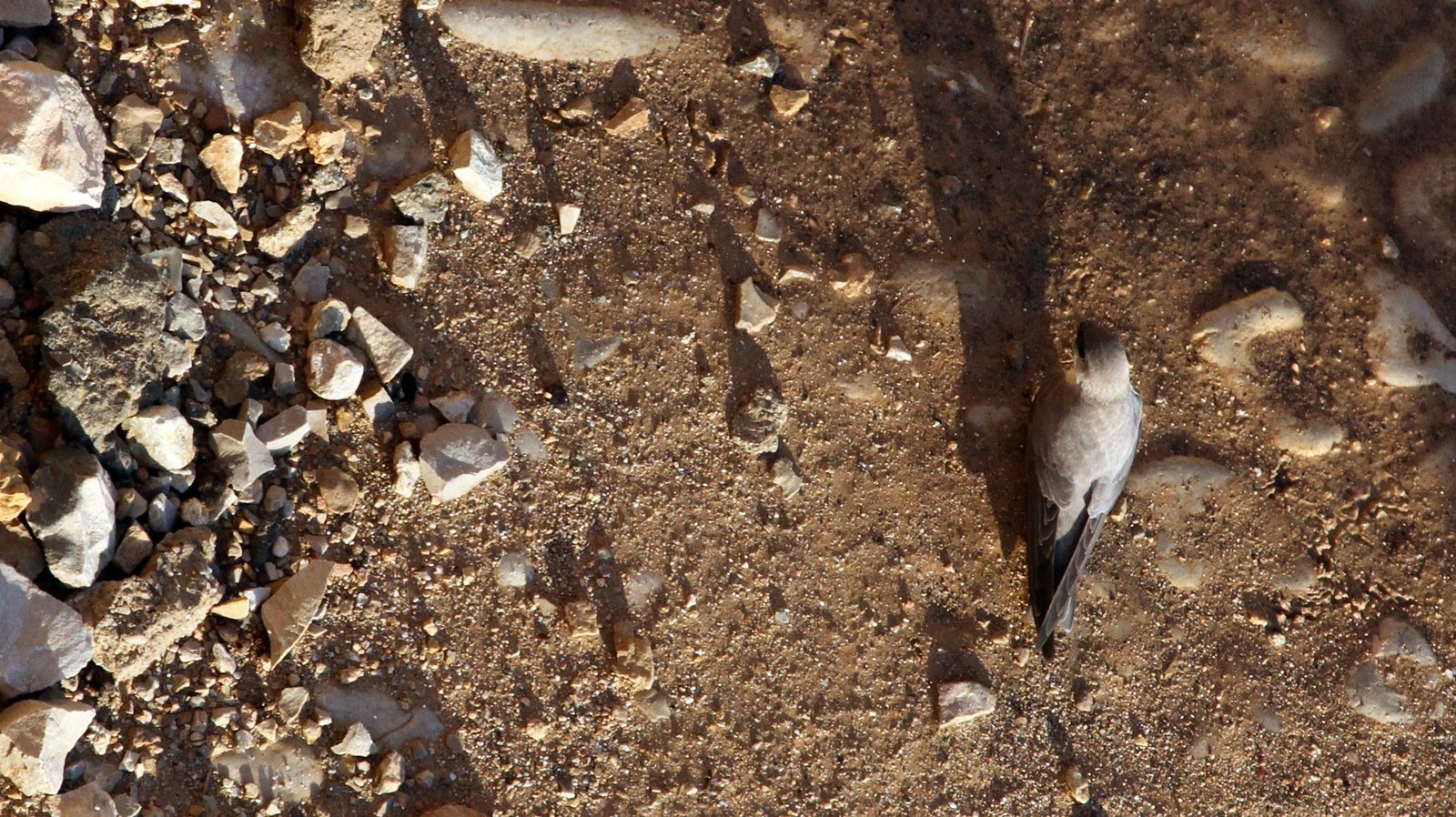
12–13 cm. Small and lightly built, with a short, square tail. Upperparts sandy brown to pale grey; throat and upper breast pale greyish-white, at most with a trace of speckling, merging gradually into an off-white to pale buff belly. The underwing coverts and undertail coverts are pale grey-brown, so the bird looks uniform and pale from below. In the spread tail a row of small white spots. There are clear regional differences: presaharica in Morocco and Algeria is sandy, spatzi in the central Sahara darker and warmer, perpallida in north-east Arabia and southern Iraq almost white below and very pale above, and arabica in south-west Arabia and on Socotra the darkest. The flight is light and agile. Sexes alike.
Confusion species
Eurasian Crag-Martin (Ptyonoprogne rupestris) is larger and heavier, with a speckled throat and dark underwing coverts and undertail coverts contrasting strongly with the belly; in winter they often hunt together. Bank Swallow (Riparia riparia) and Pale Martin (Riparia diluta) have a breast band and a tail without spots. Brown-throated Martin (Riparia paludicola) is uniformly brown on throat and breast and hunts low over water. Dark birds of the subspecies arabica can recall Large Rock Martin (Ptyonoprogne fuligula) of southern Africa, which has not been reliably recorded in the region.
Habitat
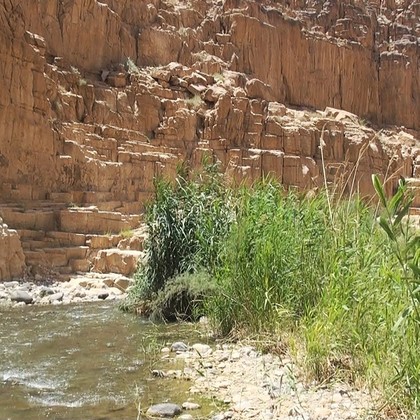
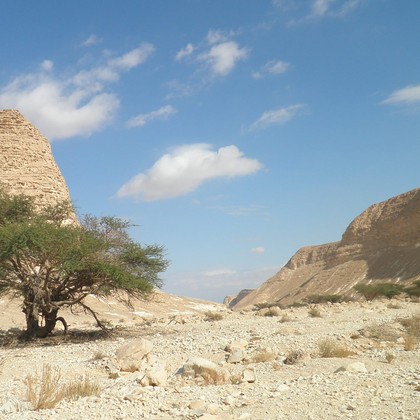
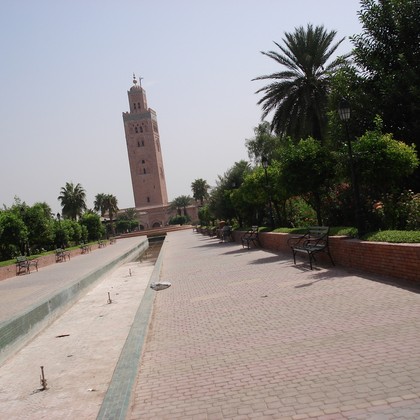
Gorges, wadis, cliffs and steep slopes in desert and semi-desert, from sea level high into the mountains, but also ancient monuments, villages, towns and high-rise buildings; in western Saudi Arabia also caves in lava fields. The mud nest is placed under an overhang of rock or building. Outside the breeding season in flocks, sometimes of hundreds, over farmland, sewage ponds, wetlands and pivot fields.
Where the bird is most at home, classified by the habitats of North Africa and the Middle East.
Range and movements
Breeds in Morocco mainly south of the Atlas and in the Anti-Atlas (scarce), locally in Western Sahara, in Algeria from the Saharan Atlas to the Hoggar (locally common), in southern Tunisia and in Libya in the south and in the mountains of the interior. In Egypt common along the Nile, from Cairo to Aswan and Abu Simbel, in Sinai and the Eastern Desert. In Israel (mainly the south, since the 1970s also on houses) and Jordan (Petra, Wadi Rum, Dead Sea), and across almost the entire Arabian Peninsula, from western Saudi Arabia and Yemen (including Socotra) to Oman and the Emirates, where thousands of pairs now breed on high-rise buildings; in southern Iraq a breeding bird since 2009. In winter many birds arrive in Arabia, which then holds up to 150,000 birds. Beyond the region from Sudan, Eritrea and Somalia in the east and the Sahel mountains in the west to Iran, Afghanistan and Pakistan.
- Resident
- Summer visitor (c. Apr–Sep)
- Winter visitor (c. Oct–Mar)
- Passage (Mar–Apr, Oct–Nov)
- dark = core range, pale = thinly spread
How and when to look
In the gorges of Wadi Rum and Petra, around the temples of Abu Simbel and Luxor, or among the tower blocks of Dubai and Abu Dhabi, where it hunts along the façades. At Ein Gedi by the Dead Sea it hunts alongside Eurasian Crag-Martin in winter: look for the uniformly pale underside.
Conservation status
Not globally threatened. In the region stable to increasing; the species benefits greatly from high-rise buildings, bridges and irrigation in the desert.
Scientific name
Ptyonoprogne obsoleta | (Cabanis, 1851)
Cabanis described the species in 1851 as Cotyle obsoleta; because it was later moved to another genus, the author and year stand in brackets. The genus Ptyonoprogne was introduced in 1850 by Reichenbach. Ptyonoprogne is Greek, from ptuon 'a fan', after the shape of the spread tail, and Procne, the girl of myth who was turned into a swallow. obsoleta is Latin for 'worn', after the pale plumage. The specimen the first description was based on came from the area around Cairo, Egypt.