All species › Divers › Divers › Pacific Loon
Pacific Loon | Gavia pacifica
Pacifische parelduiker | Colimbo del Pacífico
The Pacific counterpart of Arctic Loon, breeding from eastern Siberia to Arctic Canada and wintering along Pacific coasts. In the Western Palearctic it is a great rarity, with the first record only in 2007 in England. In the region it has been reported only from Israel, and any new report calls for very careful identification.
Voice
Silent in winter. On the breeding grounds a loud, wailing oo-AH-wee and a croaking quack.
Recording: Logan McLeod — CC BY-NC-SA 4.0 · shortened to the first 60 s, mono · xeno-canto
Identification
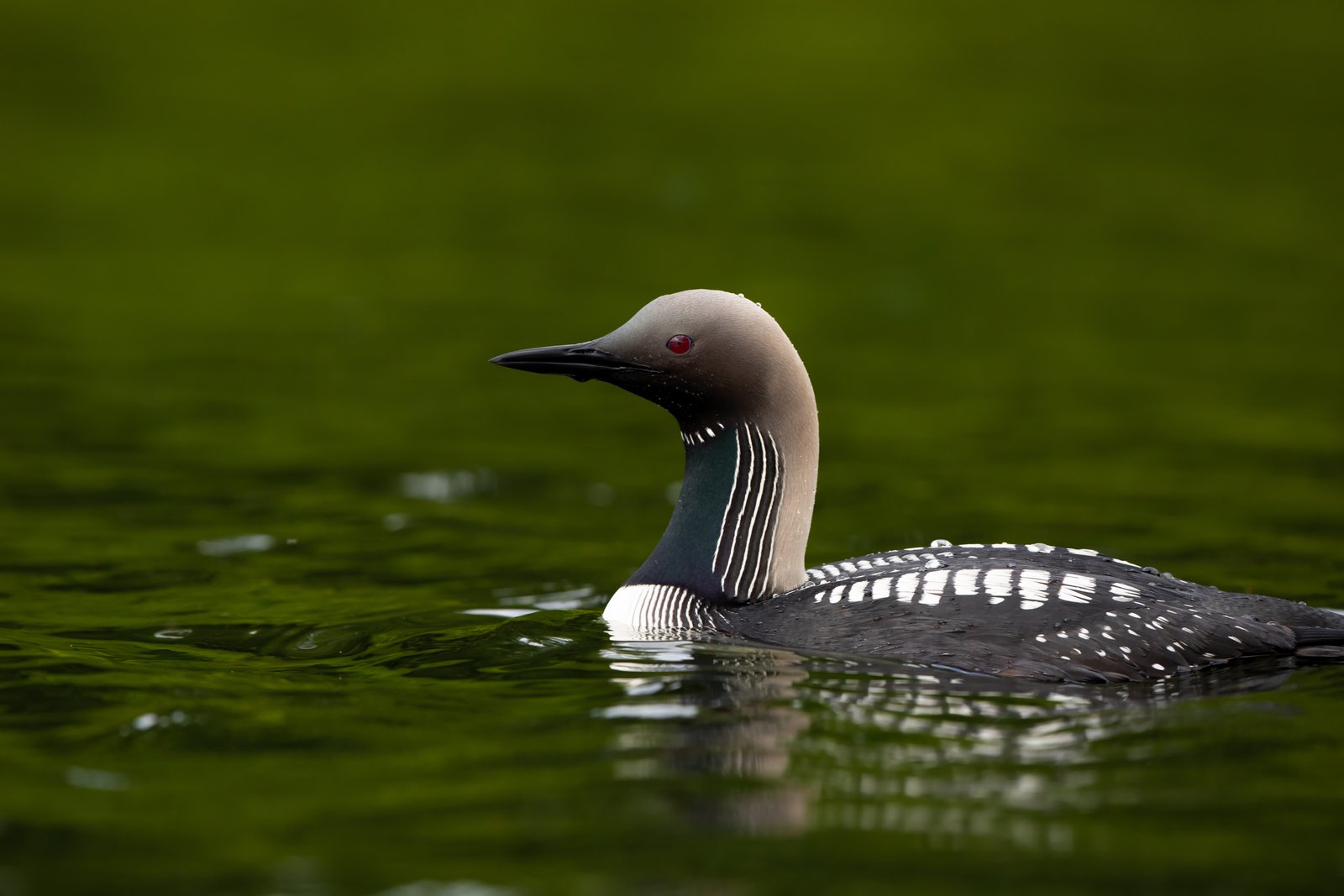
Very like a small, compact Arctic Loon: a straight, fairly short bill held horizontally, a rounded head with a slightly fuller nape and a dark, plain back. In winter plumage the border between the dark hindneck and the white foreneck is sharp and straight; a narrow dark chin strap across the throat is often visible. The key difference from Arctic Loon: the flank at the waterline is dark, without a large white patch. In summer plumage a silver-grey head and hindneck, a black throat with a purple sheen and a black back with white chequers.
Confusion species
Arctic Loon (Gavia arctica) is larger, with a longer bill and a more angular head, and shows a conspicuous white patch on the rear flank, which this species lacks; it has no chin strap. Red-throated Loon (Gavia stellata) is paler, with an upturned bill and a white-spotted back. Common Loon (Gavia immer) is much larger, with a heavy bill and an irregular neck border.
Habitat
In winter coastal waters and open sea close inshore; vagrants in Europe also on large inland waters and gravel pits. Dives for fish.
Where the bird is most at home, classified by the habitats of North Africa and the Middle East.
Range and movements
Israel: the species is on the national list as a vagrant; no published description of the circumstances could be found for this guide. No records are known from the other countries of the region. Elsewhere it breeds on the tundra of eastern Siberia, Alaska and Arctic Canada east to Hudson Bay, and winters along the Pacific coasts of North America south to Mexico and from Japan to China. In Europe an extremely rare vagrant, including England (Yorkshire, from January 2007, the first Western Palearctic record) and Poland.
How and when to look
Check every Arctic Loon for the flank: if the white patch is missing on a bird that otherwise looks like an Arctic Loon, look at the chin strap, bill size and head shape, and photograph the bird from several angles. Any report in the region belongs with the national rarities committee.
Conservation status
Globally not threatened, with a large and fairly stable population. Sensitive to oil pollution and bycatch in fishing nets in the wintering areas. Of no significance for the region.
Scientific name
Gavia pacifica | (Lawrence, 1858)
Lawrence described the species in 1858 as Colymbus pacificus; because it was later moved to another genus, the author and year stand in brackets. The genus Gavia was introduced in 1788 by Forster. Gavia is the Latin word for an unidentified seabird. pacifica refers to the Pacific Ocean, where the species winters; the Latin word itself means 'peaceful'. The specimen the first description was based on came from San Diego, California.