All species › Divers › Divers › Red-Throated Loon
Red-Throated Loon | Gavia stellata
Roodkeelduiker | Colimbo chico
The smallest and slimmest loon, breeding on the tundra and wintering along the coasts of north-west Europe. Only rarely does a bird drift so far south that it ends up in the region: almost always a lone bird in winter plumage in a bay or harbour on the Atlantic or Mediterranean coast.
Voice
Almost silent in winter. On the breeding grounds a goose-like, rapid cackle, kak-kak-kak, in flight, and long wailing calls.
Recording: Stanislas Wroza — CC BY-NC-SA 4.0 · shortened to the first 60 s, mono · xeno-canto
Identification
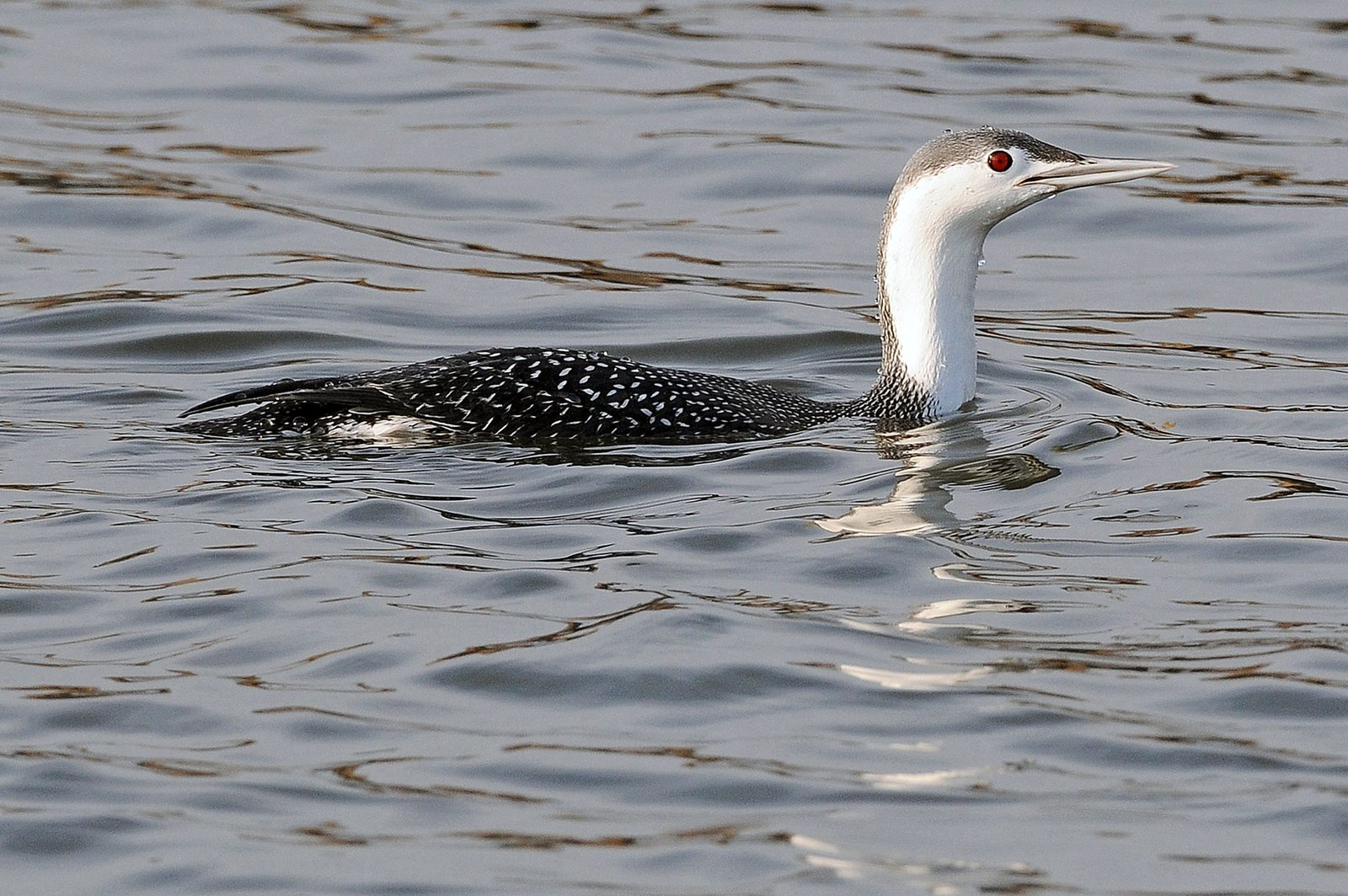
Slim, with a thin, slightly upturned bill often held tilted upwards, and a small head. In winter plumage, the plumage seen here, pale: light grey above with fine white spots on the back, much white on the face extending well around the eye, and a pale grey crown and hindneck without a sharp border. In summer plumage a grey head, a dark red throat patch and a plain brownish-grey back. In flight a loon with a thin neck, a slightly drooping head and fast, deep wingbeats. Juveniles are dingier grey on the face and neck.
Confusion species
Arctic Loon (Gavia arctica) is larger, with a straight, heavier bill held horizontally, a darker unspotted back, a sharp black-and-white border on the neck and a white flank patch at the waterline. Common Loon (Gavia immer) is much larger and heavier, with a stout dagger bill and an angular head. A winter Great Crested Grebe (Podiceps cristatus) has a white supercilium, a pink bill and a longer, thin neck.
Habitat
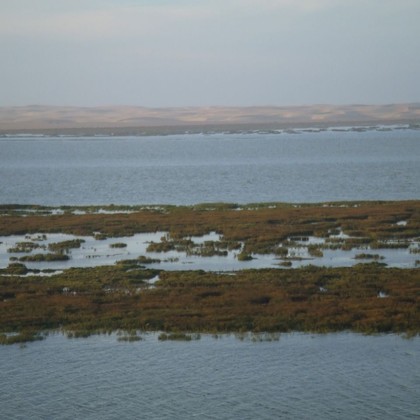
In winter shallow coastal waters, bays, harbours and estuaries; sometimes a lagoon or a large lake close to the coast. Dives for small fish.
Where the bird is most at home, classified by the habitats of North Africa and the Middle East.
Range and movements
Morocco: rare winter visitor, most records along the northern Atlantic coast (Tangier to Larache) and in the Strait of Gibraltar, a few on the Mediterranean coast; treated as a vagrant assessed by the rarities committee. Algeria and Tunisia: a few records on the Mediterranean coast, in Tunisia an accepted vagrant. Israel: a handful of records, mostly on the Mediterranean coast. A few older reports are known from Egypt; there are no confirmed records from Arabia, Iraq or the Levant. Elsewhere it breeds right around the Arctic, from Scotland and Scandinavia to Siberia, Alaska and Greenland, and winters along the coasts of north-west Europe south to Portugal, in the Black Sea and along the Pacific and Atlantic coasts of North America and East Asia.
How and when to look
In winter check from the capes and harbour piers of Tangier and Asilah and in the lagoon at Moulay Bousselham. With every loon, watch how the bill is held: tilted upwards points to this species. Report a sighting with photographs to the national rarities committee.
Conservation status
Globally not threatened, with a large population, although numbers are declining in parts of the range. Sensitive to oil pollution, bycatch in gillnets and disturbance by shipping and offshore wind farms in the wintering areas. As a vagrant it plays no significant role in the region.
Scientific name
Gavia stellata | (Pontoppidan, 1763)
Pontoppidan described the species in 1763 as Colymbus Stellatus; because it was later moved to another genus, the author and year stand in brackets. The genus Gavia was introduced in 1788 by Forster. Gavia is the Latin word for an unidentified seabird. stellata is Latin for 'starred' or 'set with stars', after the fine white speckling on the back in non-breeding plumage. The specimen the first description was based on came from the River Tame in England.