All species › Passerines › Reed warblers › Moustached Warbler
Moustached Warbler | Acrocephalus melanopogon
Zwartkoprietzanger | Carricerín real
The Moustached Warbler is a dark, contrasting reed warbler of dense, wet reed marshes which, unlike its relatives, migrates little or only over short distances. In the region it is most numerous in the marshes of Mesopotamia; elsewhere it is a scarce breeder or winter visitor, easily overlooked.
Voice
The song is softer and more melodious than that of Sedge Warbler, with a characteristic series of rising, pure, nightingale-like whistles: lu-lu-lu-lu, interspersed with Sedge-like scratchy notes. Sings from February. The call is a hard tchek or trrt and a rattling trrrr.
Recording: András Schmidt — CC BY-NC-SA 4.0 · converted to mono · xeno-canto
Identification
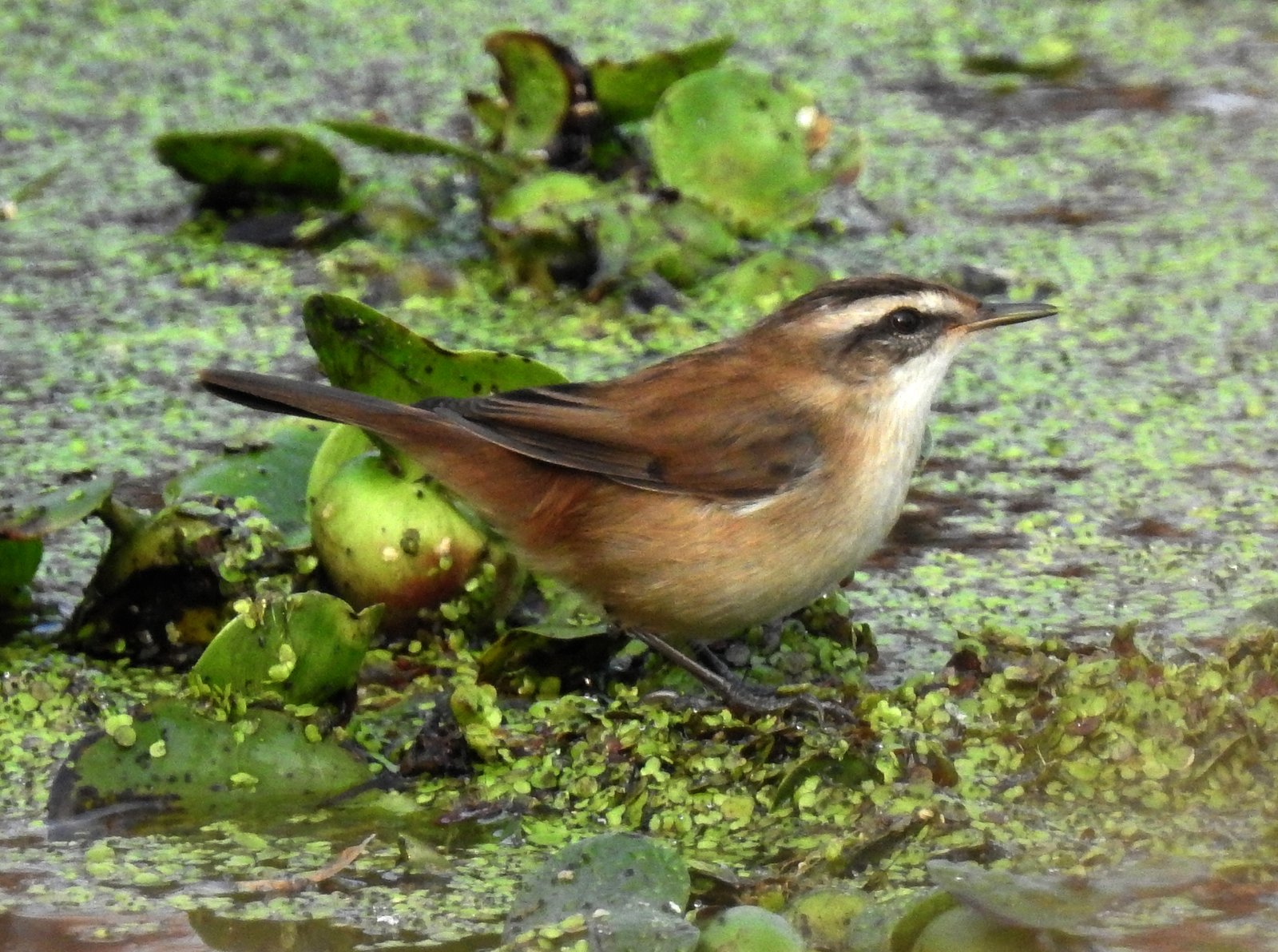
12–13.5 cm. Crown almost black, sharply set off against a broad, pure white supercilium ending squarely behind the eye; black eye-stripe and dark cheeks. Mantle warm rufous-brown with black streaks, rump unstreaked rufous. Throat bright white, breast and flanks rusty ochre. Wings short, with a short primary projection. Often flicks and cocks its tail, like a wren or Cetti's Warbler. The eastern form mimicus (Iraq and further east) is paler and less contrasting, with a less black crown.
Confusion species
Sedge Warbler (Acrocephalus schoenobaenus) has a brown, finely streaked crown, a less sharply defined creamy supercilium tapering gradually, a duller brown mantle and a much longer primary projection; it does not flick its tail. Pale mimicus birds look most like Sedge Warbler; note the square-ended supercilium, the white throat and the tail-flicking. Aquatic Warbler (Acrocephalus paludicola) has a pale central crown-stripe.
Habitat
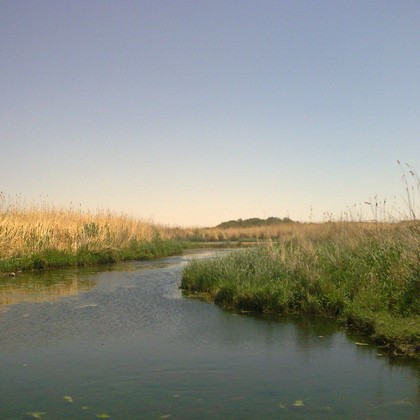
Dense, wet reedbeds and reedmace over shallow water, often with patches of old, broken reed and a rich understorey; also reed fringes along rivers, fish ponds and marsh edges. Forages low near the water, sometimes on floating vegetation. In winter also in smaller reedbeds, sewage works and irrigation channels.
Where the bird is most at home, classified by the habitats of North Africa and the Middle East.
Range and movements
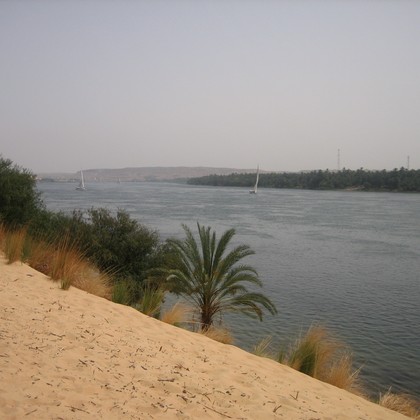
Common resident in the reed marshes of southern and central Iraq (Hawizeh, Central and Hammar marshes) and along the Euphrates and Tigris. Scarce breeder in Syria, northern Israel (Hula) and eastern Saudi Arabia (Hofuf, Jubail); in northwest Africa a very local and irregular breeder in Tunisia and Morocco. Winter visitor in small numbers to Israel, Jordan, Lebanon, Kuwait, Bahrain, northern Saudi Arabia and the Nile Delta; rare in Qatar, the United Arab Emirates and Oman. Beyond the region from Iberia and the Mediterranean through the Balkans, Ukraine and Turkey to the Caspian and Kazakhstan; eastern birds winter in the Middle East and the Indian subcontinent.
- Resident
- Summer visitor (c. Apr–Sep)
- Winter visitor (c. Oct–Mar)
- Passage (Mar–Apr, Oct–Nov)
- dark = core range, pale = thinly spread
How and when to look
In February or March, on a calm early morning, in a reed marsh such as the Hula or the Mesopotamian marshes: it is then in full song and sometimes shows itself on a reed stem. In winter search low along the water's edge, where it creeps through broken reed with flicking tail.
Conservation status
Not globally threatened. In the region strongly dependent on large reed marshes; drainage of the Mesopotamian marshes in the 1990s caused a sharp decline there, and the partial recovery since 2003 remains vulnerable to drought and water shortage.
Scientific name
Acrocephalus melanopogon | (Temminck, 1823)
Temminck described the species in 1823 as Sylvia melanopogon; because it was later moved to another genus, the author and year stand in brackets. The genus Acrocephalus was introduced in 1811 by Naumann & Naumann. Acrocephalus is Greek, from akros 'topmost, pointed' and kephalē 'head'; the Naumanns, who introduced the genus, called these birds Spitzkopf 'pointed head', so they read akros as 'pointed'. melanopogon is Greek for 'black-beard', from melas, genitive melanos, 'black', and pōgōn, 'beard', after the dark markings on the head. The specimen the first description was based on came from the countryside near Rome.