All species › Passerines › Reed warblers › Clamorous Reed Warbler
Clamorous Reed Warbler | Acrocephalus stentoreus
Indische karekiet | Carricero estentóreo
The Clamorous Reed Warbler is the large reed warbler that stays: a big, long-billed warbler present year-round in the reeds of the Nile and the Levant and in the mangroves and reed swamps of Arabia. Its loud, grating song belongs to every large reedbed in Israel, Egypt and the Gulf states.
Voice
A loud, harsh, grating song of short, rapidly repeated phrases that rattles rather than stutters: kre-kre-kre-chak-chak-chirr, at an even, continuous pace without the deep and shrill extremes of Great Reed Warbler. Sings from February into summer from a reed top or mangrove branch, also at night. Calls: a deep cherr and a hard chak.
Recording: David Darrell-Lambert — CC BY-NC 4.0 · converted to mono · xeno-canto
Identification
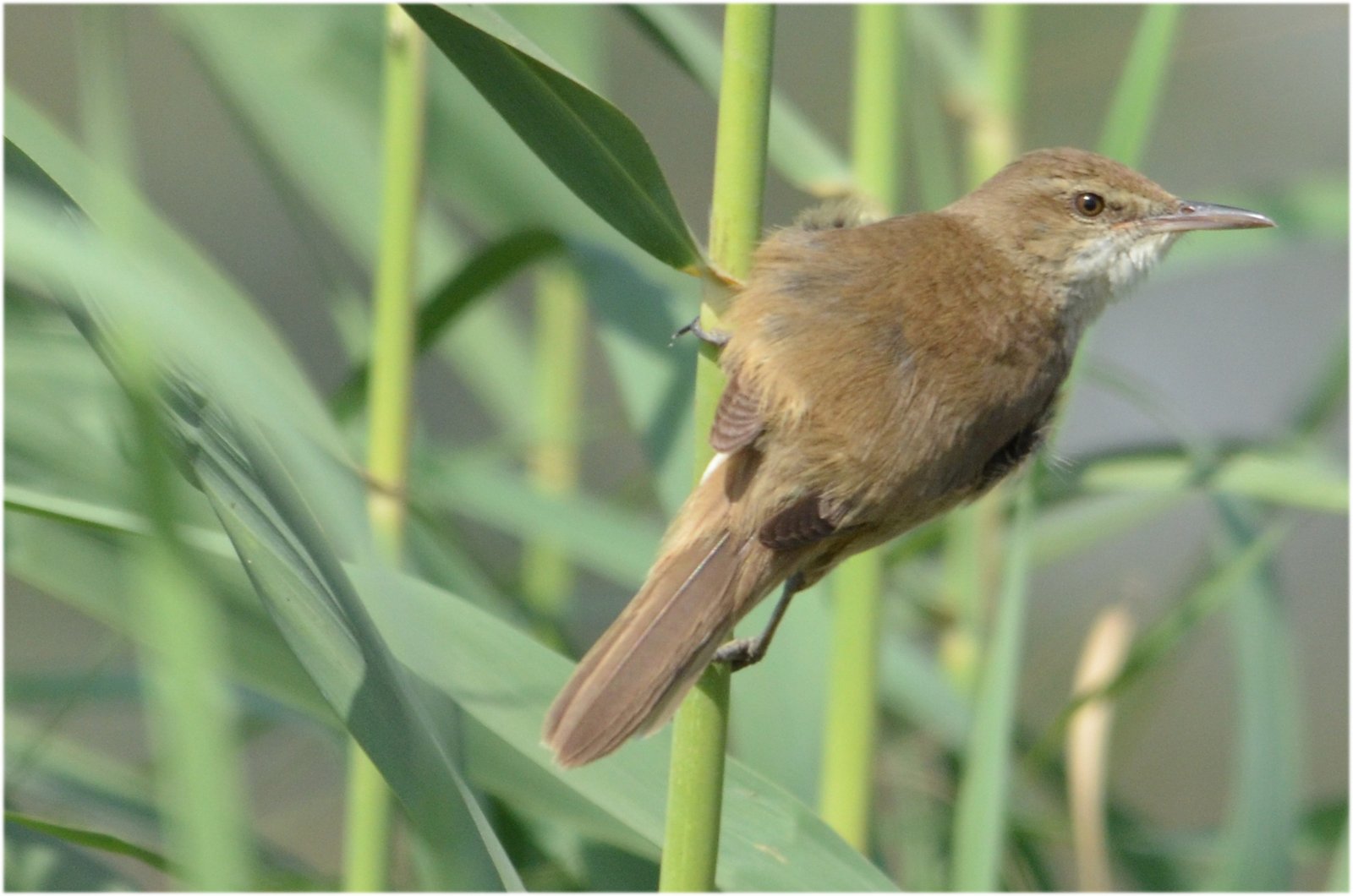
18–20 cm. A large reed warbler, as long as Great Reed Warbler but slimmer, with a longer, graduated tail. The bill is long, thin and evenly tapering below a flat forehead, so that head and bill form one pointed line. Upperparts dull olive- to grey-brown, underparts off-white with ochre-brown flanks and undertail coverts; the supercilium is narrow, short and faint. The wing is rounded with a short primary projection, about half the visible length of the secondaries. The Arabian form brunnescens is paler and greyer than the warmer birds of the Nile and the Levant. Sexes alike.
Confusion species
Great Reed Warbler (Acrocephalus arundinaceus) is the main confusion in spring and late summer: it has a shorter, thicker bill, a more obvious supercilium, a long primary projection with a pointed wingtip and a slower, deeper song with frog-like notes; it is absent from November to March. Basra Reed Warbler (Acrocephalus griseldis), in the marshes of southern Iraq, is smaller, colder grey-brown above and whiter below, with a long, slender bill and a softer, less harsh song. Eurasian Reed Warbler (Acrocephalus scirpaceus) is much smaller and sings in even, chattering phrases.
Habitat
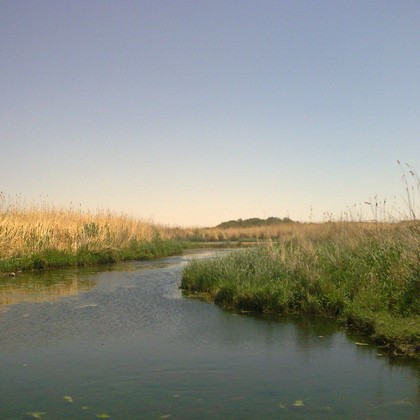
Tall, permanently wet reeds and reedmace along rivers, canals, fishponds, sewage lagoons and lakes; in Arabia also the mangroves of the Red Sea, the Arabian Sea and the Persian Gulf. Benefits greatly from artificial wetlands such as irrigation drains and treatment ponds in the desert. Eats insects and their larvae, small snails and sometimes small frogs.
Where the bird is most at home, classified by the habitats of North Africa and the Middle East.


Range and movements
Resident. In Egypt in the Nile Delta, the Nile Valley, Wadi Natrun, the oases of the Western Desert and along the Suez Canal; in Israel common in the Hula Valley, the coastal plain, the Jordan Valley, around the Dead Sea and at Eilat; in Jordan in the Jordan Valley and at Azraq; scarce in Lebanon and Syria. In Arabia the form brunnescens has long bred in the mangroves of the Red Sea (Saudi Arabia and Yemen), the coast of Oman and the United Arab Emirates; since the 1970s it has spread via oases and artificial reed swamps in eastern Saudi Arabia (Al-Hufuf, Dammam, Jubail) and Bahrain, reaching Qatar and Kuwait in the 1990s. Scarce and poorly known in Iraq. Beyond the region from south-west and Central Asia to India, South-East Asia and Australia.
- Resident
- Summer visitor (c. Apr–Sep)
- Winter visitor (c. Oct–Mar)
- Passage (Mar–Apr, Oct–Nov)
- dark = core range, pale = thinly spread
How and when to look
One of the easiest warblers of the region: any reedbed in the Hula Valley, at the Dead Sea or at the Eilat sewage ponds, and the mangroves of Khor Kalba and Abu Dhabi. In winter this is the only large reed warbler present, and then its rounded wing and long bill are easiest to study.
Conservation status
Not globally threatened. In the region stable to increasing thanks to artificial wetlands; locally vulnerable to marsh drainage and mangrove clearance along the Gulf coast.
Scientific name
Acrocephalus stentoreus | (Hemprich & Ehrenberg, 1833)
Hemprich & Ehrenberg described the species in 1833 as Curruca stentorea; because it was later moved to another genus, the author and year stand in brackets. The genus Acrocephalus was introduced in 1811 by Naumann & Naumann. Acrocephalus is Greek, from akros 'topmost, pointed' and kephalē 'head'; the Naumanns, who introduced the genus, called these birds Spitzkopf 'pointed head', so they read akros as 'pointed'. stentoreus is Latin, from Greek stentoreios, 'loud-voiced', after Stentor, the herald in the Iliad whose shout was as loud as fifty men. The specimen the first description was based on came from Damietta, Egypt.