All species › Passerines › Reed warblers › Marsh Warbler
Marsh Warbler | Acrocephalus palustris
Bosrietzanger | Carricero políglota
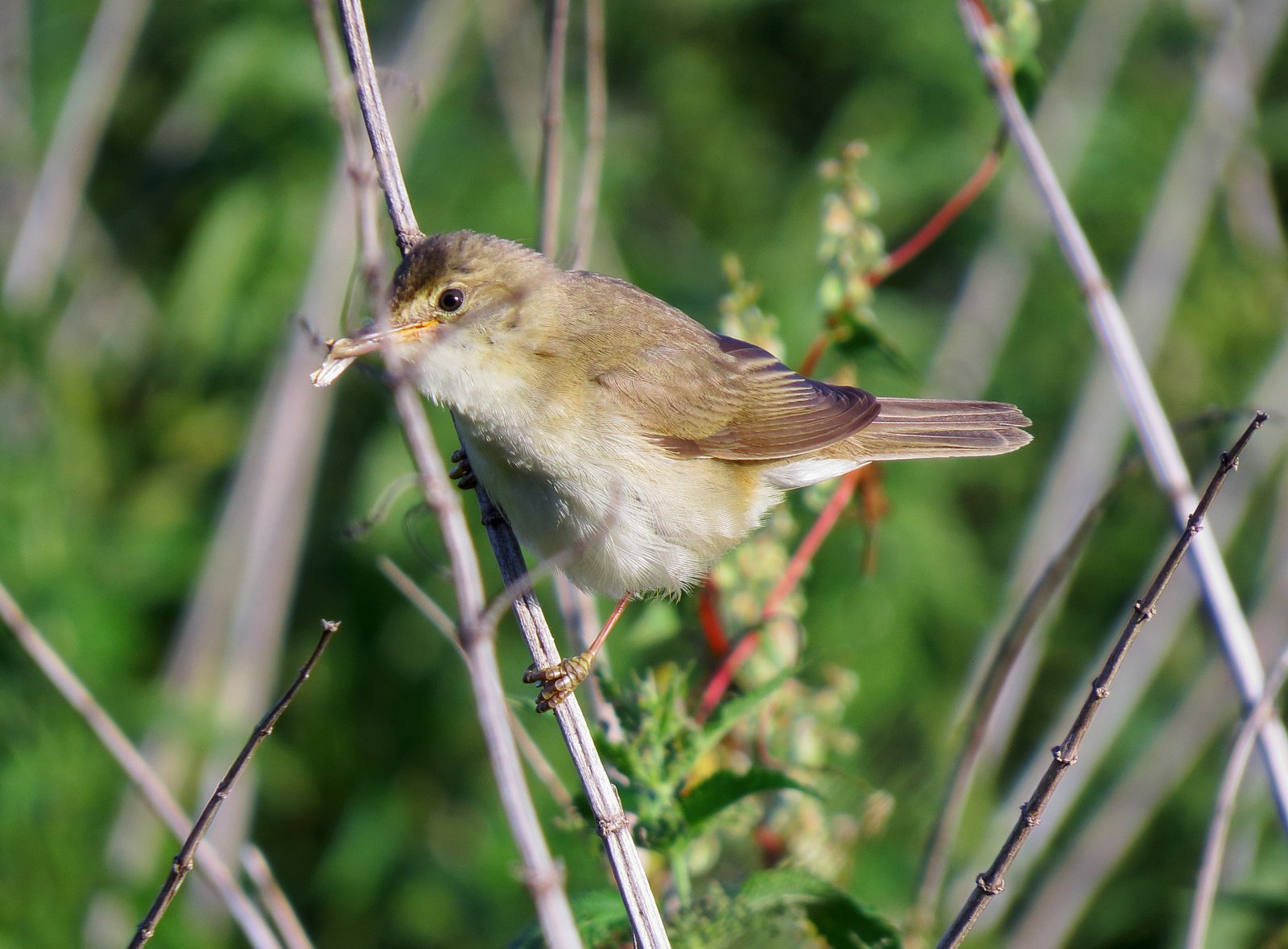
The Marsh Warbler is a plain olive-brown reed warbler famous for a song full of imitations of European and African birds. Travelling between Europe and southeastern Africa it passes through the east of the region, late in spring and often with a long stopover in autumn; in the Maghreb it is a rarity.
Voice
The song is fast, loud and highly varied, a fluent stream of imitations of dozens of European and African species, interspersed with nasal cheh-wee motifs and fast trills. Migrants often sing in spring, also at night. The call is a hard chek and a rattling cherr.
Recording: FlackoWeasel — CC BY-NC-SA 4.0 · shortened to the first 60 s, mono · xeno-canto
Identification
13–15 cm. Upperparts plain olive-brown with a yellowish tinge, without a warm rump; underparts pale yellowish-white, with yellowish-buff flanks. Head rounded with a fairly steep forehead; short, faint supercilium mainly in front of the eye and a noticeable pale eye-ring. Primary projection long, with pale, sharply defined primary tips, and the tertials have pale fringes. Legs pale flesh to yellowish-brown, with yellow soles. Juveniles in autumn are warmer brown and then hard to separate from Eurasian Reed Warbler.
Confusion species
Eurasian Reed Warbler (Acrocephalus scirpaceus) has a warmer, rufous rump, a flatter forehead, a slightly shorter primary projection and darker, greyer legs; the eastern form fuscus is greyer and thus even more like Marsh Warbler. Blyth's Reed Warbler (Acrocephalus dumetorum) is cold grey-brown, with a short primary projection without pale tips, plain tertials and dark legs. Iduna warblers such as Eastern Olivaceous Warbler (Iduna pallida) have a broader bill and a square tail with pale edges.
Habitat
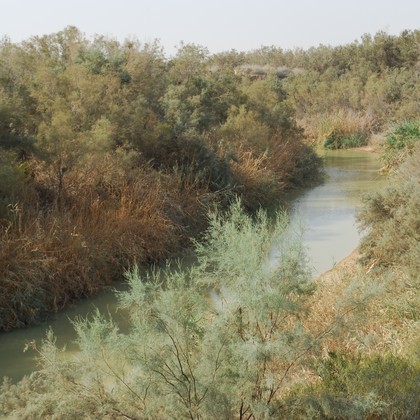
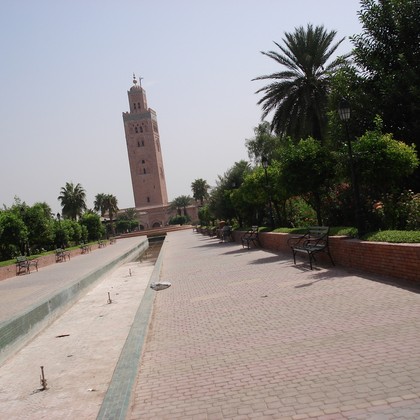
In the breeding range tall herbage with nettles, willowherb and bushes along ditches and field edges, not in reeds over water. On passage in dense bushes, tamarisks, gardens, parks, oases, sewage works and rank edges of irrigated fields.
Where the bird is most at home, classified by the habitats of North Africa and the Middle East.

Range and movements
Passage migrant through the east of the region, on a fairly narrow route via the eastern Mediterranean, the Levant and Arabia to the Horn of Africa. In Egypt (especially Sinai and the Red Sea coast), Israel, Jordan, Lebanon, Syria, Iraq, Kuwait and Saudi Arabia a fairly common migrant; in Yemen, Oman, the United Arab Emirates, Bahrain and Qatar fairly common to scarce, with long autumn stopovers in Arabia and northeast Africa. Spring passage is late, from mid-May into June. Scarce in Libya; a rare migrant in Tunisia, Algeria and Morocco. Breeds from northwest Europe to western Siberia and winters in southeastern Africa.
- Summer visitor (c. Apr–Sep)
- Passage (Mar–Apr, Oct–Nov)
- dark = core range, pale = thinly spread
How and when to look
In late May at a ringing station or a green garden on the Gulf of Aqaba or in Kuwait: a reed warbler in full song with imitations of African birds is almost certainly a Marsh Warbler. In silent birds check the long primary projection, the pale tertial fringes and the pale legs.
Conservation status
Not globally threatened. In the region a regular migrant without known problems, apart from the loss of green stopover sites in arid areas.
Scientific name
Acrocephalus palustris | (Bechstein, 1798)
Bechstein described the species in 1798 as Motacilla s. Sylvia palustris; because it was later moved to another genus, the author and year stand in brackets. The genus Acrocephalus was introduced in 1811 by Naumann & Naumann. Acrocephalus is Greek, from akros 'topmost, pointed' and kephalē 'head'; the Naumanns, who introduced the genus, called these birds Spitzkopf 'pointed head', so they read akros as 'pointed'. palustris is Latin for 'marshy'. The specimen the first description was based on came from Germany.