All species › Waterfowl › Ducks, geese and swans › Mallard
Mallard | Anas platyrhynchos
Wilde eend | Ánade azulón
The world's best-known duck is less of an everyday bird in the region than in Europe. In the Maghreb, the Levant and Iraq it is a common breeder of marshes and lakes, but it becomes scarce quickly to the south, and in Arabia many are tame or feral birds around parks and treated-water lagoons.
Voice
The female gives the familiar loud descending quack, quack-quack-quack; the male a soft hoarse rhaeb and a short whistle in display.
Recording: Esperanza Poveda — CC BY-NC-SA 4.0 · shortened to the first 60 s, mono · xeno-canto
Identification
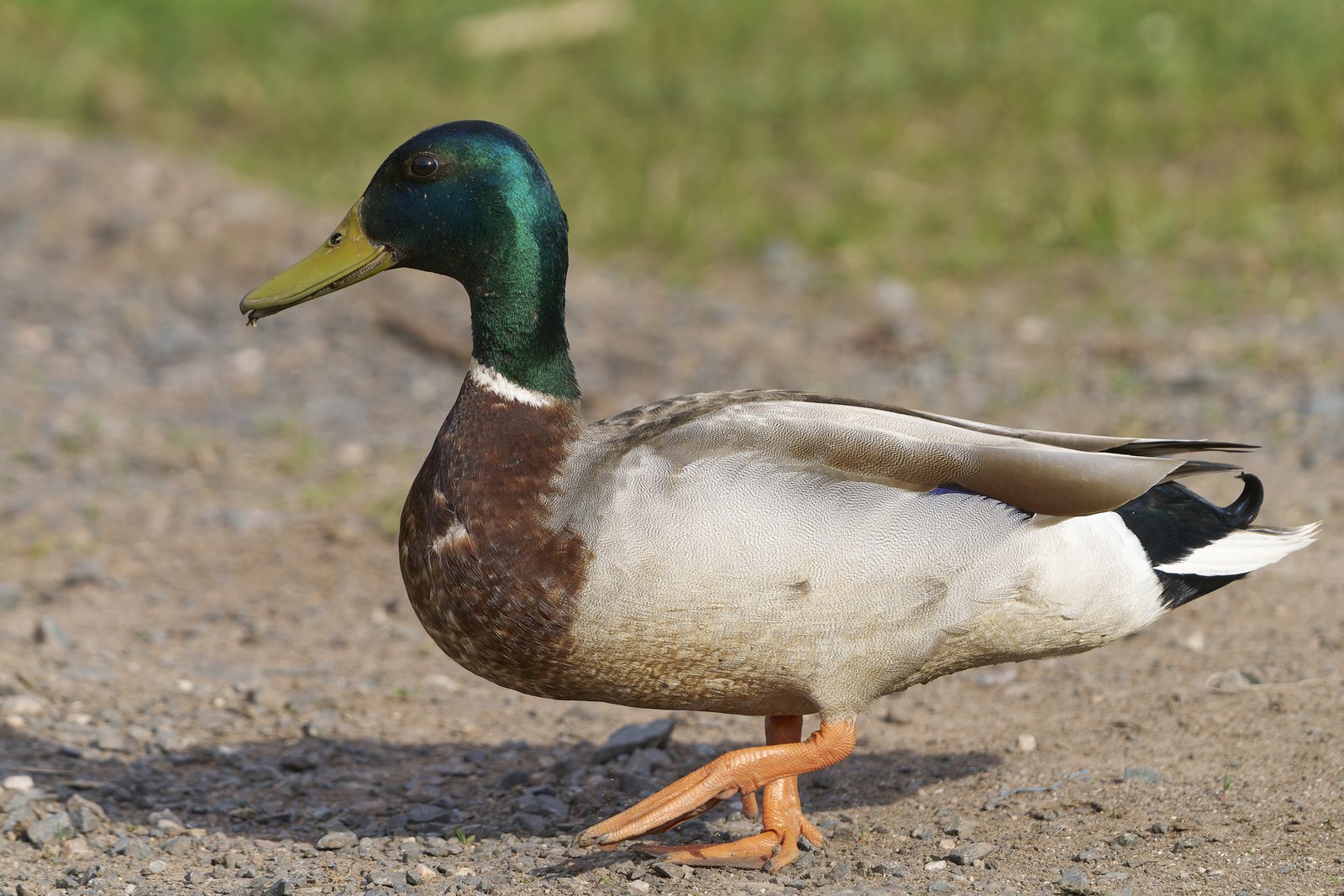
Large and heavy, with a broad flat bill. The male has a glossy green head, a narrow white neck ring, a purple-brown breast, a pale grey body, a black rear end with curled central tail feathers and a yellow bill. The female is mottled brown with a dark eye-stripe and an orange bill with a dark saddle. Both sexes have a blue-purple speculum bordered white in front and behind, and orange legs. In eclipse the male resembles the female but keeps a plain yellow bill.
Confusion species
The female resembles female Gadwall (Mareca strepera), which is smaller, with a sharply defined orange bill edge, a white belly and a white speculum. Male Northern Shoveler (Spatula clypeata) also has a green head, but a white breast, chestnut flanks and a huge bill. Tame and feral birds and hybrids show odd colours and sizes and are often more heavily built.
Habitat
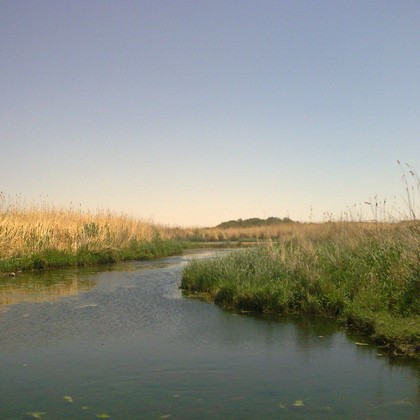
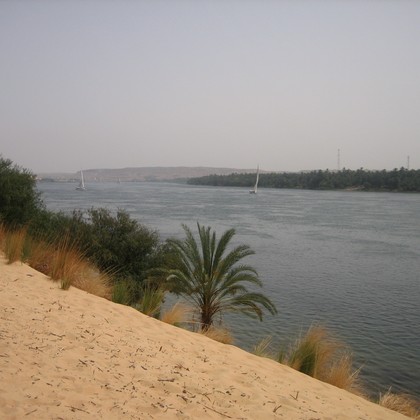
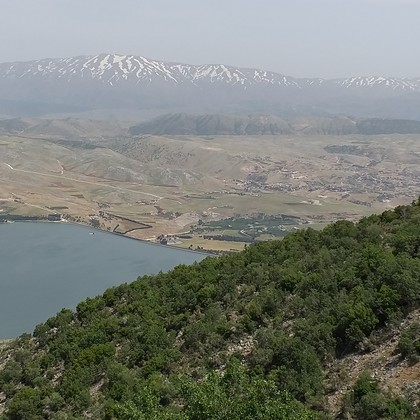
Almost any fresh or brackish water with cover along the bank: marshes, reedbeds, rivers, oases, reservoirs, fishponds, irrigation canals and city parks. Nests on the ground in dense vegetation, sometimes far from water. Eats seeds, water plants, grain and small animals.
Where the bird is most at home, classified by the habitats of North Africa and the Middle East.
Range and movements
Breeds in Morocco, Algeria and Tunisia (mainly the north, also in the Atlas and some oases), in northern Egypt, Israel, Lebanon, Syria, Jordan and Iraq, where the southern marshes hold large numbers. In winter it is reinforced by birds from Europe and western Asia, also in Libya and Egypt. Scarce in Arabia: wild birds winter in small numbers in Kuwait, Saudi Arabia and the Gulf states, and tame and feral populations live in parks and on treated-water lagoons in the Emirates, Bahrain, Qatar and Oman, among others. Beyond the region across the whole northern hemisphere, and introduced to Australia and New Zealand, among other places.
- Resident
- Summer visitor (c. Apr–Sep)
- Winter visitor (c. Oct–Mar)
- Passage (Mar–Apr, Oct–Nov)
- dark = core range, pale = thinly spread
How and when to look
Wild birds are best seen on the lakes of the Maghreb, such as Ichkeul and Merja Zerga, at the Hula valley fishponds and in the marshes of southern Iraq. Take care in the Gulf states: check size, colour and behaviour, because birds there are often feral or hybrids.
Conservation status
Not threatened and extremely numerous worldwide. In the region the wild populations are under pressure from hunting and drainage, while hybridisation with domestic ducks obscures the origin of many birds in Arabia.
Scientific name
Anas platyrhynchos | Linnaeus, 1758
Linnaeus described the species in 1758 and placed it straight away in the genus where it still stands. He introduced the genus Anas in that same work. Anas is the Latin word for 'duck'. platyrhynchos is Greek for 'broad-billed', from platus 'broad' and rhunkhos 'bill'. The specimen the first description was based on came from Sweden.