All species › Waterfowl › Ducks, geese and swans › Gadwall
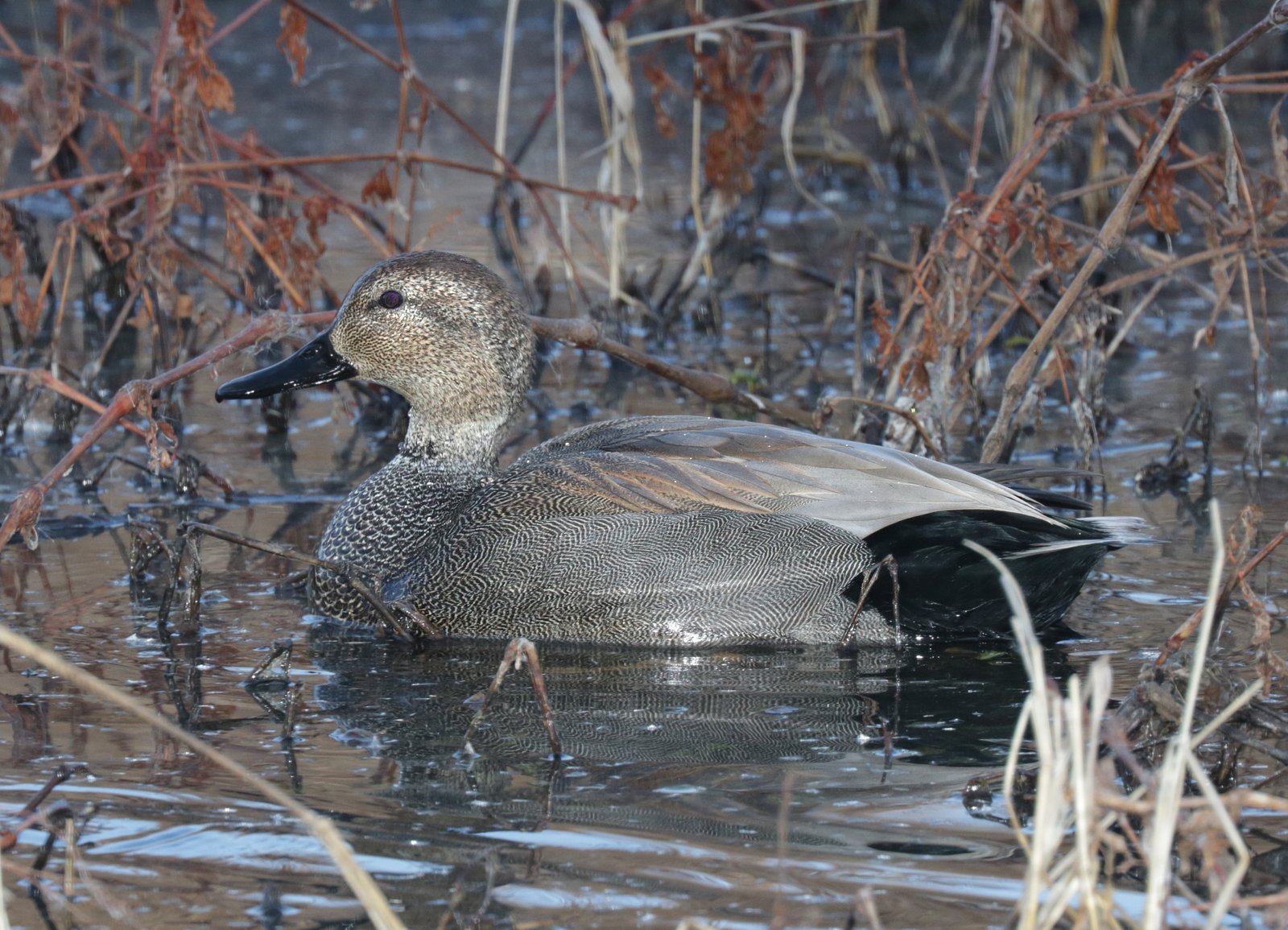
Gadwall | Mareca strepera
Krakeend | Ánade friso
A sober grey dabbling duck that proves finely patterned at close range. In winter it occurs on the lakes of the Maghreb, the Nile Delta and Iraq and on the fishponds of Israel, but nowhere in the huge numbers of shovelers or wigeon; in Arabia it is a scarce visitor.
Voice
The male gives a low rasping ehp and a clear whistle in display; the female quacks higher and faster than a Mallard, kak-kak-kak.
Recording: David Darrell-Lambert — CC BY-NC-SA 4.0 · converted to mono · xeno-canto
Identification
Slightly smaller and slimmer than Mallard, with a steeper forehead and a narrower bill. The male is grey with fine vermiculation and dark scaling on the breast, a brownish-grey head, a black rear end with no white, and a dark grey bill. The female is mottled brown and resembles a female Mallard, but has a sharply defined orange bill edge with a dark culmen and a white belly. The best feature in both sexes is the white speculum, sometimes visible on the water as a small white patch and obvious in flight, in the male combined with a chestnut and black panel on the wing.
Confusion species
The female closely resembles female Mallard (Anas platyrhynchos), which is larger, has a blue speculum with white borders and a less sharply defined orange bill edge. Female Eurasian Wigeon (Mareca penelope) is more rufous, with a short blue-grey bill and a rounded head. The very rare Falcated Duck (Mareca falcata) is darker, with a dark bill and a grey to greenish speculum.
Habitat
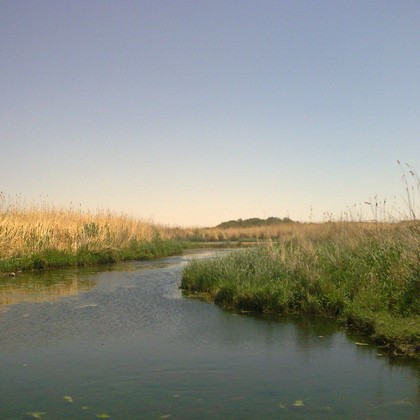
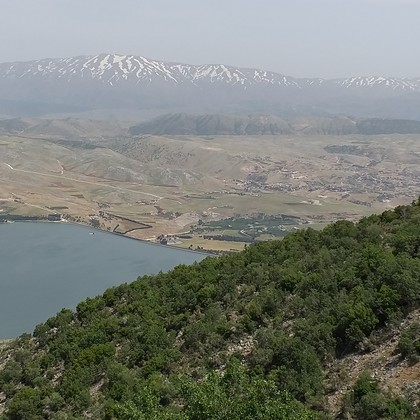
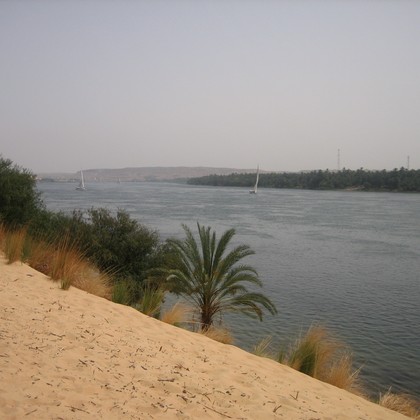
Fresh to slightly brackish lakes and marshes with rich submerged vegetation, reedbeds and quiet margins: natural lakes such as Ichkeul and El Kala, reservoirs, fishponds, and the marshes of the Nile Delta and southern Iraq. It dabbles and eats mainly water plants, which it sometimes steals from diving coots or diving ducks.
Where the bird is most at home, classified by the habitats of North Africa and the Middle East.
Range and movements
A winter visitor to Morocco, Algeria, Tunisia and Libya (mainly the coast), Egypt (Nile Delta and Fayoum), Israel, Lebanon, Syria, Jordan and Iraq, where the largest numbers winter in the southern marshes. Scarce but regular in Kuwait, Bahrain, Qatar, the Emirates, Oman and Saudi Arabia, exceptional in Yemen. Breeds in small numbers in Morocco (including the Middle Atlas and Merja Zerga), Algeria (El Kala) and Tunisia, and sporadically in Israel. Beyond the region from Europe to East Asia and in North America; winters as far as the Sahel, South Asia and Mexico.
- Resident
- Summer visitor (c. Apr–Sep)
- Winter visitor (c. Oct–Mar)
- Passage (Mar–Apr, Oct–Nov)
- dark = core range, pale = thinly spread
How and when to look
The fishponds of the Hula and Beit She'an valleys in Israel and Ichkeul in Tunisia are the most reliable in winter. Look for pairs quietly dabbling along reed edges and wait for them to fly: the white speculum separates it at once from female Mallard.
Conservation status
Not threatened and increasing in Europe. In the region, wetland drainage, disturbance and hunting limit the small breeding populations in the Maghreb. Numbers in Iraq have grown again since the marshes were restored in the 2000s.
Scientific name
Mareca strepera | (Linnaeus, 1758)
Linnaeus described the species in 1758 as Anas strepera; because it was later moved to another genus, the author and year stand in brackets. The genus Mareca was introduced in 1824 by Stephens. Mareca comes from the Portuguese marreco, a word for a small duck. strepera is Latin for 'noisy', from strepere 'to make a din', after the rattling call. The specimen the first description was based on came from Sweden.