All species › Passerines › Shrikes › Lesser Gray Shrike
Lesser Gray Shrike | Lanius minor
Kleine klapekster | Alcaudón chico
The Lesser Gray Shrike is a compact grey shrike of open farmland and steppe that passes mainly through the eastern part of the region, on its way between Eastern Europe and Central Asia and its winter quarters in southern Africa. It follows a loop migration: in spring it travels further east, through Arabia and Iraq, than in autumn.
Voice
The call is a short, hard chek or kyek. The song is a chattering twitter with much mimicry of other birds, often given in a short song flight.
Recording: András Schmidt — CC BY-NC-SA 4.0 · converted to mono · xeno-canto
Identification
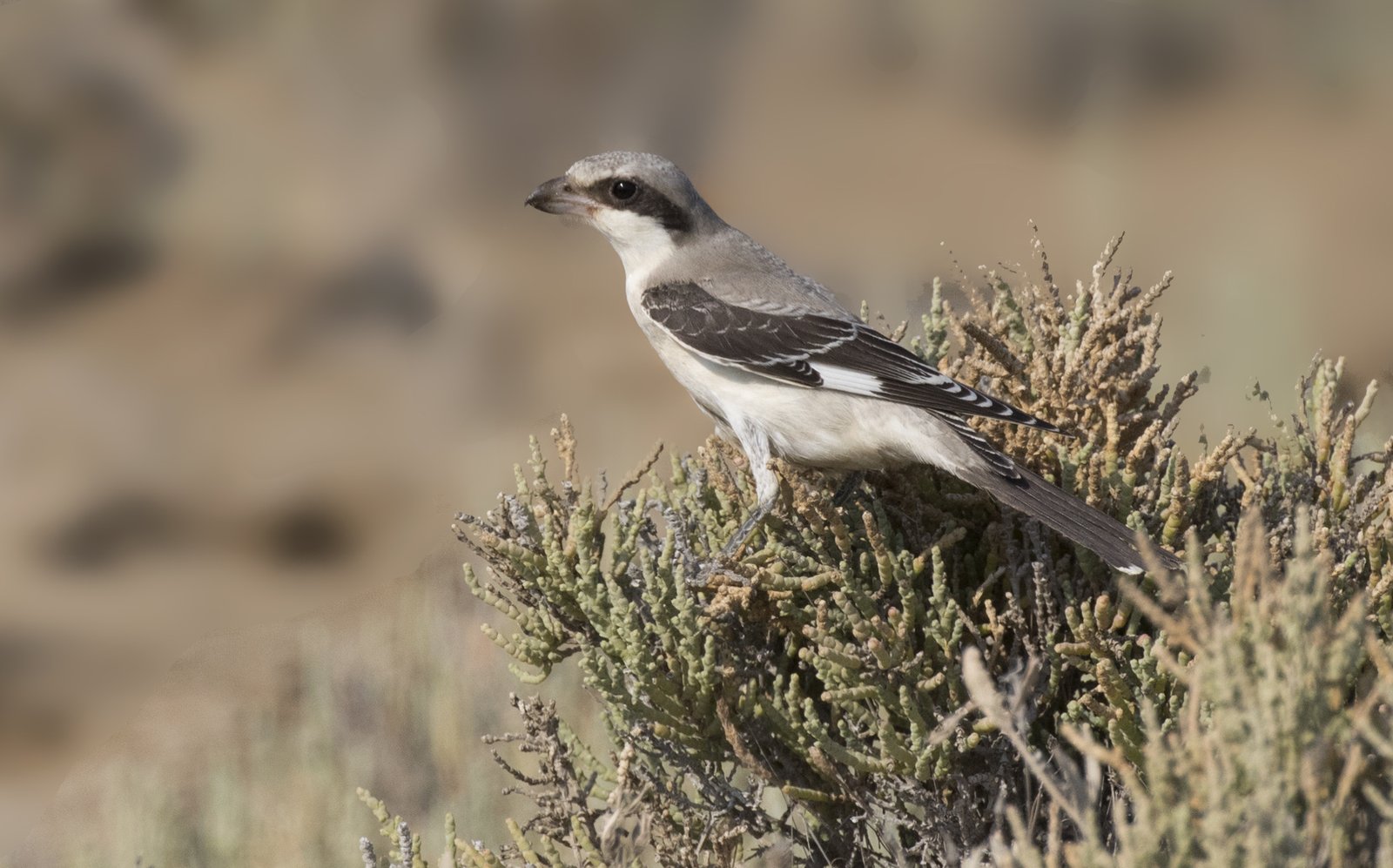
19–21 cm. Smaller and more compact than Great Gray Shrike, with a shorter tail and long wings whose primary projection nearly equals the tertials. Adults are pale grey above with a broad black mask that extends across the forehead, black wings with a large white primary patch and a black tail with white sides. Breast and flanks are softly washed pink. The female has a narrower black forehead band, often mixed with grey. Juveniles lack the black forehead, are finely barred on crown and back and have whitish underparts. Sits upright and flies with a noticeably light, undulating flight.
Confusion species
Great Gray Shrike (Lanius excubitor) is larger and longer-tailed with shorter wings, and has a grey forehead, often a white supercilium and no pink breast; the Middle Eastern forms do show a narrow black forehead band. Young Lesser Grays resemble the pale Steppe Grey Shrike (L. e. pallidirostris) but have a shorter tail, longer primary projection and a darker bill.
Habitat
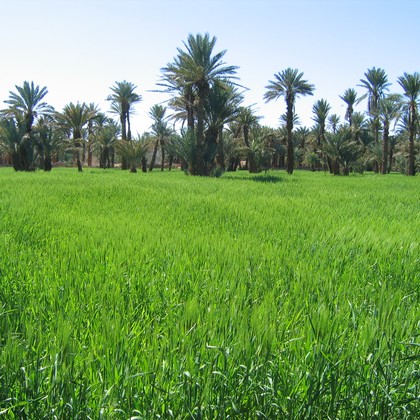
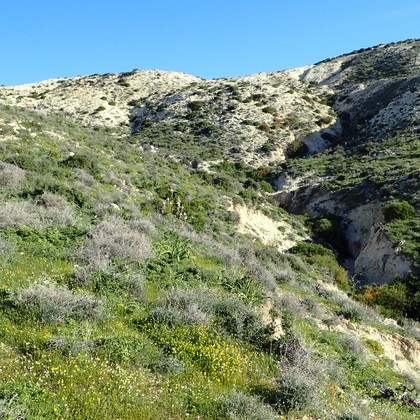
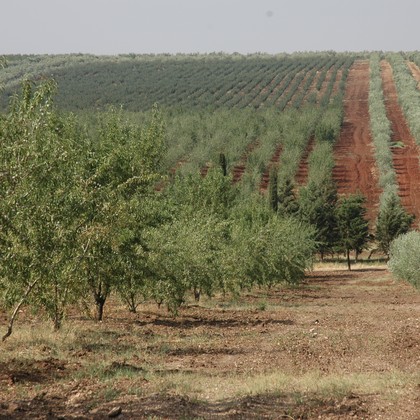
Open, warm farmland and steppe with scattered trees, rows of poplars or mulberries, telephone wires and hedges; in the breeding range also orchards and vineyards. On migration in open farmland, steppe, semi-desert and the edges of oases and parks. Hunts mainly beetles and grasshoppers, often from a wire, and sometimes hovers over the ground.
Where the bird is most at home, classified by the habitats of North Africa and the Middle East.
Range and movements
Breeds in small numbers in northern Syria, northern Iraq (Kurdistan) and, recently confirmed, in the mountains of Lebanon. On spring passage, late April to early June, widespread and sometimes numerous through Iraq, Kuwait, eastern Saudi Arabia, the Gulf states, Oman and Yemen, and also through Israel, Jordan and Sinai. In autumn it migrates further west, through the eastern Mediterranean, Egypt and eastern Libya, and less through Arabia. In the Maghreb a scarce to rare migrant, mainly in Tunisia and eastern Algeria. Beyond the region it breeds from southern and eastern Europe to western Siberia and Central Asia and winters in southern Africa, especially the Kalahari.
- Summer visitor (c. Apr–Sep)
- Passage (Mar–Apr, Oct–Nov)
- dark = core range, pale = thinly spread
How and when to look
In May the farmland and parks of Kuwait and the Emirates (for example at Al Jahra or Al Wathba) and the fields around Eilat are good places. Look for a grey shrike on a wire that looks shorter and rounder than a Great Gray, with long wings and a black forehead.
Conservation status
Not globally threatened, but it has declined steeply across much of Europe and disappeared from the western edge of its range through agricultural intensification, loss of insects and bad weather in the breeding season. Trapping occurs on migration.
Scientific name
Lanius minor | Gmelin, 1788
Gmelin described the species in 1788 and placed it straight away in the genus where it still stands. The genus Lanius was introduced in 1758 by Linnaeus. Lanius is Latin for 'butcher', from shrikes' habit of impaling prey on thorns and barbed wire. minor is Latin for 'smaller', this bird being smaller than the great grey shrike. The specimen the first description was based on came from Italy.