All species › Passerines › Monarch flycatchers › Indian Paradise Flycatcher
Indian Paradise Flycatcher | Terpsiphone paradisi
Indiase paradijsmonarch | Monarca colilargo indio
A slender flycatcher with a glossy black head and crest, the male rufous or entirely white and carrying long tail streamers. It breeds from Turkmenistan and Afghanistan to India and is a rare vagrant to the region, mainly in Oman and the United Arab Emirates.

Voice
The call is a harsh, hoarse chey or chwey; the song, in the breeding season, a short rippling series of whistles. Vagrants are often silent.
Recording: Jim Holmes — CC BY-NC-SA 4.0 · converted to mono · xeno-canto
Identification
19–50 cm; the body measures 19–22 cm, while the two central tail feathers of the adult male can be up to 30 cm long. Head, crest and throat are glossy blue-black, with a blue eye-ring and a bluish bill. The male occurs in two morphs: rufous above with a pale grey breast and white belly, or almost entirely white with black shaft streaks in wings and tail; intermediates also occur. The female and young males are rufous above, with grey throat and breast, a white belly and no streamers; young males gain streamers only in their second or third year. Birds reaching the region probably belong to the north-western subspecies leucogaster, in which many old males are white.
Confusion species
African Paradise Flycatcher (Terpsiphone viridis), resident in south-west Arabia, has slate-grey breast and belly and pale grey undertail coverts, lacking the white belly; white males in Arabia are almost always Indian. A female may briefly recall Spotted Flycatcher (Muscicapa striata), but that has no black head and no rufous.
Habitat
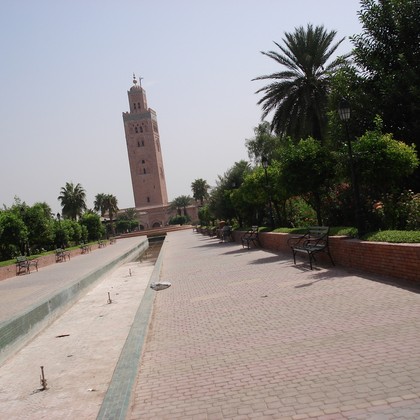
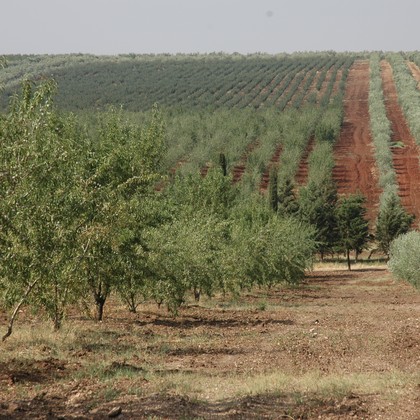
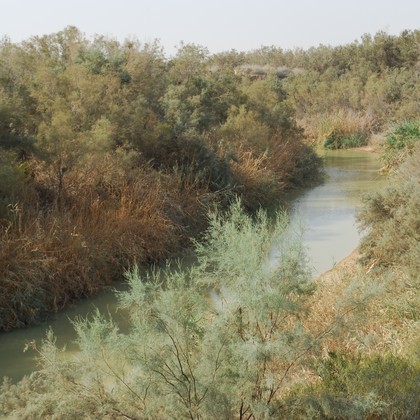
In the breeding range broadleaved forest, riverine woodland, orchards and gardens with tall trees, often near water. In the region birds have been seen in parks, gardens, date-palm groves and well-wooded wadis, usually in the shade of the mid-canopy, where they hunt flying insects.
Where the bird is most at home, classified by the habitats of North Africa and the Middle East.
Range and movements
A rare vagrant to the region, with a few records in Oman and the United Arab Emirates, mainly in autumn and winter; there are no confirmed records elsewhere in the region. Beyond the region it breeds from Turkmenistan, Uzbekistan, Tajikistan and Afghanistan through Pakistan, northern and central India and the Himalayas to Nepal; it is resident in southern India and Sri Lanka. Northern birds winter in southern India and Sri Lanka.
How and when to look
There is no regular site. The best chances are in the green parks and gardens of the Emirates and northern Oman, and in Dhofar, where African Paradise Flycatcher also occurs; a white paradise flycatcher there deserves a good photograph.
Conservation status
Not globally threatened and common in South Asia. In the region a rare vagrant without colonisation.
Scientific name
Terpsiphone paradisi | (Linnaeus, 1758)
Linnaeus described the species in 1758 as Corvus paradisi; because it was later moved to another genus, the author and year stand in brackets. The genus Terpsiphone was introduced in 1827 by Gloger. Terpsiphone comes from the Greek terpsis, 'delight', and phōnē, 'voice' — for the pleasant song of paradise flycatchers. paradisi is Latin for 'of paradise', for the splendid long tail. The specimen the first description was based on came from India.