All species › Grebes › Grebes › Horned Grebe
Horned Grebe | Podiceps auritus
Kuifduiker | Zampullín cuellirrojo
The Horned Grebe is a small, compact grebe of northern lakes that winters along the coasts of Europe. In North Africa and the Middle East it is an extreme rarity, with only a few records in Israel and Kuwait.
Voice
On the breeding grounds a rolling nasal trill and a hoarse jarr. In the region, as a vagrant outside the breeding season, almost silent.
Recording: Alan Dalton — CC BY-NC-SA 4.0 · shortened to the first 60 s, mono · xeno-canto
Identification
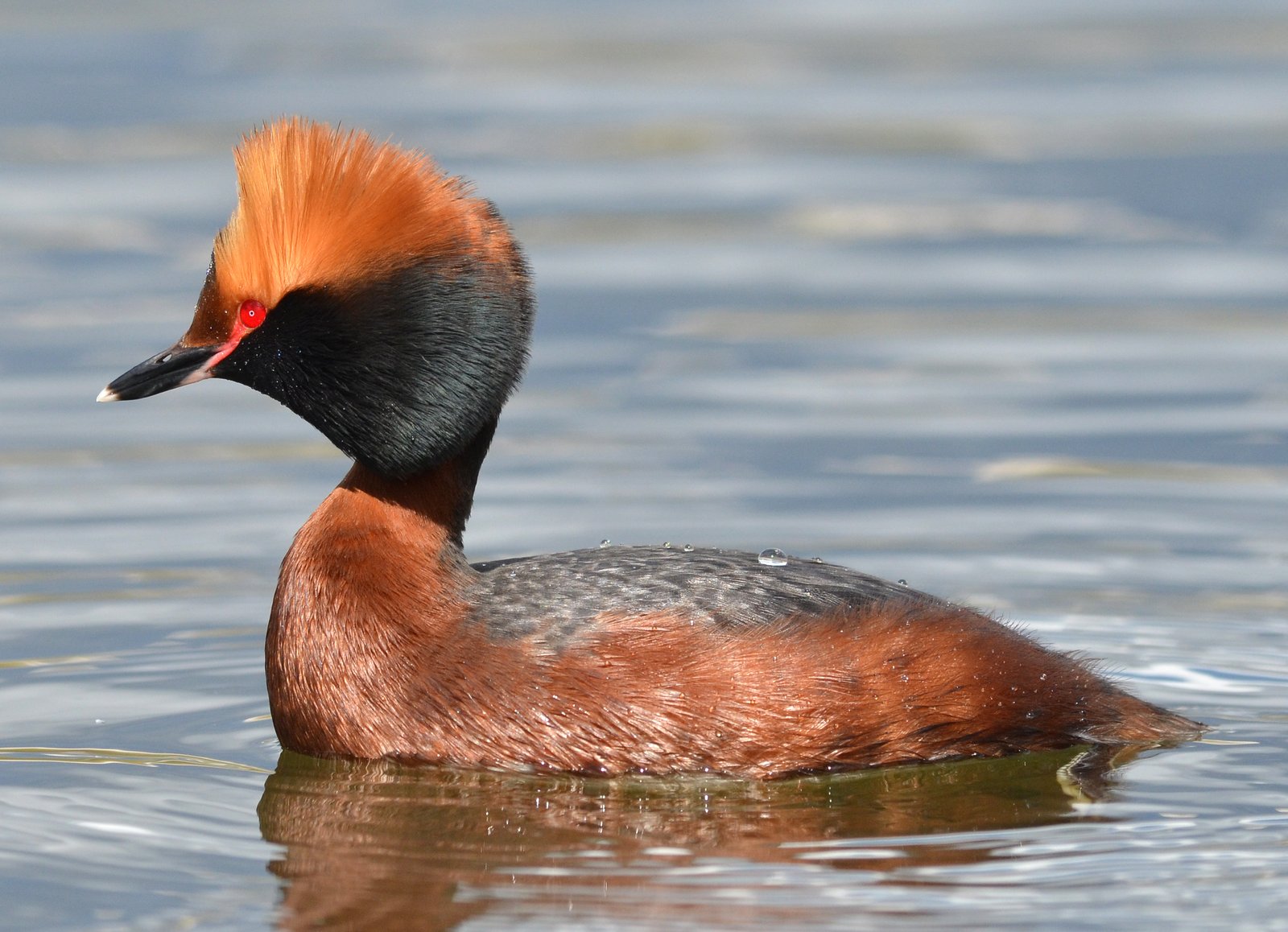
Small and compact, with a flat crown, a fairly thick neck and a short, straight bill with a pale tip; the eye is red. In breeding plumage a black head with a broad golden band running back from the eye, which can be raised like a pair of horns, and rufous neck and flanks. In winter crisply black and white: a black cap ending exactly at eye level, clean white cheeks and foreneck, and often a small pale spot between eye and bill. In flight white patches on the leading and trailing edges of the wing.
Confusion species
Eared Grebe (Podiceps nigricollis), common in the region in winter, is the main pitfall: it has a steep forehead peaking above the eye, a thin, slightly upturned bill without a pale tip and, in winter, dirtier cheeks with the black extending below the eye. Little Grebe (Tachybaptus ruficollis) is smaller, browner and rounder.
Habitat
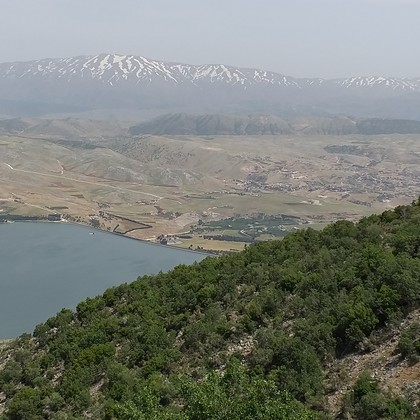
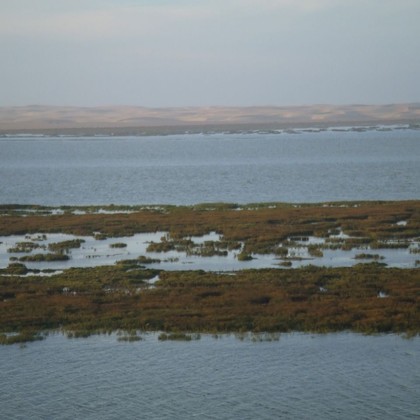
Breeds on shallow, vegetated lakes in the boreal zone. Winters mainly at sea in sheltered bays and along coasts, and in smaller numbers on large inland waters. The few birds in the region were found on sewage ponds, reservoirs and the Sea of Galilee.
Where the bird is most at home, classified by the habitats of North Africa and the Middle East.
Range and movements
A very rare vagrant to the region. In Israel a few records since 1981: a bird in summer 1981 at the Ashdod sewage ponds, one in 1993 at Hulda reservoir, one in winter 2004–2005 on the Sea of Galilee, and a wintering bird in 2016–2017. In Kuwait two winter records, in 1988 and 2013, at pools near Jahra. Not recorded elsewhere in the region as far as known. Beyond the region it breeds in Iceland, Scotland, Scandinavia and from Russia to Siberia and North America, wintering along the coasts of north-west Europe, the Black Sea and the Caspian.
How and when to look
Check any winter Eared Grebe that looks strikingly flat-headed and clean black and white, especially in Israel and Kuwait. Note the straight, pale-tipped bill and the straight border between black cap and white cheek; a photograph is essential for acceptance by the national rarities committee.
Conservation status
Vulnerable on the global Red List, owing to continuing declines in Europe and North America: loss and pollution of breeding lakes, predation and drowning in fishing nets in the wintering areas. As a vagrant the species plays no part in conservation in the region.
Scientific name
Podiceps auritus | (Linnaeus, 1758)
Linnaeus described the species in 1758 as Colymbus auritus; because it was later moved to another genus, the author and year stand in brackets. The genus Podiceps was introduced in 1787 by Latham. Podiceps is Latin, from podex, genitive podicis, 'rear end', and pes 'foot', after the legs set far back on the body. auritus is Latin for 'eared', from auris 'ear', after the golden tufts behind the eye in breeding plumage. The specimen the first description was based on came from Sweden.