All species › Woodpeckers and allies › Woodpeckers › Great Spotted Woodpecker
Great Spotted Woodpecker | Dendrocopos major
Grote bonte specht | Pico picapinos
Europe's familiar pied woodpecker occurs in the region only in the Maghreb, with two distinct subspecies: mauritanus in Morocco and the striking numidus in Algeria and Tunisia, which has a red-and-black breast band. In the Middle East it is replaced by Syrian Woodpecker.
Voice
A sharp, explosive kik! or tchik, often repeated, and a rapid rattling kre-kre-kre when excited. The drum roll is short, powerful and stops abruptly, and is heard from winter into spring.
Recording: Walter Wallner — CC BY-NC-SA 4.0 · converted to mono · xeno-canto
Identification
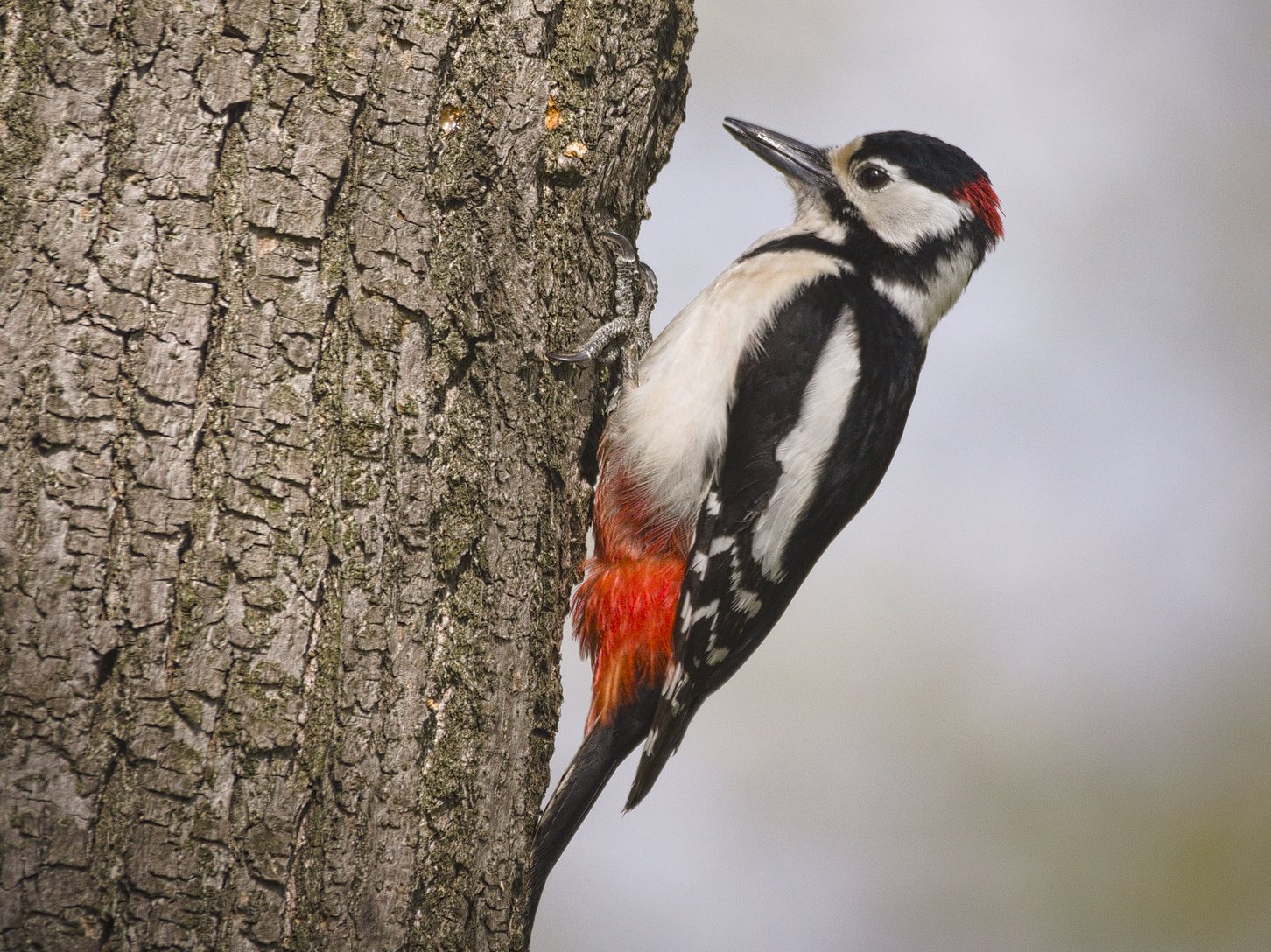
Medium-sized and pied, with large white shoulder patches, white-barred flight feathers and scarlet undertail coverts. The white face is enclosed by a black moustache that runs through to the nape, with a black link to the breast side. The male has a red nape patch, the female no red on the head, juveniles a red cap. The North African races are dirtier and browner below than European birds: mauritanus often has some red in the centre of the breast, numidus a distinct breast band of black feathers with red tips.
Confusion species
Syrian Woodpecker (Dendrocopos syriacus) does not occur in the Maghreb; elsewhere it is told by the moustache not reaching the nape, the pink undertail and the less white outer tail feathers. Lesser Spotted Woodpecker (Dryobates minor) is much smaller, sparrow-sized, without white shoulder patches and with a white-barred back. In the Maghreb it cannot otherwise be confused.
Habitat
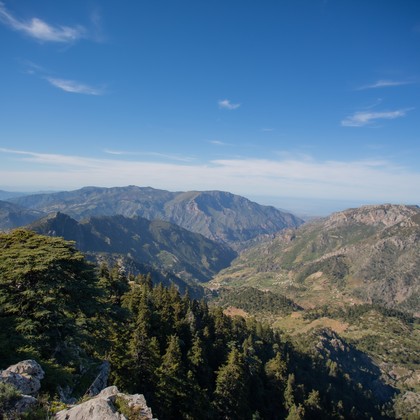
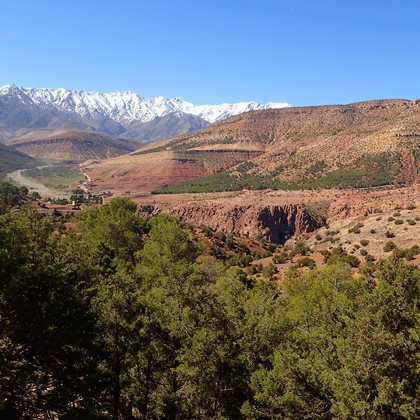
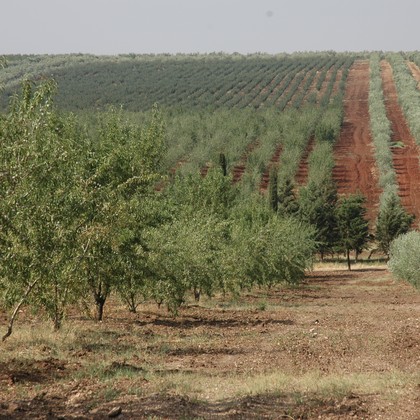
Woodland of all kinds with dead and old trees: cork and holm oak forest, cedar, pine and fir forest (Abies in the Rif and Kabylia), also forest edges, riverine woods and old olive and fruit groves. In Morocco from the lowlands to about 2,200 m. Excavates its nest hole in a dead or diseased trunk and works pine and cedar cones in an anvil in winter.
Where the bird is most at home, classified by the habitats of North Africa and the Middle East.
Range and movements
In Morocco widespread in the Rif, Middle Atlas, High Atlas and the woodlands of the north-western lowlands, such as the Mamora (mauritanus). In Algeria through the wooded Tell and Kabylia and in the mountains of the Saharan Atlas, and in northern Tunisia in the Kroumirie, Mogods and the woods of the Dorsale (numidus). Absent from Libya and Egypt. It does not breed in the Levant or Mesopotamia; pied woodpeckers reported there are Syrian Woodpeckers. Beyond the region it breeds across almost all of Europe, Turkey, the Caucasus and northern Iran to Siberia, China and Japan, and in the Canary Islands.
- Resident
- Summer visitor (c. Apr–Sep)
- Winter visitor (c. Oct–Mar)
- Passage (Mar–Apr, Oct–Nov)
- dark = core range, pale = thinly spread
How and when to look
It is common in the cedar forests around Ifrane and Azrou and in the Mamora cork-oak forest; its drumming gives it away as early as January and February. To see the red-banded numidus, search the forests around Aïn Draham in the Tunisian Kroumirie or in Kabylia.
Conservation status
Not globally threatened, and common and increasing in Europe. Fairly common in Maghreb woodlands, but dependent on forest with old and dead trees; logging, forest fires and overgrazing that prevents regeneration threaten its habitat locally.
Scientific name
Dendrocopos major | (Linnaeus, 1758)
Linnaeus described the species in 1758 as Picus major; because it was later moved to another genus, the author and year stand in brackets. The genus Dendrocopos was introduced in 1816 by Koch. Dendrocopos is Greek, from dendron 'tree' and kopos 'striking'. major is Latin for 'larger', distinguishing it from the smaller pied woodpeckers. The specimen the first description was based on came from Sweden.