All species › Passerines › Shrikes › Great Gray Shrike
Great Gray Shrike | Lanius excubitor
Klapekster | Alcaudón norteño
The Great Grey Shrike is the region's big grey shrike of steppe, desert edge and wadi, from Morocco's Atlantic coast to Socotra. It is represented here by a series of desert forms formerly lumped as Southern Grey Shrike (Lanius meridionalis) and now placed in this species; only the Iberian form has been split off as a separate species. Conspicuous on a lookout on a bush, post or wire.
Voice
The call is a hard, nasal shek or chek-chek, and a harsh scolding when alarmed. The song, mainly in early winter and spring, is a quiet mixture of short whistles, scratchy notes and mimicry, often with a repeated too-ip.
Recording: Stanislas Wroza — CC BY-NC-SA 4.0 · converted to mono · xeno-canto
Identification
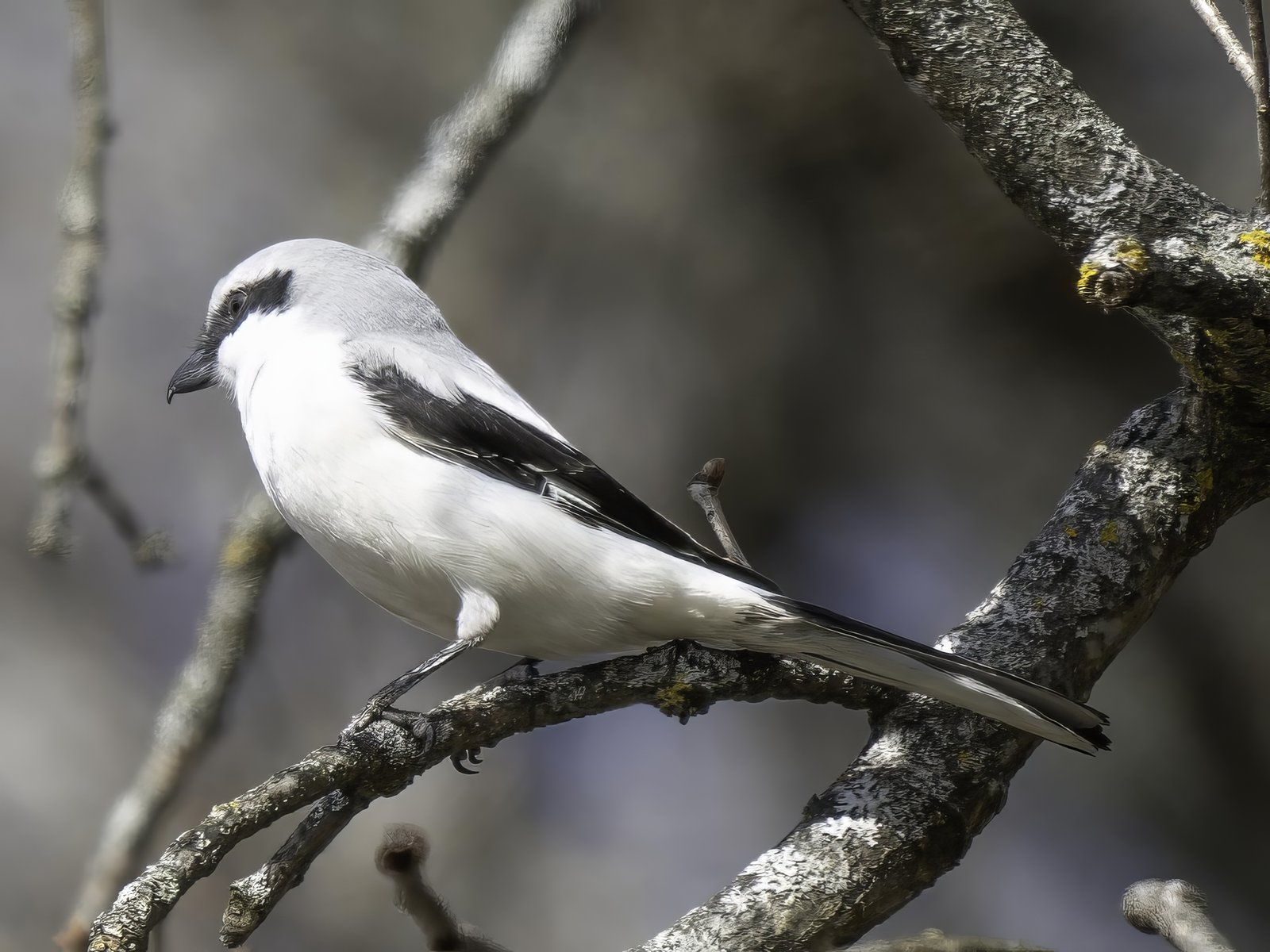
23–26 cm. Large, long-tailed and grey, black and white: grey upperparts, a black mask from bill to ear-coverts, black wings with a white primary patch and a long black tail with white sides. Underparts white to greyish. The forms differ strongly: algeriensis in the northern Maghreb is dark slate-grey with grey flanks and a narrow white supercilium; elegans in the Sahara is much paler, silvery grey with clean white underparts, much white in the wing and a white rump; aucheri in the Middle East and Arabia is mid-grey with a black forehead band and a greyish breast; buryi in Yemen is the darkest, and uncinatus on Socotra has a heavy, strongly hooked bill. The winter visitor pallidirostris (Steppe Grey Shrike) is pale sandy grey with a pale horn bill, a narrow mask not reaching in front of the eye and much white in the wing. Juveniles are browner and finely barred below.
Confusion species
Lesser Gray Shrike (Lanius minor) is smaller and shorter-tailed with relatively longer wings; adults have a broad black forehead and a pinkish breast, and no white supercilium. Iberian Grey Shrike (Lanius meridionalis) closely resembles algeriensis but has a distinctly pink breast, darker grey upperparts and a fine white supercilium; in the region it is at most a vagrant. Masked Shrike (Lanius nubicus) is much smaller and slimmer, with a black back and orange flanks.
Habitat
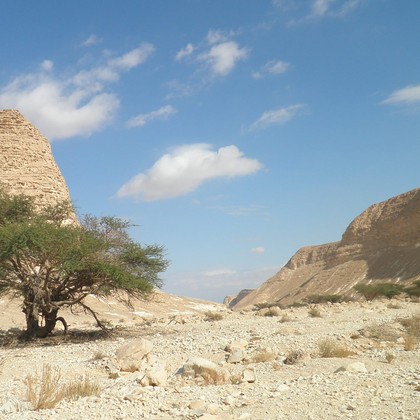
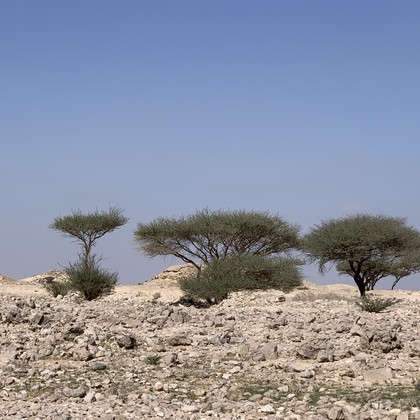
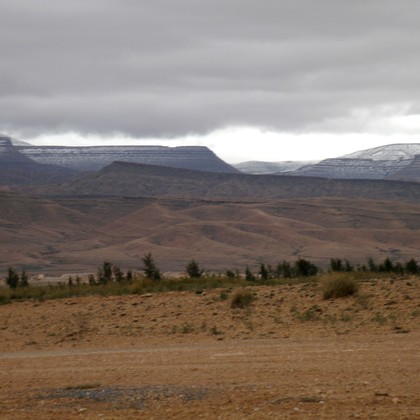
Open, dry country with scattered bushes or trees as lookouts: steppe and alfa plains, semi-desert, wadis with acacias and tamarisk, oases and the edges of fields and palm groves; in Yemen high into the mountains. Hunts from a perch for large insects, lizards, small rodents and birds, and impales prey on thorns or barbed wire.
Where the bird is most at home, classified by the habitats of North Africa and the Middle East.
Range and movements
In the northern Maghreb the form algeriensis: in the Atlantic lowlands and interior of Morocco to northern Algeria, Tunisia and north-west Libya. South of it the pale elegans throughout the Sahara, from southern Morocco and Western Sahara through Algeria, Tunisia and Libya to Egypt's Western Desert; the related leucopygos on the southern edge of the Sahara. From eastern Egypt and Sinai through Israel, Jordan, Syria, Iraq and almost all of the Arabian Peninsula the form aucheri (in northern Israel and southern Lebanon the related theresae), in Yemen buryi and on Socotra uncinatus. In winter Steppe Grey Shrikes (pallidirostris) from Central Asia arrive, mainly in eastern Arabia, the Emirates, Oman, Kuwait and Iraq, scarcer in Saudi Arabia, Israel and Egypt. Beyond the region the species breeds from northern Europe across Siberia to North America, and in the Sahel, Central Asia and India.
- Resident
- Summer visitor (c. Apr–Sep)
- Winter visitor (c. Oct–Mar)
- Passage (Mar–Apr, Oct–Nov)
- dark = core range, pale = thinly spread
How and when to look
Drive slowly along the tracks of the Moroccan desert edge near Merzouga or Boumalne and check every lone bush or telegraph pole; in Israel and Jordan along the Arava and around Wadi Rum. In the Emirates and Oman the Steppe Grey Shrike is a regular winter visitor to waste ground and farmland, for example around Al Ain and at Sun Farms in Sohar.
Conservation status
Not globally threatened. Widespread in the region, although algeriensis has declined locally in North Africa through conversion of steppe to cropland, overgrazing and insecticide use; drought also affects the desert forms. The taxonomy of the grey shrikes is still in flux: some authors treat the desert forms as a separate species.
Scientific name
Lanius excubitor | Linnaeus, 1758
Linnaeus described the species in 1758 and placed it straight away in the genus where it still stands. He introduced the genus Lanius in that same work. Lanius is Latin for 'butcher', from shrikes' habit of impaling prey on thorns and barbed wire. excubitor is Latin for 'watchman, sentinel'; the full name means 'sentinel butcher', for the bird watching from a high perch. The specimen the first description was based on came from Sweden.