All species › Pelicans, herons and ibises › Ibises and spoonbills › Glossy Ibis
Glossy Ibis | Plegadis falcinellus
Zwarte ibis | Morito común
A dark, slender ibis with a long decurved bill that passes in flight as a line of black crosses with neck and legs outstretched. In the region it breeds in a few marshes of North Africa and southern Iraq, but as a passage migrant and winter visitor it can turn up anywhere, from the Moroccan merjas to the oases of Arabia.
Voice
Usually silent. At colonies and when flushed a low, hoarse grrr or a nasal, grating kraa-kraa.
Recording: Xavier Riera — CC BY-NC-SA 4.0 · converted to mono · xeno-canto
Identification
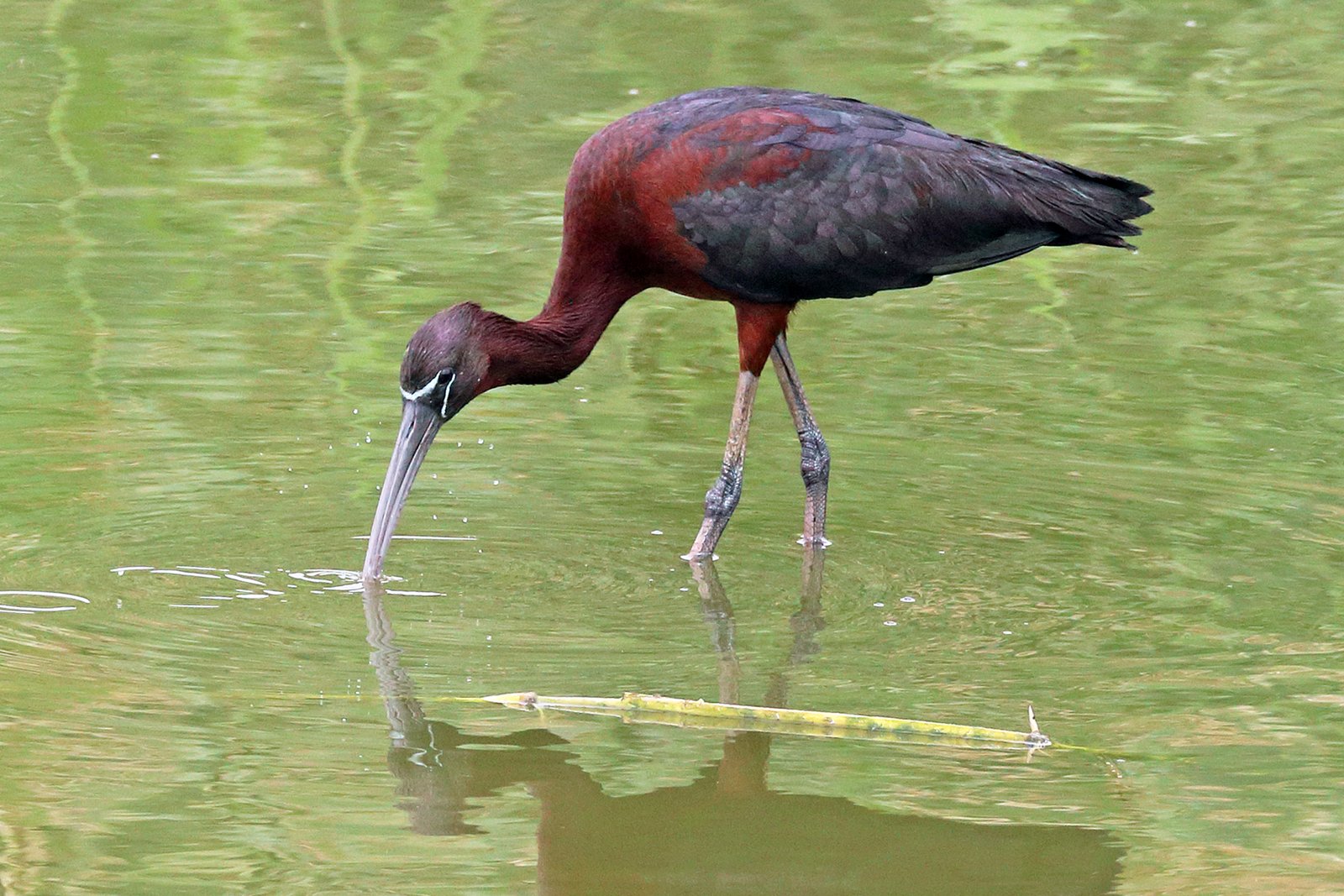
Medium-sized, with long legs, a long neck and a long, evenly decurved bill. In the breeding season the head, neck and body are deep chestnut and the wings glossed metallic green and purple; a narrow blue-white line borders the bare lores. In winter plumage the head is dark with fine white streaks and the body duller. Juveniles are duller brown with little gloss and pale flecks on the head and neck. Bill brown, legs dark greenish-brown. Flies with neck and legs extended, alternating flaps and glides, often in lines or loose V's.
Confusion species
At a distance and against the light it may recall Great Cormorant (Phalacrocorax carbo) or Eurasian Curlew (Numenius arquata), but the combination of dark plumage, decurved bill and long legs is unique. Northern Bald Ibis (Geronticus eremita) is larger and bulkier, with a bare red head, red bill and legs and a shaggy ruff, and lives on dry steppe and cliffs rather than in marshes. A juvenile African Sacred Ibis (Threskiornis aethiopicus) has a paler, dirty-white body.
Habitat
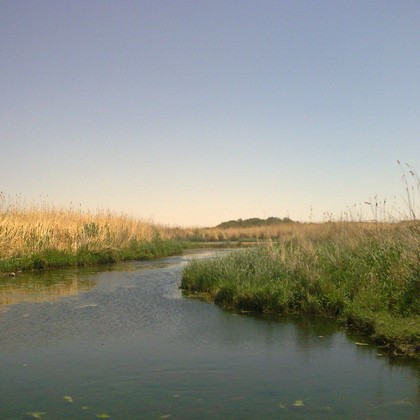
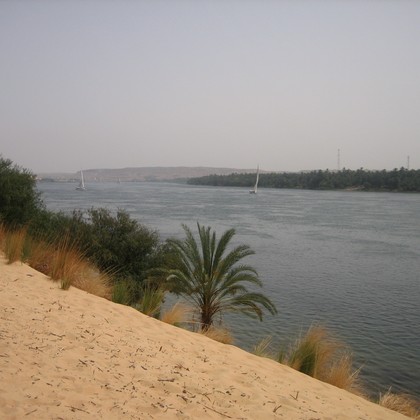
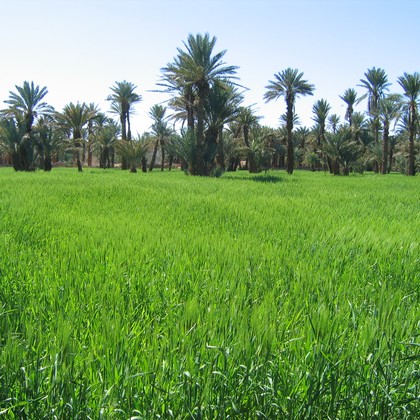
Freshwater marshes with shallow water, flooded grassland, rice fields, fishponds, riverbanks and lagoon edges; on passage also irrigated farmland, sewage ponds and oases. Probes in mud and shallow water for insect larvae, snails, worms and small fish. Breeds in mixed colonies with herons in reeds, tamarisks or bushes over water.
Where the bird is most at home, classified by the habitats of North Africa and the Middle East.
Range and movements
In North Africa it breeds locally in north-west Morocco and in the marshes of north-east Algeria (around El Kala and Lake Fetzara); in Tunisia and Libya mainly a passage migrant. In Egypt it winters and passes through in the Nile Delta and Nile Valley. In the east it breeds in the marshes of southern Iraq and locally in Syria, and occasionally in Israel. On passage, mainly in April – May and August – October, it appears in almost every country of the region, including oases, irrigated fields and sewage ponds in Arabia; small numbers winter in Israel, along the Persian Gulf and in Oman. Beyond the region it breeds patchily in southern and eastern Europe, Central and South Asia, Africa, Australia and eastern America; European birds winter largely in the Sahel and West Africa.
- Resident
- Summer visitor (c. Apr–Sep)
- Winter visitor (c. Oct–Mar)
- Passage (Mar–Apr, Oct–Nov)
- dark = core range, pale = thinly spread
How and when to look
In April and May flocks move up the Jordan Valley and rest on the fishponds of the Hula and Beit She'an valleys, often with herons. In Egypt it feeds in winter in the rice fields and canals of the Nile Delta. A line of dark birds with long, drooping bills flying low over a marsh is almost always this species.
Conservation status
Not globally threatened, and increasing in western Europe and North Africa in recent decades; the Moroccan and Algerian breeders probably derive partly from Spain. In the region it depends on marshes under pressure from drainage, water abstraction and drought, especially in Iraq, where the partial restoration of the marshes after 2003 also benefited this species.
Scientific name
Plegadis falcinellus | (Linnaeus, 1766)
Linnaeus described the species in 1766 as Tantalus Falcinellus; because it was later moved to another genus, the author and year stand in brackets. The genus Plegadis was introduced in 1829 by Kaup. Plegadis is Greek, from plēgas, plēgados 'sickle', after the curved bill. falcinellus is a Latin diminutive of falx, falcis 'sickle': 'little sickle', likewise after the bill. The specimen the first description was based on came from Java and Sulawesi.