All species › Waterfowl › Ducks, geese and swans › Garganey
Garganey | Spatula querquedula
Zomertaling | Cerceta carretona
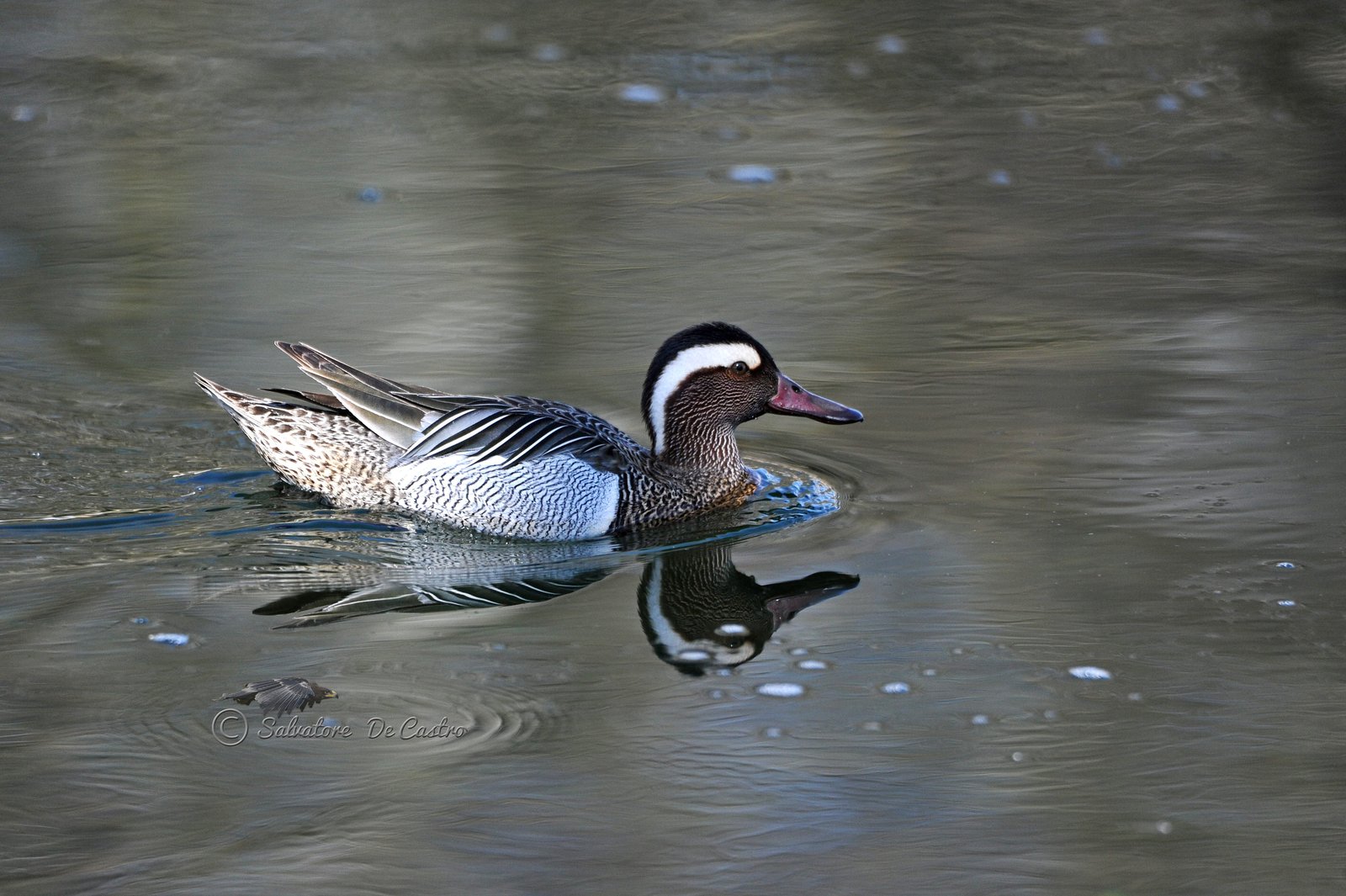
A small, slender dabbling duck known in the region mainly as a migrant. Whole flocks from the Sahel and East Africa move north along the Nile, through the Jordan Valley and over the Arabian Gulf coast in February and March, when the male stands out by the broad white sickle across the brown head.
Voice
The male gives a dry crackling rattle, krrrrr, like a nail run down a comb, heard mainly in spring at roosts. The female gives a short hoarse knek.
Recording: Stanislas Wroza — CC BY-NC-SA 4.0 · converted to mono · xeno-canto
Identification
Small, with a straight grey bill and a flat crown. The breeding male has a chocolate-brown head with a broad white supercilium reaching the nape, a brown-mottled breast, grey finely vermiculated flanks and long drooping black-and-white scapulars. In flight he shows a pale blue-grey forewing. The female is brown with a strongly marked face: dark eye-stripe, pale supercilium, a dark cheek bar, a pale spot at the bill base and a white throat; her speculum is dull with broad white borders. Eclipse males resemble females but keep the blue-grey forewing.
Confusion species
The female closely resembles Eurasian Teal (Anas crecca), which has a plainer face without the pale loral spot, a shorter bill and a glossy green speculum. Females of Blue-winged Teal (Spatula discors), a vagrant, have a broken white eye-ring, a pale bill base and yellowish legs. Marbled Teal (Marmaronetta angustirostris) is greyish-buff with spotting and a dark eye patch, and lacks the striped face.
Habitat
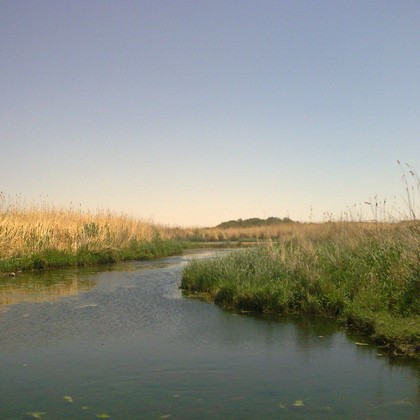
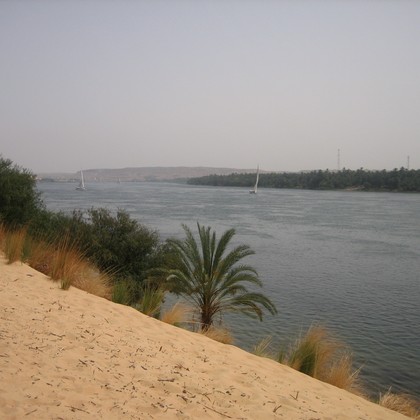
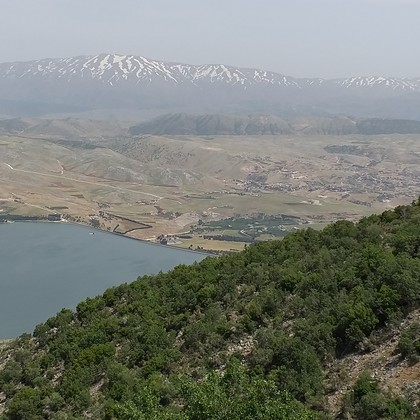
Shallow fresh to brackish marshes with plenty of fringing vegetation: flooded fields, reed edges, rice paddies, the lakes of the Nile Delta, the marshes of southern Iraq and treated-water pools in the Gulf states. Also rests in flocks on open lagoons and reservoirs. Feeds by sieving at the surface, taking seeds, water plants and small invertebrates.
Where the bird is most at home, classified by the habitats of North Africa and the Middle East.
Range and movements
A passage migrant throughout the region, with the largest numbers in spring along the Nile and the Egyptian Mediterranean coast, through Israel and the Jordan Valley, in southern Iraq and along the Red Sea and the Gulf coasts of Saudi Arabia, Kuwait, Qatar, Bahrain, the Emirates and Oman; more scattered in autumn. Small numbers winter in the Nile Delta, southern Iraq, Yemen and Oman. Breeds sporadically in Morocco, Algeria and Tunisia and very sparsely in Iraq and Syria. Beyond the region it breeds from Europe to eastern Siberia and winters in the Sahel, East Africa, South Asia and South-East Asia.
- Resident
- Summer visitor (c. Apr–Sep)
- Winter visitor (c. Oct–Mar)
- Passage (Mar–Apr, Oct–Nov)
- dark = core range, pale = thinly spread
How and when to look
Spring is the time: in March flocks of tens to hundreds rest at the fishponds of the Hula and Beit She'an valleys, on the Nile Delta lakes and on the pools around Eilat, and in the Gulf states at treated-water lagoons. Check small ducks carefully: Eurasian Teal often mix in, and in the west there is the odd Blue-winged Teal.
Conservation status
Not threatened, although the European and West Asian breeding populations have declined steeply. On migration it is vulnerable to hunting, especially along the Nile and in the Sahel, and to the loss of shallow wetlands. One of the few ducks that crosses the Sahara almost in its entirety to winter in tropical Africa.
Scientific name
Spatula querquedula | (Linnaeus, 1758)
Linnaeus described the species in 1758 as Anas Querquedula; because it was later moved to another genus, the author and year stand in brackets. The genus Spatula was introduced in 1822 by Boie. Spatula is Latin for 'spoon' or 'spatula', after the broad, spoon-shaped bill of the shoveler. querquedula is a Latin name for a small duck or teal, thought to imitate the bird's rattling call. The specimen the first description was based on came from Sweden.