All species › Waterfowl › Ducks, geese and swans › Ferruginous Duck
Ferruginous Duck | Aythya nyroca
Witoogeend | Porrón pardo
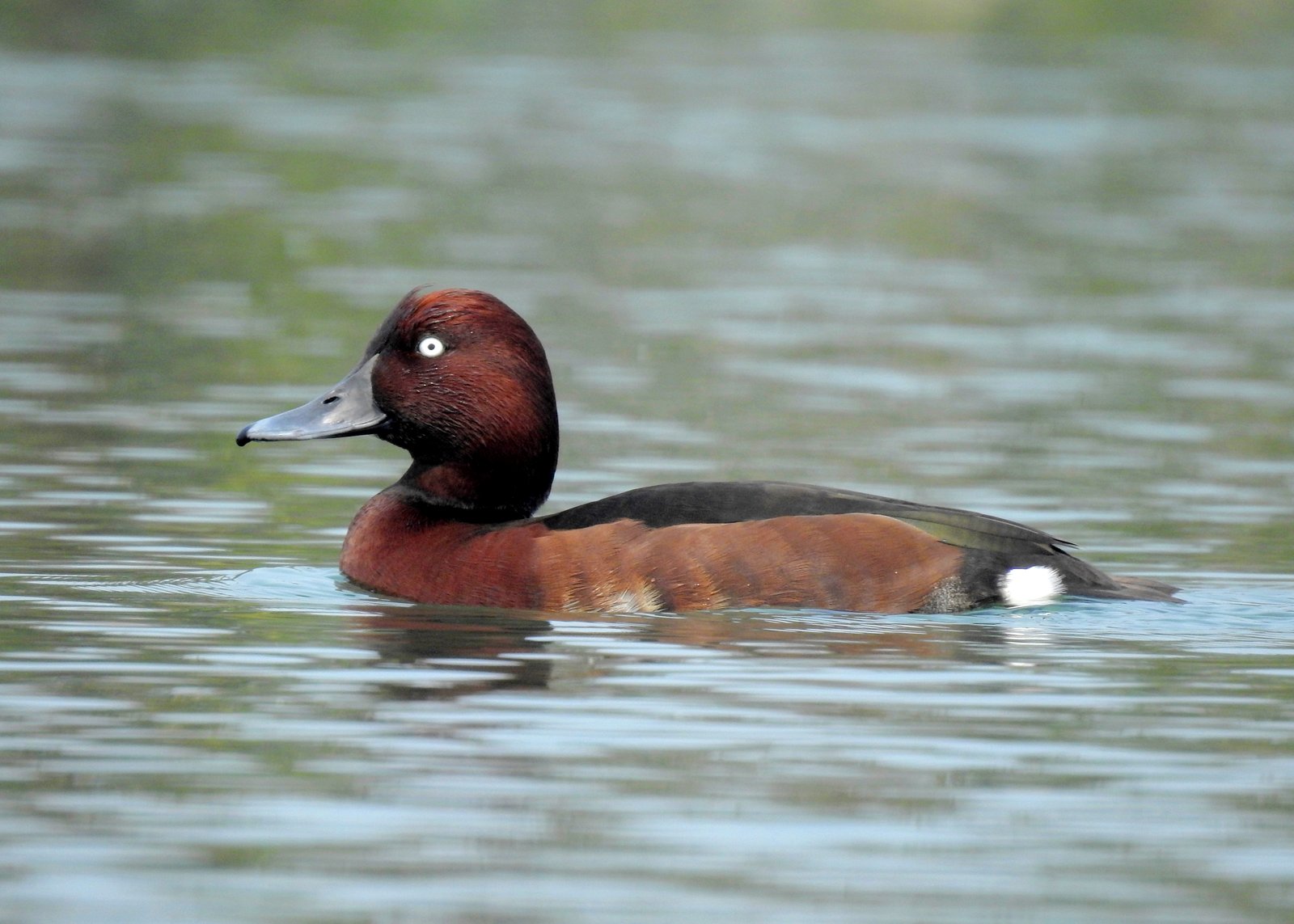
A small, dark mahogany-brown diving duck with a bright white undertail that likes to keep among reeds and floating plants. The lakes near El Kala in north-eastern Algeria and the marshes of southern Iraq are the region's main breeding areas; in the rest of North Africa and the Middle East it is seen mainly on passage and in winter.
Voice
Largely silent. In display the male gives a soft chuk and a whistled wee-oo, the female a harsh, repeated err-err-err.
Recording: András Schmidt — CC BY-NC-SA 4.0 · converted to mono · xeno-canto
Identification
About 40 cm, compact, with a high, somewhat peaked crown in the centre of the head and a fairly long dark grey bill with a black tip. The male is rich chestnut to mahogany brown, darker on the back, with a striking white eye and sharply defined white undertail coverts; in flight a white belly patch also shows. The female is duller and browner, with a dark eye, but also has a white undertail. In flight there is a broad, bright white wingbar that extends well into the primaries.
Confusion species
The female Tufted Duck (Aythya fuligula) can also show a white undertail, but has a rounded head with a short tuft, a yellow eye and colder brown tones. The female Common Pochard (Aythya ferina) is greyer with a pale spectacle and has a grey wingbar. Hybrids between Ferruginous Duck and Common Pochard or Tufted Duck occur and call for attention to head shape, bill pattern and undertail colour.
Habitat
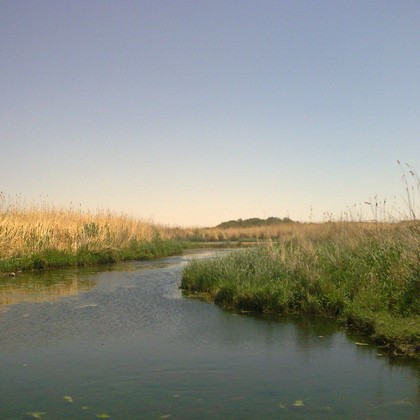
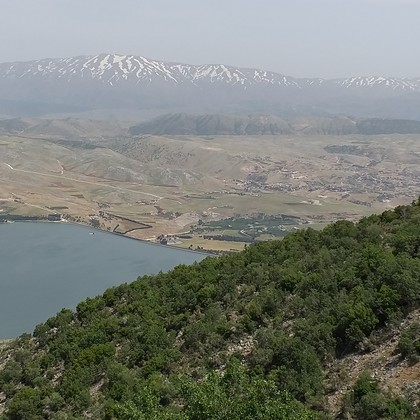
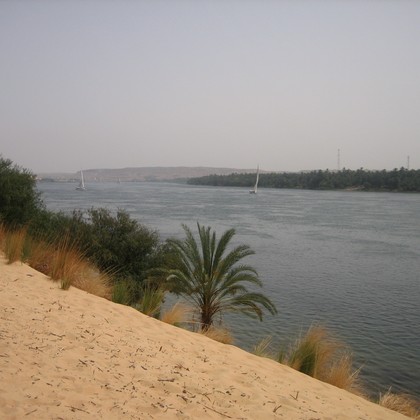
Shallow, nutrient-rich fresh waters with plenty of fringing, floating and submerged vegetation, reed fringes and open patches among the plants. Outside the breeding season also on larger lakes, reservoirs and rivers, often close to the edge. It dives for seeds, aquatic plants and invertebrates and also dabbles in shallow water.
Where the bird is most at home, classified by the habitats of North Africa and the Middle East.
Range and movements
In Algeria an important breeder on the lakes near El Kala (including Lac Tonga and Lac des Oiseaux), and scarce on the Hauts Plateaux. In Morocco a scarce breeder at a few wetlands in the north and the Middle Atlas; a small number breed in northern Tunisia. In Egypt mainly a winter visitor to the Nile Delta and the coastal lakes. In Israel, Jordan and Syria a scarce passage migrant and winter visitor. In Iraq it breeds in the Mesopotamian marshes and winters there in numbers. On the Arabian Peninsula, from Kuwait to Oman and Yemen, a scarce winter visitor to wetlands and sewage pools. Beyond the region it breeds from eastern Europe to Central Asia and western China and winters south to the Sahel and India.
- Resident
- Summer visitor (c. Apr–Sep)
- Winter visitor (c. Oct–Mar)
- Passage (Mar–Apr, Oct–Nov)
- dark = core range, pale = thinly spread
How and when to look
In spring Lac Tonga in El Kala National Park is the best site: scan the edges of the floating vegetation. If you see a dark diving duck among Common Pochards, wait until it shows its rear end: the white undertail is the best feature, even at a distance.
Conservation status
Near Threatened. The species declined steeply in the last century through the drainage and pollution of wetlands and through hunting. The populations of north-eastern Algeria and Iraq are of great importance; in Iraq the species benefited from the restoration of the marshes after 2003, but upstream water abstraction and drought threaten that recovery.
Scientific name
Aythya nyroca | (Güldenstädt, 1770)
Güldenstädt described the species in 1770 as Anas nyroca; because it was later moved to another genus, the author and year stand in brackets. The genus Aythya was introduced in 1822 by Boie. Aythya is from Greek aithuia, an unidentified diving seabird mentioned by Aristotle and Hesychius. nyroca goes back to the Russian word nyrok, the name for pochards. The specimen the first description was based on came from southern Russia.