All species › Tubenoses › Northern storm petrels › European Storm-Petrel
European Storm-Petrel | Hydrobates pelagicus
Stormvogeltje | Paíño europeo
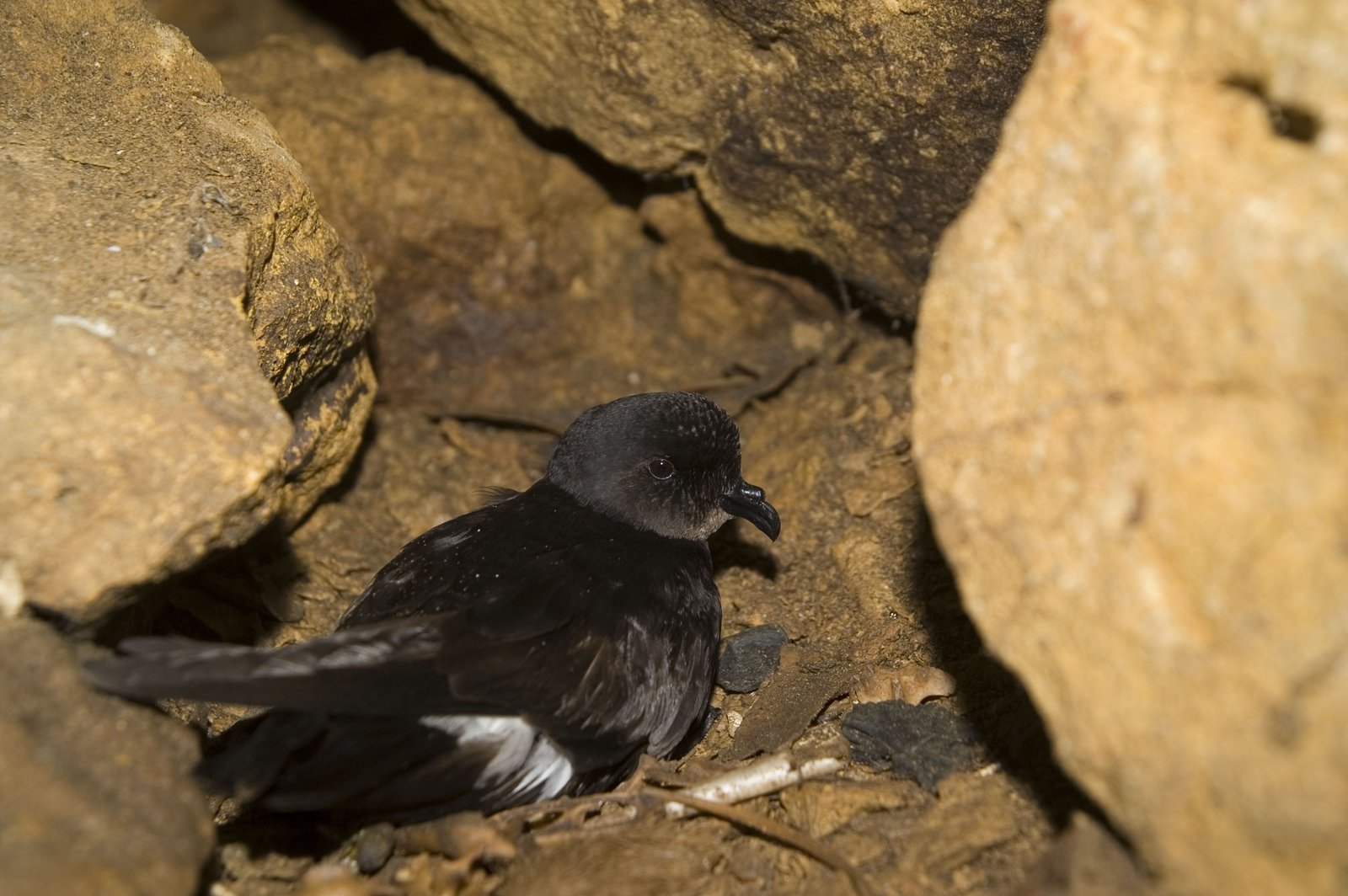
The smallest seabird of the region, barely bigger than a House Martin, fluttering low over the waves like a bat. The Mediterranean form melitensis breeds in small numbers on rocky islands off Tunisia and possibly Algeria; along the Atlantic coast of Morocco and Western Sahara, birds from north-west Europe pass through on their way to and from the waters off southern Africa.
Voice
Silent at sea. At the colony a long, purring churr comes from burrows and crevices at night, urrrrrrr, each ending in a hiccup, chikka. In flight over the colony a squeaky terr-chik.
Recording: David Boyle — CC BY-NC-SA 4.0 · converted to mono · xeno-canto
Identification
Very small and sooty black, with a short, square-cut tail and a bright white rump that wraps round onto the flanks. The best feature is a white stripe across the underwing, shown by no other storm-petrel in the region. Upperwing almost uniformly dark, with at most a narrow, faint pale bar across the greater coverts, mainly in worn birds. The short, rounded wings and feet that do not project beyond the tail give a compact shape. Flight fast and fluttering, with short glides; when feeding it hangs with its feet pattering on the water.
Confusion species
Wilson's Storm-Petrel (Oceanites oceanicus) is slightly larger, with long legs projecting beyond the tail, a clear pale bar across the upperwing and no white underwing stripe. Leach's Storm-Petrel (Hydrobates leucorhous) and Band-rumped Storm Petrel (Hydrobates castro) are clearly larger, with longer, angled wings, a forked or notched tail and a flight with long glides; they too lack the white underwing stripe.
Habitat
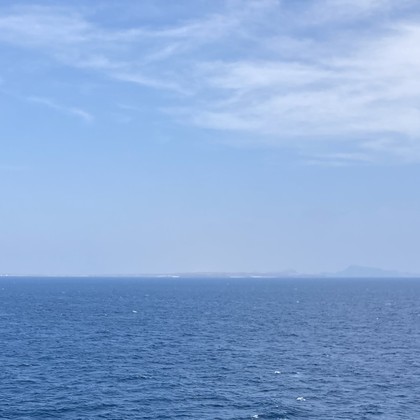
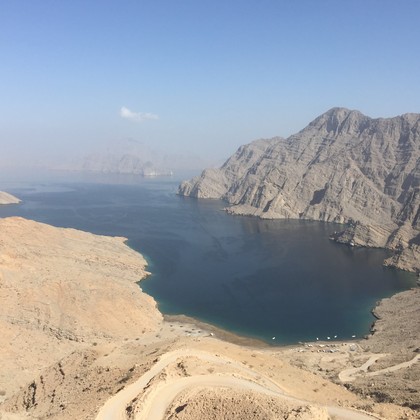
Open sea, especially over the continental shelf and along fronts where nutrient-rich water wells up; readily follows fishing boats. Breeds in crevices and burrows on uninhabited rocky islands and in old walls and coastal caves, which it visits only after dark.
Where the bird is most at home, classified by the habitats of North Africa and the Middle East.
Range and movements
Tunisia: breeds on the Galite archipelago off the north coast, the only confirmed breeding site in the region. Algeria: possibly breeds on the Habibas Islands off Oran; otherwise scarce at sea off the west coast. Morocco: probably breeds on the Mediterranean coast; a regular passage migrant through the Strait of Gibraltar and off the whole Atlantic coast, from Tangier via Cap Ghir and Agadir to the waters off Dakhla in Western Sahara, sometimes in small flocks in spring and autumn. Libya: a few winter records. Israel: a very rare vagrant off the Mediterranean coast (fewer than ten records, including off Haifa) and since July 2023 once in the Gulf of Eilat. Practically unknown from Egypt, Lebanon, Syria and the Arabian seas. Elsewhere the Atlantic form breeds from Iceland, the Faroes and Norway through Britain and Ireland to Brittany, northern Spain and the Canary Islands, and the Mediterranean form on Malta (Filfla), Sicily, Sardinia, the Balearics and in Greece. Atlantic birds winter off Namibia and South Africa; Mediterranean birds largely stay near the colonies.
- Resident
- Summer visitor (c. Apr–Sep)
- Passage (Mar–Apr, Oct–Nov)
- dark = core range, pale = thinly spread
How and when to look
From the headlands of Cap Ghir or Cap Spartel you can see them skimming low along the surf in onshore westerlies; a boat trip out of Agadir or Dakhla in May or October gives the best chance of good views. Look for the white underwing stripe and the short legs: that separates it from Wilson's Storm-Petrel, which occurs on the same trips.
Conservation status
Not globally threatened. The Mediterranean form is small in number and depends on a handful of rat-free islands; introduced rats, disturbance, coastal artificial light and bycatch are the main threats. The Galite colony is poorly studied and its size is unknown.
Scientific name
Hydrobates pelagicus | (Linnaeus, 1758)
Linnaeus described the species in 1758 as Procellaria pelagica; because it was later moved to another genus, the author and year stand in brackets. The genus Hydrobates was introduced in 1822 by Boie. Hydrobates is Greek, from hudro- 'water' and batēs 'walker': 'water walker'. pelagicus comes from Greek pelagos 'open sea' and means 'of the high seas'. The specimen the first description was based on came from the coast of Sweden.