All species › Tubenoses › Southern storm petrels › White-Faced Storm-Petrel
White-Faced Storm-Petrel | Pelagodroma marina
Bont stormvogeltje | Paíño pechialbo
A strikingly pale, long-legged storm-petrel that breeds on remote ocean islands, closest to the region on the Selvagens, the Canary Islands and Cape Verde. Despite that proximity it stays far out at sea and is seen in the waters of the region only exceptionally, both in the Atlantic and in the Arabian Sea.
Voice
Silent at sea.
Recording: Rinse van der Vliet — CC BY-NC-SA 4.0 · converted to mono · xeno-canto
Identification
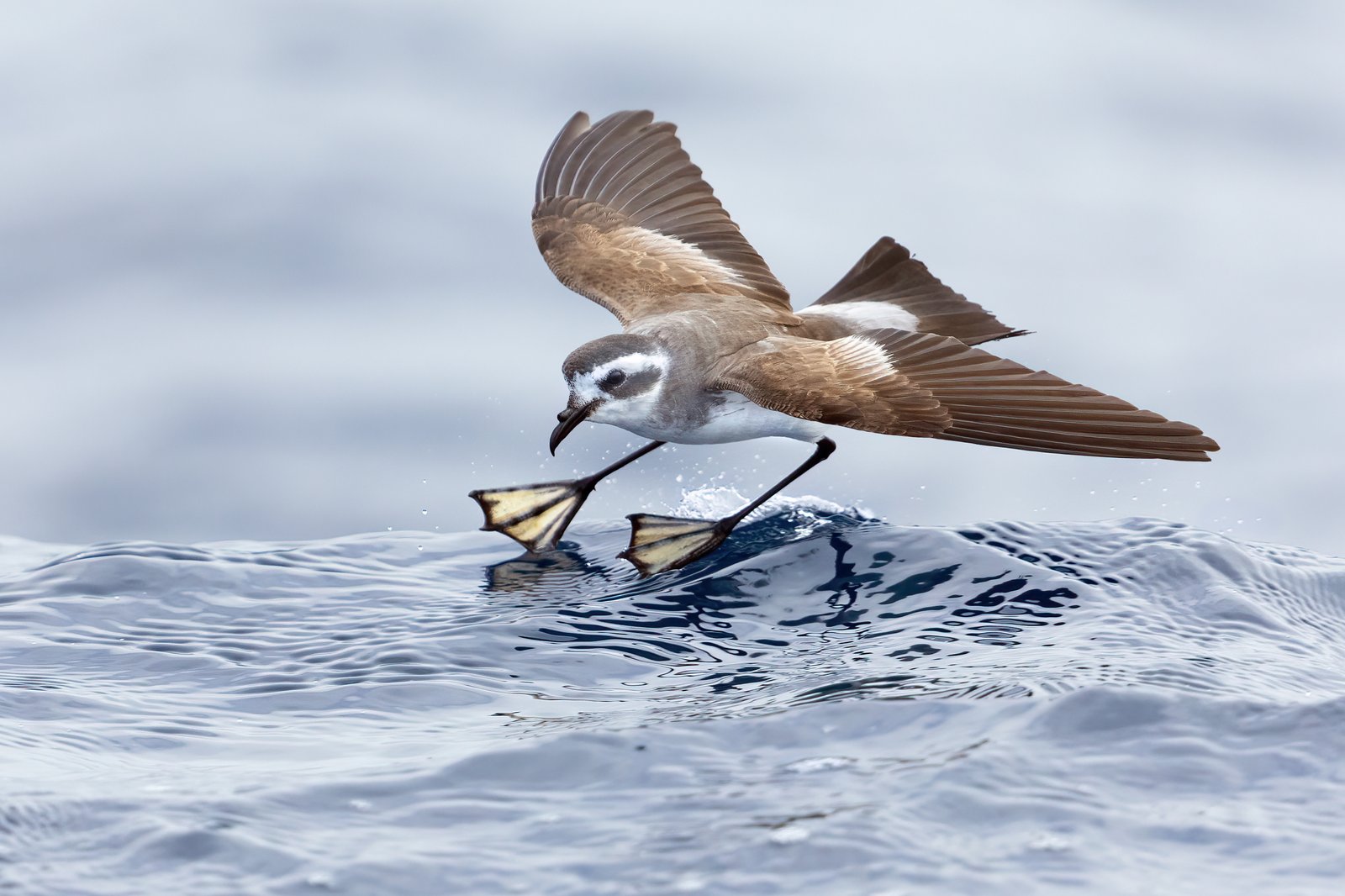
Larger than most storm-petrels, with long, broad wings and very long legs. Upperparts grey-brown with a pale grey rump, the wings darker with a pale band across the upperwing; the underparts including the underwing coverts bright white. The face is distinctive: a white supercilium above a dark eye-stripe and a grey crown, giving a "face" reminiscent of a phalarope. Feeds in a unique way: it hangs with spread wings low over the water and repeatedly pushes off with both feet together, bouncing like a pendulum across the waves.
Confusion species
No other storm-petrel in the region combines white underparts with a white face crossed by a dark eye-stripe. White-Bellied Storm-Petrel (Fregetta grallaria), recorded outside this guide in the Arabian Sea, has a black head and breast and a white rump. Red Phalarope (Phalaropus fulicarius) in winter plumage has a similar face pattern, but is a wader with a short neck that swims buoyantly on the water.
Habitat
Open ocean, especially over deep water and along fronts where water of different temperatures meets. Breeds in burrows on rocky islands free of predators.
Where the bird is most at home, classified by the habitats of North Africa and the Middle East.
Range and movements
Morocco including Western Sahara: vagrant with a few accepted records on the open sea off the Atlantic coast; given the breeding colonies on the Selvagens and the Canary Islands, it probably occurs more often than it is recorded. Oman: vagrant with a few records in the Arabian Sea; these birds probably belong to southern-hemisphere populations. No records are known from the other countries of the region. Elsewhere it breeds in the Atlantic on the Selvagens, the Canary Islands, Cape Verde, Tristan da Cunha and Gough, and further in Australia, New Zealand and the Chatham Islands; outside the breeding season it wanders over the tropical Atlantic and Indian Oceans.
How and when to look
The chance is greatest on pelagic trips from Dakhla or on a ferry between the Canary Islands and the mainland in late summer. Look for a pale, long-legged storm-petrel bouncing over the water with dangling legs.
Conservation status
Globally not threatened, with a large population. Some colonies are vulnerable to introduced rats, cats and mice, and birds are attracted to and killed by artificial light from ships and coastal development. Of no significance for the region as a vagrant.
Scientific name
Pelagodroma marina | (Latham, 1790)
Latham described the species in 1790 as Procellaria marina; because it was later moved to another genus, the author and year stand in brackets. The genus Pelagodroma was introduced in 1853 by Reichenbach. Pelagodroma is Greek, from pelagos 'open sea' and -dromos 'runner', for the way the bird patters over the water. marina is Latin for 'of the sea'. The specimen the first description was based on came from off the mouth of the Río de la Plata.