All species › Tubenoses › Northern storm petrels › Leach's Storm-Petrel
Leach's Storm-Petrel | Hydrobates leucorhous
Vaal stormvogeltje | Paíño boreal
A slim, long-winged storm-petrel of the northern oceans that migrates in autumn along the Atlantic coast of Morocco to the tropical waters off West Africa. From land it is seen mainly after strong westerly gales; in February 2023 a storm unexpectedly drove more than a hundred close to the coast of Israel.
Voice
Silent at sea. At the colony at night a fast, rhythmic, rather laughing chatter, kuk-kuk-kuk-kurr-kuk-ku, and from the burrows a long, purring churr.
Recording: Doug Hynes — CC BY-SA 4.0 · converted to mono · xeno-canto
Identification
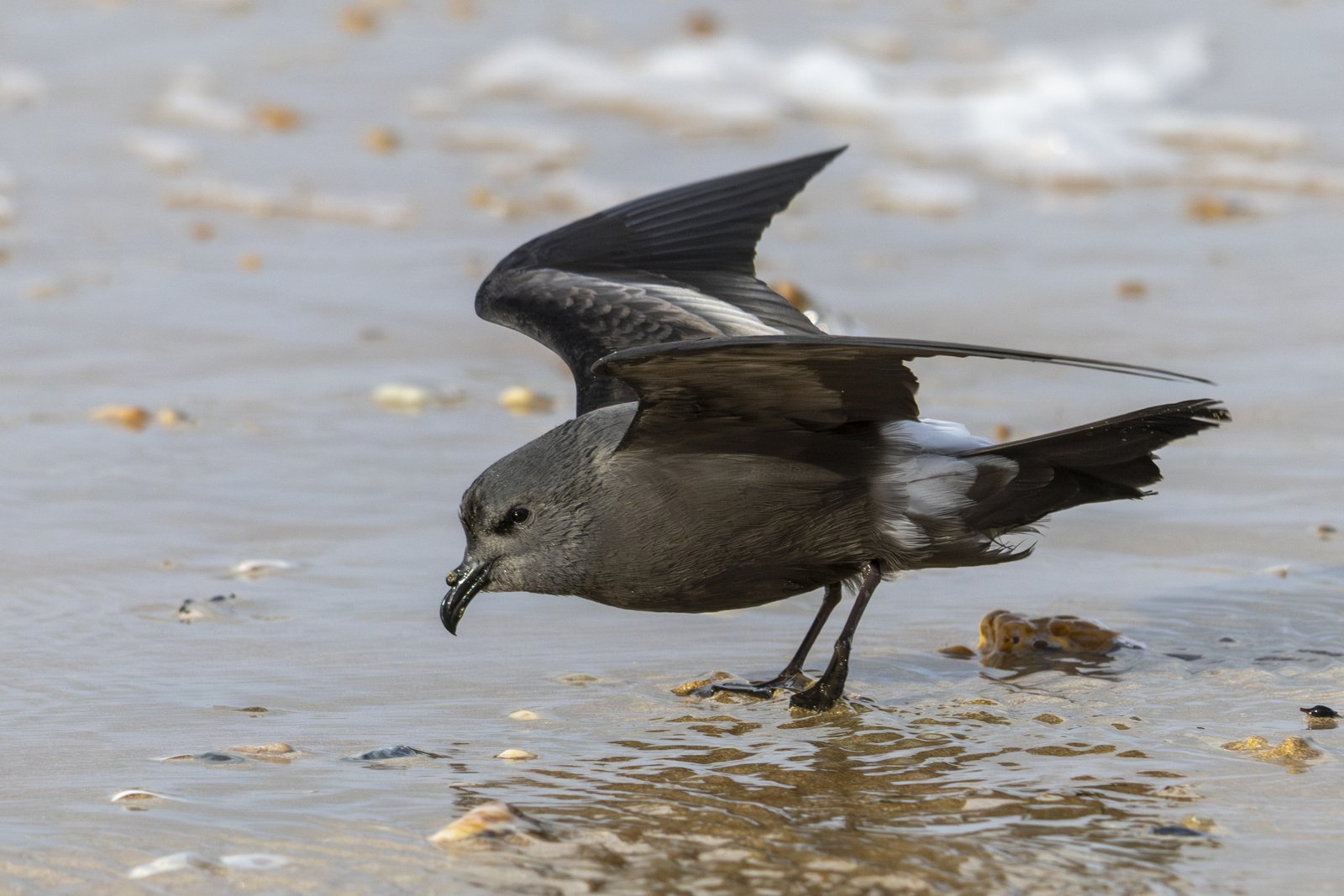
Medium-sized and dark grey-brown, with long wings sharply angled at the wrist and a clearly forked tail. The white rump is V-shaped and often split down the middle by a grey line; it does not extend far onto the sides of the undertail. A prominent pale grey-brown bar crosses the upperwing and reaches the leading edge of the wing. Head and neck slightly greyer than the back. Feet do not project beyond the tail. Flight erratic and tern-like, with deep beats, sudden swerves and short glides on bowed wings; rarely follows ships.
Confusion species
Band-rumped Storm Petrel (Hydrobates castro) has a square or slightly notched tail, a broader, bright white rump band extending further onto the undertail, a fainter wing bar and a calmer, shearwater-like flight. Wilson's Storm-Petrel (Oceanites oceanicus) is smaller, with shorter, straight wings, a square tail and feet projecting beyond the tail. European Storm-Petrel (Hydrobates pelagicus) is much smaller and more fluttery, with a white underwing stripe. Swinhoe's Storm-Petrel (Hydrobates monorhis) in the Arabian Sea is very similar in shape and flight but has a dark rump.
Habitat
Deep, open ocean, outside the breeding season mainly over the continental slope and in upwelling areas; comes close inshore, into bays and harbours, only in strong onshore winds. Breeds in burrows on islands in the northern Atlantic and Pacific, not in the region.
Where the bird is most at home, classified by the habitats of North Africa and the Middle East.
Range and movements
Morocco: a regular passage migrant and winter visitor off the Atlantic coast, mainly in November, best seen from Cap Spartel and the Strait of Gibraltar to Cap Ghir and Agadir after westerly gales. Western Sahara: a few records off Dakhla and further out at sea. Rare in the western Mediterranean, barely reported off Algeria and Tunisia. Israel: formerly only a handful of confirmed records, but on 8 February 2023, after storm Barbara, more than a hundred were counted along the coast at Jaffa and Palmachim, with more birds in the following weeks. Lebanon: two birds in November 2024. Red Sea: one trapped bird in southern Sinai (August 1978); older reports from Eilat are doubted. United Arab Emirates: one found dead at Sharjah (June 1969) and one at sea off Fujairah (May 2018). No records from Oman. Elsewhere it breeds in North America (with the largest colonies on Newfoundland), Iceland, the Faroes, Scotland and Norway, and in the northern Pacific; Atlantic birds winter in the tropical Atlantic, from West Africa to the waters off South Africa and Brazil.
- Summer visitor (c. Apr–Sep)
- Winter visitor (c. Oct–Mar)
- Passage (Mar–Apr, Oct–Nov)
- dark = core range, pale = thinly spread
How and when to look
Seawatch from a headland on the Moroccan Atlantic coast in November, on the days after a strong westerly gale; the birds then come close inshore and even into harbours. Look for the deep tail fork, the split white rump and the erratic, tern-like flight. After severe winter storms, check the Israeli and Lebanese coast as well.
Conservation status
Vulnerable. The world population still numbers millions of birds, but has declined sharply since the 1980s, above all in the large colonies on Newfoundland, through predation by gulls, attraction to artificial light and gas flares on oil platforms, mercury and plastic pollution and changes in food supply at sea. No specific threats are known within the region itself.
Scientific name
Hydrobates leucorhous | (Vieillot, 1818) (GBIF: Oceanodroma leucorhoa)
Vieillot described the species in 1818 as Procellaria leucorhoa; because it was later moved to another genus, the author and year stand in brackets. The genus Hydrobates was introduced in 1822 by Boie. Hydrobates is Greek, from hudro- 'water' and batēs 'walker': 'water walker'. leucorhous is Greek, from leukos 'white' and orrhos 'rump', after the white rump band. The specimen the first description was based on came from the coast of Picardy.