All species › Passerines › Orioles › Eurasian Golden Oriole
Eurasian Golden Oriole | Oriolus oriolus
Wielewaal | Oropéndola europea
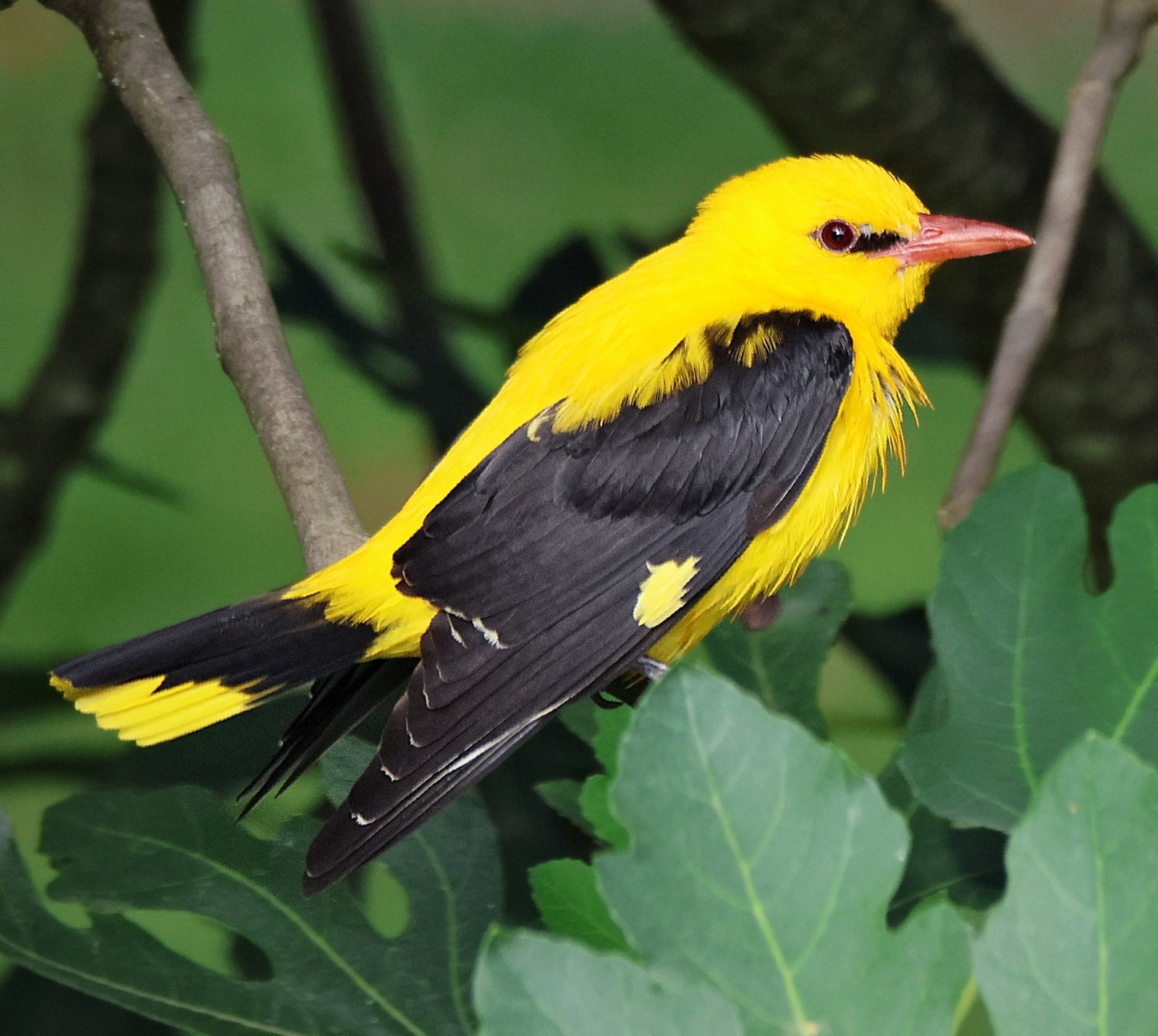
The Eurasian Golden Oriole is a golden-yellow songbird of tall broadleaved trees, seen in this region mainly as a passage migrant to and from sub-Saharan Africa. It breeds in small numbers in the Maghreb and the Levant; elsewhere it turns up in spring in oases, gardens and orchards.
Voice
The song is a loud, fluty whistle, weela-weeo or dudel-yo, also heard from migrants in spring. The call is a harsh, cat-like screeching kreeeh, often the first clue.
Recording: João Ferreira Tomás — CC BY-NC-SA 4.0 · shortened to the first 60 s, mono · xeno-canto
Identification
22–25 cm. The male is bright golden yellow with black wings with a yellow patch at the base of the primaries, a black tail with yellow corners, a black lore and a dark pink bill. The female is greenish-yellow above, off-white and finely streaked below, with greenish wings and dull yellow tail corners; older females can be almost as yellow as males. Juveniles resemble the female but are more heavily streaked and have a dark bill. The flight is fast and slightly undulating, like that of a large thrush.
Confusion species
Females and juveniles may resemble Levaillant's Woodpecker (Picus vaillantii), but that has a red crown, a pale rump and a strongly undulating flight. Indian Golden Oriole (Oriolus kundoo), from Central Asia to India, has in the male a black loral stripe extending behind the eye and more yellow in the tail; it is a potential vagrant to the region. Apart from escaped exotic orioles and weavers there is no real confusion species.
Habitat
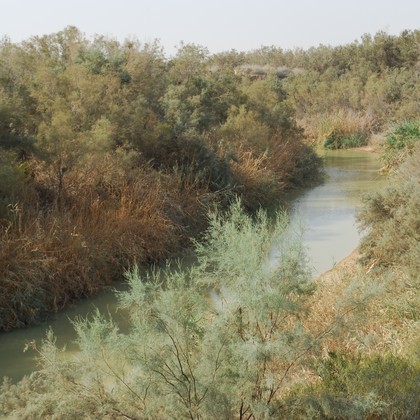
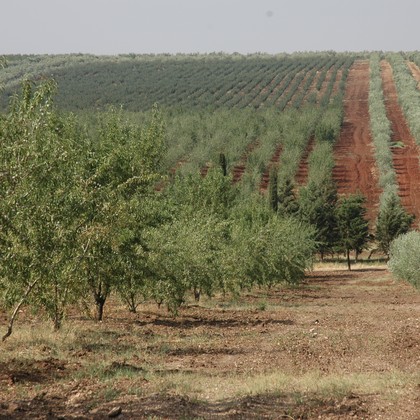
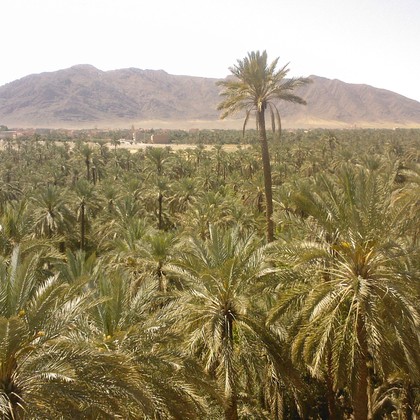
In the breeding season tall, old broadleaved trees: riverine woodland with poplars, willows and ashes, oak and cedar woodland in the Atlas, large orchards, olive groves and parks. On passage any area with trees: oases, date-palm gardens, gardens, parks and orchards, even in the middle of the desert. Eats insects and caterpillars, and in late summer much fruit and berries.
Where the bird is most at home, classified by the habitats of North Africa and the Middle East.
Range and movements
Breeds in Morocco in the Rif, the Middle Atlas and the valleys of the Atlantic lowlands, in northern Algeria and Tunisia, in Lebanon, Syria, northern Israel (scarce) and northern Iraq. On spring and autumn passage common throughout the region, from the oases of the Sahara and Egypt to Jordan, Israel, Saudi Arabia, Yemen, Oman and the Gulf states; in spring most conspicuous along the Jordan Valley and the Red Sea. Winters in sub-Saharan Africa. Beyond the region it breeds across almost all of Europe and western Asia to western Siberia and Iran.
- Summer visitor (c. Apr–Sep)
- Passage (Mar–Apr, Oct–Nov)
- dark = core range, pale = thinly spread
How and when to look
On passage in April and early May in an oasis or a garden with tall trees: in Eilat, Sinai, the oases of the Moroccan desert edge or the parks of the Gulf states. A group of migrants often hides in a fig or mulberry tree; listen for the cat-like screech and watch for a flash of yellow in the canopy.
Conservation status
Not globally threatened. Declined at the edge of its range through felling of old riverine woodland; on migration trapping and shooting also occur, particularly in parts of North Africa and the Middle East.
Scientific name
Oriolus oriolus | (Linnaeus, 1758)
Linnaeus described the species in 1758 as Coracias oriolus; because it was later moved to another genus, the author and year stand in brackets. The genus Oriolus was introduced in 1766 by Linnaeus. Oriolus goes back to Latin aureolus 'golden', after the yellow plumage of the male. The specific name repeats the genus name. The specimen the first description was based on came from Sweden.