All species › Passerines › Reed warblers › Paddyfield Warbler
Paddyfield Warbler | Acrocephalus agricola
Veldrietzanger | Carricero agrícola
The Paddyfield Warbler is a small, warm-brown reed warbler of the steppes around the Black and Caspian Seas and Central Asia, wintering in the Indian subcontinent. Its route lies largely north and east of the region; in the Gulf states and Israel it is a rare vagrant, mainly in autumn.
Voice
The song is a fairly fast, varied series of chattering and pure notes with much mimicry, faster and more melodious than that of Eurasian Reed Warbler. The call is a soft chik or chek and a hard, rattling cherr; autumn vagrants are usually silent.
Recording: Arend Wassink — CC BY-NC-SA 4.0 · converted to mono · xeno-canto
Identification
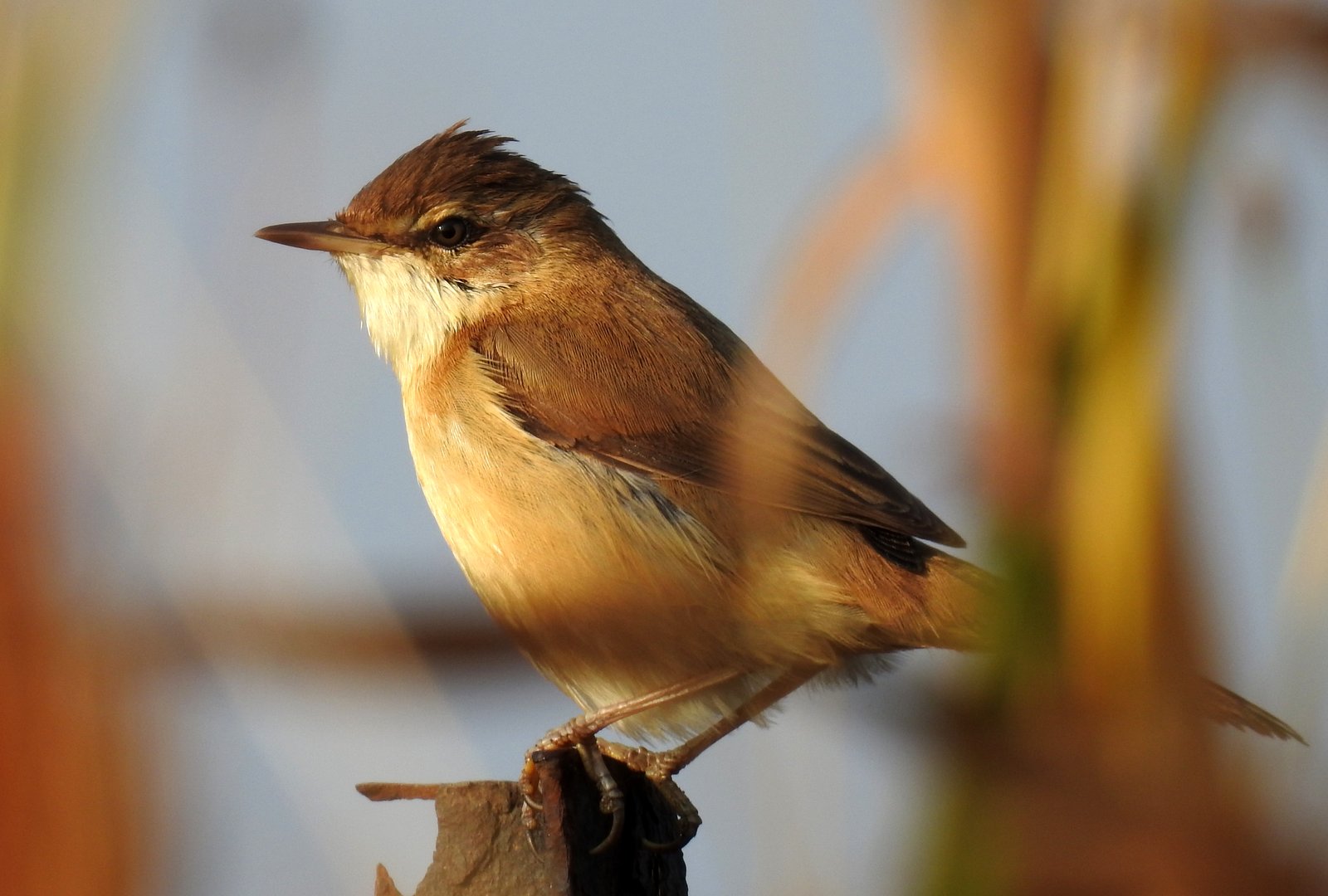
12–13 cm. A small, unstreaked reed warbler with a short bill with a dark tip to the lower mandible, and a striking face pattern: a broad white supercilium widest behind the eye, bordered above by a dark line along the crown side, and a thin dark eye-stripe. Upperparts warm cinnamon to rufous-brown, warmest on the rump; greyer in worn summer plumage. Underparts white with warm buff flanks. Short primary projection; the tail looks relatively long and is often cocked. Legs pale pinkish-brown.
Confusion species
Eurasian Reed Warbler (Acrocephalus scirpaceus), especially its eastern form fuscus, has a longer bill, a short, faint supercilium without a dark upper border and a longer primary projection. Blyth's Reed Warbler (Acrocephalus dumetorum) is greyer olive-brown, with a short supercilium most obvious in front of the eye. Booted Warbler (Iduna caligata) has a shorter, pale bill without a dark tip, white outer tail feathers and a duller, sandier plumage; it favours drier bushes.
Habitat
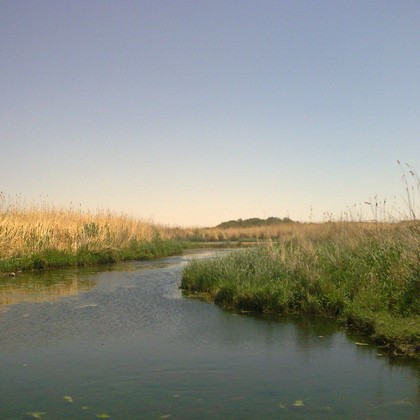
In the breeding range reedbeds and rank vegetation along steppe lakes and rivers. In the region mainly in reeds, tamarisks and rank growth around sewage works, ponds and irrigation channels, near small marshes and coastal reedbeds.
Where the bird is most at home, classified by the habitats of North Africa and the Middle East.
Range and movements
In the literature a rare vagrant: a few records in Kuwait, Bahrain, Qatar and the United Arab Emirates, mainly between August and January, and a handful in Oman and Israel; in Saudi Arabia very rarely or not yet confirmed. Possibly a slightly more regular but overlooked migrant in Iraq and the northeast of the Arabian Peninsula. Breeds from the western Black Sea and the Caspian through the steppes of Central Asia to Mongolia and winters in the Indian subcontinent.
How and when to look
The best chance is in autumn at the ringing stations and sewage works of Kuwait, Bahrain and the Emirates, where most birds have been identified in the hand. A warm-brown reed warbler with a short bill and a broad white supercilium with a dark upper border is worth a close look; photograph the bill tip and the wing formula.
Conservation status
Not globally threatened. In the Western Palearctic the species is slowly expanding along the Black Sea. In the region a rare vagrant, probably under-recorded owing to its similarity to other reed warblers.
Scientific name
Acrocephalus agricola | (Jerdon, 1845)
Jerdon described the species in 1845 as Sylvia (acrocephalus) agricola; because it was later moved to another genus, the author and year stand in brackets. The genus Acrocephalus was introduced in 1811 by Naumann & Naumann. Acrocephalus is Greek, from akros 'topmost, pointed' and kephalē 'head'; the Naumanns, who introduced the genus, called these birds Spitzkopf 'pointed head', so they read akros as 'pointed'. agricola is Latin for 'farmer'. The specimen the first description was based on came from near Nellore, India.