All species › Passerines › Crows and jays › Carrion Crow
Carrion Crow | Corvus corone
Zwarte kraai | Corneja negra
In the region this species occurs almost exclusively in its grey-and-black form, Hooded Crow, which many lists treat as a separate species (Corvus cornix). In the Nile Delta, in the cities of Egypt and in the Levant it is one of the most familiar birds; in Iraq lives the strikingly pale Mesopotamian form.
Voice
A harsh, grating kraa kraa kraa, usually in series of three or four, often with a bowing movement of the body; also a dull klok-klok, a rattling alarm and soft muttering at the nest.
Recording: Lucien Hueber — CC BY-NC-SA 4.0 · converted to mono · xeno-canto
Identification
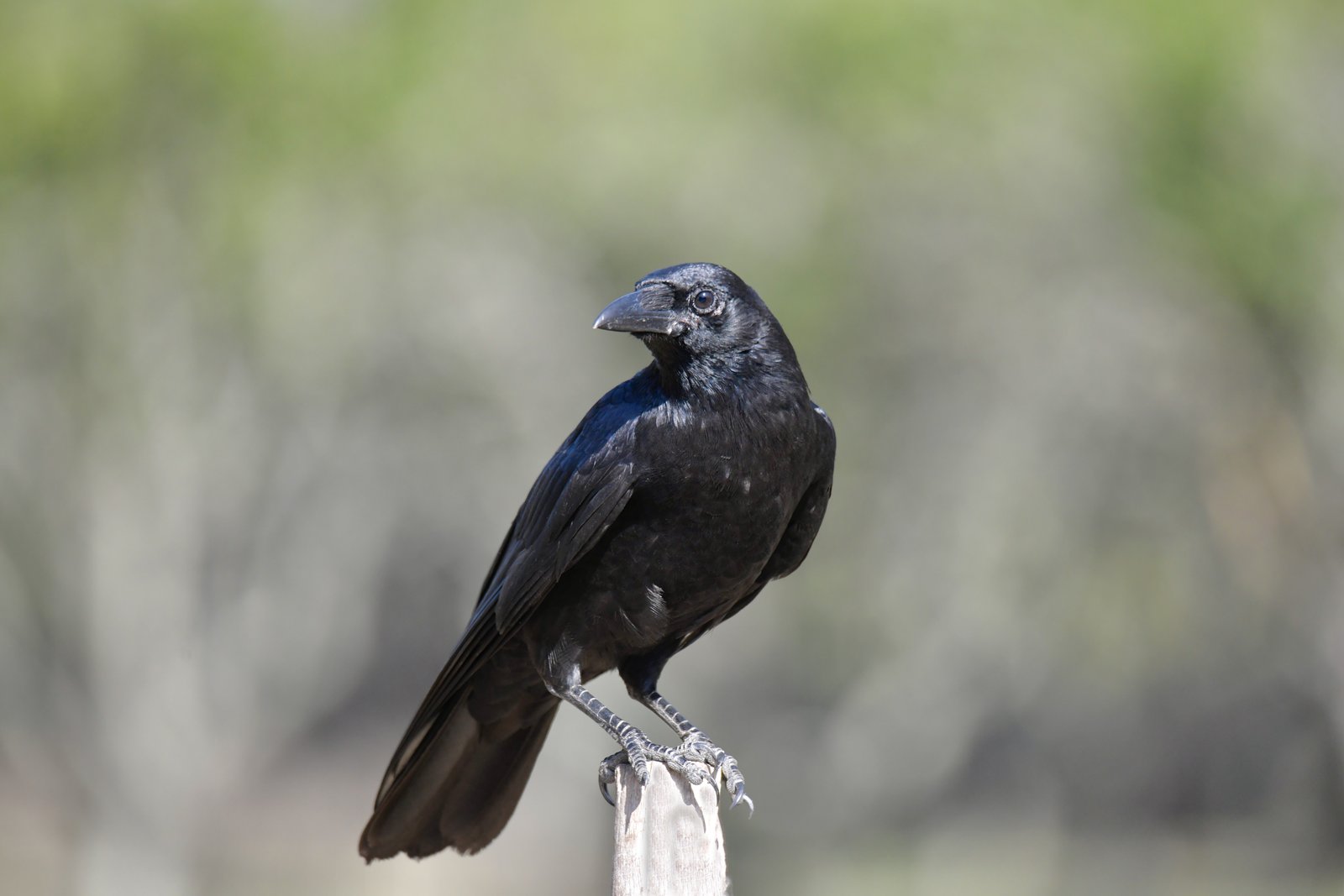
A robust, compact crow with a heavy, slightly curved bill with a feathered base, a dark eye and a rounded tail. The hooded form has head, throat, upper breast, wings, tail and thighs black and mantle, back, breast and belly grey, with a sharp border along the black bib. In Egypt and the Levant (pallescens) the grey is pale and the bird is somewhat smaller than in Europe; the Iraqi form capellanus is so pale grey that it looks almost white at a distance. The all-black form has a green-blue gloss. Juveniles are duller, with browner grey. In flight a straight, shallow wingbeat and a rounded tail.
Confusion species
House Crow (Corvus splendens) is smaller and slimmer, with a high forehead and a grey shawl around a black face, but with a dark back and belly. Eurasian Jackdaw (Coloeus monedula) is much smaller, with a grey nape and a pale eye. Rook (Corvus frugilegus), a winter visitor to Iraq and the Levant, is all black with a bare, pale bill base. Northern Raven (Corvus corax) is much larger with a wedge-shaped tail. An all-black crow in the region is more likely a young Rook or a Brown-necked Raven (Corvus ruficollis) than a true black Carrion Crow.
Habitat
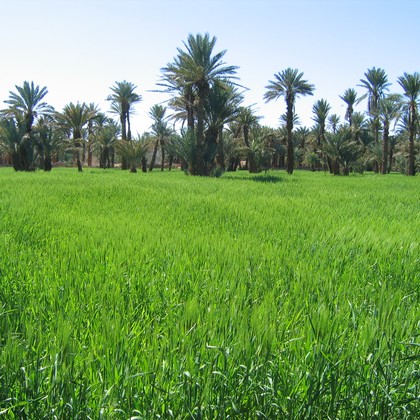
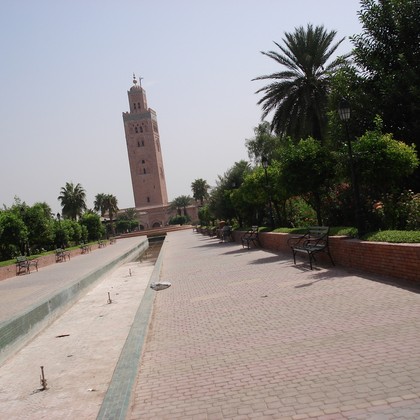
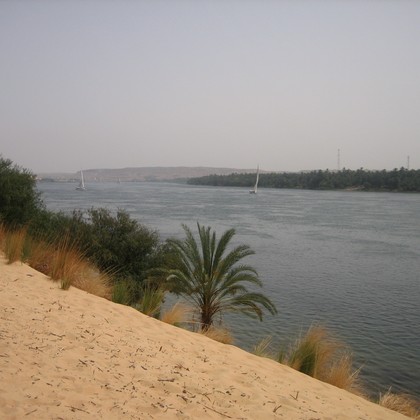
Irrigated farmland, date palm groves and orchards, river and canal banks, villages, towns, parks and rubbish dumps; in Egypt almost everywhere in the inhabited Nile Valley. In Iraq in the lowlands of the Tigris and Euphrates, also in the marshes. Nests in trees, palms and on pylons.
Where the bird is most at home, classified by the habitats of North Africa and the Middle East.
Range and movements
In Egypt common in the Nile Delta and the Nile Valley to beyond Aswan, in the Faiyum, along the Suez Canal and on the north coast of Sinai. In the Levant in Israel (especially the coastal plain, the northern valleys and the towns), in Judea and Samaria, Lebanon, western and northern Syria and northwestern Jordan; in Iraq the form capellanus in the Tigris and Euphrates lowlands to Basra. Elsewhere very scarce: the Mesopotamian form has been recorded as a vagrant in Kuwait (2012) and the United Arab Emirates (2012), and in northern Saudi Arabia it is rare. It is absent from the Maghreb and Libya; the black form is at most an exceptional vagrant anywhere in the region. Beyond the region Hooded Crow breeds from Ireland and Scandinavia to western Siberia, Turkey and Iran, the black form in western Europe and, as a separate population, in East Asia.
- Resident
- Summer visitor (c. Apr–Sep)
- Winter visitor (c. Oct–Mar)
- Passage (Mar–Apr, Oct–Nov)
- dark = core range, pale = thinly spread
How and when to look
In Cairo, Alexandria and along the Nile there is no need to search. To see the almost white Mesopotamian form, go to southern Iraq, for example the marshes near Chibayish. In Egypt and Israel the crow is the usual host of Great Spotted Cuckoo (Clamator glandarius): a crow's nest with a noisy young cuckoo is no rarity in spring.
Conservation status
Not globally threatened. In the region common in Egypt and the Levant and certainly not declining; locally common in Iraq. There is no cause for concern.
Scientific name
Corvus corone | Linnaeus, 1758
Linnaeus described the species in 1758 and placed it straight away in the genus where it still stands. He introduced the genus Corvus in that same work. Corvus is the Latin word for 'raven'. corone comes from Greek korone 'crow'. The specimen the first description was based on came from England.