All species › Pigeons and doves › Pigeons and doves › Bruce's Green Pigeon
Bruce's Green Pigeon | Treron waalia
Waaliaduif | Vinago waalia
The only green pigeon in the region: a stocky, parrot-like fruit-eater living in the crowns of wild figs in south-western Arabia and Dhofar. Despite its bright colours it is hard to see in the foliage until a small flock bursts from a tree on clattering wings.

Voice
A strange, un-pigeon-like song of whistling, slurred notes, rising and falling, followed by growling and clicking sounds, roughly tiuu-tiuu-tiuu… krrr-krrr-kek. The whistles sound more like a raptor or starling than a pigeon.
Recording: Stanislas Wroza — CC BY-NC-SA 4.0 · converted to mono · xeno-canto
Identification
Stocky pigeon with a short tail. Head, neck and breast are grey, the mantle and wings olive-green with a purplish shoulder patch and a narrow yellow edge along the wing coverts. The belly is bright yellow, the undertail coverts chestnut with pale fringes. The bill is pale, the legs yellow to orange. The sexes are alike; young birds are duller and lack the purple shoulder patch. It clambers through branches like a parrot and sometimes hangs upside down from fruit.
Confusion species
In the region it is hardly confusable: no other pigeon is green and yellow. In poor light a silhouette in a fig tree may be taken for Dusky Turtle Dove (Streptopelia lugens) or Laughing Dove (Spilopelia senegalensis), but these are slimmer, longer-tailed and brown. African Olive Pigeon (Columba arquatrix) is larger, dark wine-red and white-spotted, with a yellow bill.
Habitat
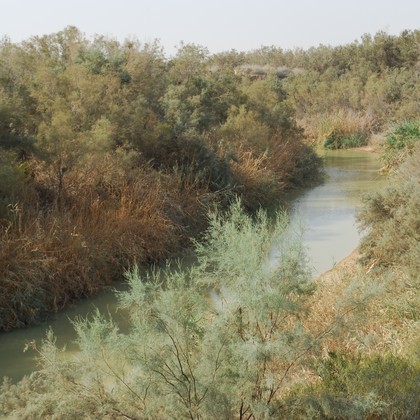
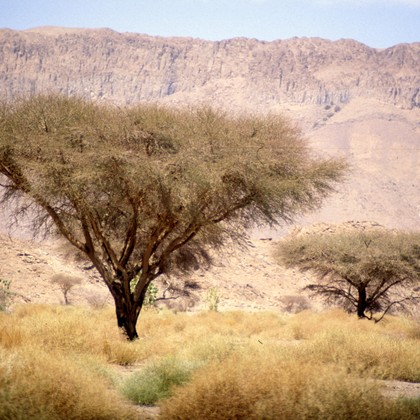
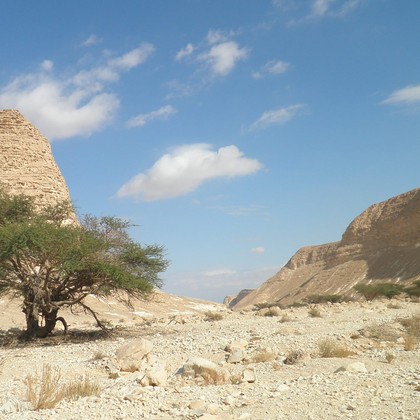
Well-wooded wadis and riverine woodland with large wild figs, acacia savanna, gardens and terraces with fruit trees, from the Tihama coastal plain to about 2000 m in the highlands. In Dhofar in the monsoon-fog forests and the wadis at the foot of the mountains.
Where the bird is most at home, classified by the habitats of North Africa and the Middle East.
Range and movements
In the region only in the south of the Arabian Peninsula. Yemen: widespread and fairly common in the western foothills and highlands and in the wadis of the Tihama. Saudi Arabia: in the south-west, in Jizan and the lower parts of Asir, north to about Al Baha. Oman: in Dhofar, mainly in the woods and wadis around Salalah. Elsewhere in the Sahel and savanna belt of Africa, from Senegal and Gambia to Ethiopia, Eritrea and Somalia.
- Resident
- Summer visitor (c. Apr–Sep)
- Winter visitor (c. Oct–Mar)
- Passage (Mar–Apr, Oct–Nov)
- dark = core range, pale = thinly spread
How and when to look
Find a fruiting wild fig in a wadi in the morning: small flocks of five to twenty birds are often present. In Dhofar the wadis around Salalah, such as Ayn Hamran and Wadi Darbat, are reliable. Listen for the whistling song, then watch patiently for movement in the canopy.
Conservation status
Not globally threatened and fairly common in its Arabian range. It depends on large fig trees and groves in the wadis, which are being lost locally to cutting, agriculture and falling groundwater.
Scientific name
Treron waalia | (Meyer, 1793)
Meyer described the species in 1793 as Columba waalia; because it was later moved to another genus, the author and year stand in brackets. The genus Treron was introduced in 1816 by Vieillot. Treron derives from the Greek trērōn, 'shy, timid', a stock epithet for doves in Homer. waalia is the Ethiopian name of this pigeon, as recorded by James Bruce. The specimen the first description was based on came from Tcherkin, near Lake Tana, Ethiopia.